Steve Malanca “The issues have been difficult to explain to those who aren’t familiar with agriculture.” This video explains the connection between farms and the businesses that depend on them.
Continue readingProjects underway to expand water supplies
From News Line, a daily compilation of farm water news distributed to CFWC members and others upon request. To receive News Line, click here.
Letter: Addressing our water shortage
Coalition response…Looking for new water supplies is always a good idea. Studies are underway on several projects—Upper Temperance Flat on the San Joaquin River, Sites Reservoir in western Colusa County and raising Shasta Dam—that would increase the water supply for California. It is estimated that 120 desalination plants the size of the recently approved Poseidon facility in San Diego would be required to meet the 6 MAF requirements of the State Water Project and the federal Central Valley Project. With 840 miles of California coastline, a desal plant would have to be placed every seven miles and would still not connect to our current water distribution system. Plans already under, such as the above and the Bay Delta Conservation Plan, would be much cheaper and more environmentally-friendly than lining our coastline with desal plants.
Water transfers provide benefits to all
From News Line, a daily compilation of farm water news distributed to CFWC members and others upon request. To receive News Line, click here.
Commentary: How our water is drying up
Coalition response…Water transfers involve willing-buyers and willing-sellers. Transfers include those who have an available supply of water and are willing to sell it and those who are willing to pay the price to purchase the water and have it transported. These transfers are usually for a short period of time and must protect the area of origin, including groundwater and the environment. Past water transfers have proven beneficial to water users throughout California and when farm water users are involved, it means that farmers are able to continue growing the food supply that consumers expect to find in their local grocery stores.
BDCP concerns need to be fact-based
From News Line, a daily compilation of farm water news distributed to CFWC members and others upon request. To receive News Line, click here.
Fish Wrap: Sacramento River project would endanger local fisheries
Coalition response…It is understandable that fishermen are concerned about the possible effects the Bay Delta Conservation Plan (BDCP) may have on fish but those concerns need to be based on facts. Saying the tunnels “could take away half or more of the Sacramento River before it reaches the Delta” does not reflect reality. Mandated water levels flowing through the Delta will be maintained under BDCP. The flow of water through the tunnels will be governed according to available supply. When the flows are high, more water will move through the tunnels. Lower flows mean less water will be exported. See more at www.farmwater.org/exportthrottle.pdf.
BDCP includes more than a 100,000 acres of habitat that will be created to protect fish by providing safe harbor from predators and an improved food supply.
Too many people mistakenly believe that the pumps that deliver water to thousands of farms and 25 million Californians are the primary cause of the dwindling salmon population of recent years. Yet, the National Marine Fisheries Service has concluded that poor ocean conditions—warm water and a reduced food supply—is the leading cause of the drop in salmon populations.
Constructing Sites Reservoir, expanding Shasta Dam would help salmon
From News Line, a daily compilation of farm water news distributed to CFWC members and others upon request. To receive News Line, click here.
Drought conditions threaten Sacramento River salmon
Coalition response…The solution to providing sufficient water for fish migration while continuing to meet the water supply needs of Northern California and the rest of the state is the development of new storage in Northern California. Construction of Sites Reservoir and expanding Shasta Dam would help improve water management flexibility for all of California. These projects can accomplish this by increasing the reliability of Sacramento Valley water supplies and other parts of the state by reducing Sacramento River diversions at a time when salmon need it most. Combined, Sites and Shasta could add over 2 million acre-feet to California’s water supply and ecosystem portfolio, which is a win-win for people and the environment.
Why California needs BDCP
“The Bay Delta Conservation Plan sets out a comprehensive conservation strategy for the Sacramento–San Joaquin River Delta (Delta) designed to restore and protect ecosystem health, water supply and water quality within a stable regulatory framework. The BDCP reflects the outcome of a multiyear collaboration between public water agencies, state and federal fish and wildlife agencies, nongovernment organizations, agricultural interests and the general public.”
Bay Delta Conservation Plan Introduction
The Bay Delta Conservation Plan represents a seven-year effort by water industry professionals working in the Delta for more than 40 years to develop a plan that increases water supply reliability and restores ecosystem resources in the Delta. The water supply for almost 4,000 farms and 25 million Californians has become increasingly unreliable in the wake of environmental pressures unforeseen at the time our existing water supply system was conceived. Experts say that climate change and earthquakes pose additional risks to our water supply.
Why is the BDCP so important for California? Because it helps restore critical habitat for native fish in the Sacramento-San Joaquin Delta, and it will help restore water deliveries to areas of the state where water supply cuts have left communities devastated and thousands of people looking for jobs. To erase any question of the hardship that exists in some of California’s most productive food growing regions, the chart below shows the direct connection between reduced water supplies and unemployment.
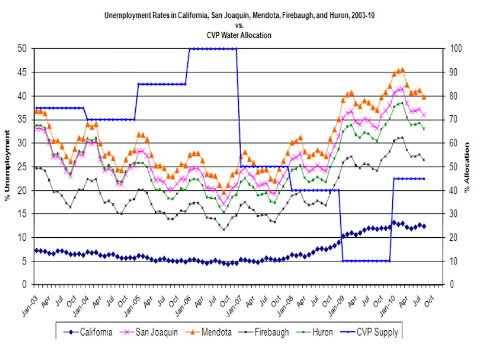
For consumers who shop for local, California-grown food products the risk is just as real. Reduced water supplies for farmers this year are already having an effect on the land that would have been used to grow food next year. Much of what would have been planted to annually produce fresh fruit and vegetables will now lie fallow because of water shortages. That can affect what is available at the grocery store and how much it will cost.
Many concerns about potential impacts exist within the Delta, which is the focus of the BDCP, as well as upstream and downstream areas. There are serious questions that need to be answered and that process is underway. The BDCP public review draft is due out this fall and the public will have an opportunity to submit comments to help improve it. The BDCP also includes a planned adaptive management strategy that is designed to address issues and concerns over the life of the project in order to minimize or eliminate any potentially negative impacts.
California’s water supply and environmental problems are significant and in one way or another they affect almost everyone in the state. The BDCP is a big solution at a time when it is needed most, but it isn’t the only element needed for the future. New storage designed to capture water during wet periods will help meet future water supply needs including water quality improvements and in-stream flow requirements for fish and the aquatic ecosystem.
A small investment by everyone today will help ensure long term water supply reliability, adequate water for our farms and ecosystem restoration activities that will benefit some of California’s native and most iconic fish species.
Facts needed to discuss water issues
From News Line, a daily compilation of farm water news distributed to CFWC members and others upon request. To receive News Line, click here.
Coalition response…Water in California has generated differing viewpoints throughout our state’s history, all the way back to the Gold Rush. Today’s discussion focuses on a proposal to provide water to 25 million Californians and almost four thousand farms while restoring the Delta ecosystem, including habitat that will benefit fish species. Pivotal to this discussion are the facts that surround the proposal.
This piece does little to provide factual information on how the Bay Delta Conservation Plan will work for California. The following are some corrections the statements made by Pat Snelling:
Fact #1—The proposed Bay Delta Conservation Plan and its two tunnels are prevented by California law from negatively impacting existing water rights.
Fact #2—Since 2003 San Joaquin Valley farmers have spent more than $2.1 billion upgrading the irrigation systems on more than 1.8 million acres to increase their water use efficiency.
Fact #3—Westlands Water District is a public water agency with a publicly elected board of directors, not a privately owned business.
Fact #4—More than 50 percent of Westlands farmland grows fresh fruits and vegetables.
Fact #5—The average farm size in Westlands Water District is actually less than 900 acres, not 3,000 as the author claims.
Fact #6—Increased water storage is essential to the future of California and also requires an improved conveyance system through the Delta.
Each Californian should seek the facts regarding water issues confronting our state and not rely on emotion expressed by others.
Water rights protected
From News Line, a daily compilation of farm water news distributed to CFWC members and others upon request. To receive News Line, click here.
Manteca leaders: Twin tunnels put water in jeopardy
Coalition response…The concern expressed by Manteca city leaders regarding their water supply is similar to questions raised by others. BDCP officials have repeatedly answered these concerns by stating that the proposed Plan, including the two tunnels, are prevented by California law from negatively impacting existing water rights.
Understanding that the current proposal is not a remake of the 1982 Peripheral Canal is crucial. The current plan offers improvements that did not exist in the canal plan such as the BDCP tunnels will only move 9,000 cubic feet per second of water compared to 21,800 cfs with the Peripheral Canal. Only two fish species, salmon and striped bass, were identified for protection in the canal plan while BDCP includes 214 biological goals and objectives for 57 fish and terrestrial species, their habitat and the Delta ecosystem. Learn more at www.farmwater.org/p-canalcomparison.pdf.
California Dairy
Did you know?
Did you know that California is America’s most productive Dairy State?
- California produces nearly 21% of the country’s dairy.
- California dairy farmers collectively tend to about 1.8 million cows.
- Those cows gave us approximately 42 billion pounds of milk.
Did you know that California’s dairy cows prefer California-Grown food?
- Some dairy cows eat the hulls (a part we don’t eat) left over from California almonds. It provides them with a diet high in energy – pretty important for milk production!
- As the price of corn has risen, many dairy farmers have sought to replace the important sugars and pectin that corn provides with fruit byproducts, such as apple peel and even tomato pulp!
- The changing markets have moved traditional fiber sources such as oat hay out of reach of many dairy farms. Some innovative dairy farms have found a replacement in rice straw- readily available here in California!
Learn More-
Did you know that 99% of California Dairies are Family Farms?
Learn more about California’s Family Dairies here.
In fact, most (97%) of California’s Farms are run by families- Meet more of California’s family farmers here.
Learn more about California Dairy at Real California Milk
RTD’s math provides $172/AF water through BDCP
From News Line, a daily compilation of farm water news distributed to CFWC members and others upon request. To receive News Line, click here.
Gov. Brown’s Bay Delta Conservation Plan Costs $54.1 Billion: Simple Math – It’s Not Worth It
Coalition response…Restore the Delta’s “Simple Math” attempt at quantifying the costs of the Bay Delta Conservation Plan and their statement that “it’s not worth it” didn’t provide enough information for a logical conclusion. Missing from the equation was the volume of water that could be reliably delivered for the cost of the project.
Considering that water users would pay the full $43.9 billion cost of the tunnels (habitat restoration is considered a public benefit and therefore a public cost) and then applying the historical average of about 5 million acre-feet of water delivered per year over the 50-year span of the project, RTD’s simple math exercise pencils out to about $172 per acre-foot. In comparison to current prices farmers are encountering right now because of the water-short year, the $172/AF may not be too bad, especially if it brings reliability back to the system. Simple.