Plants need three things to grow: sunlight, soil…and water. Farmers depend on all three to grow hundreds of different crops right here in California. There’s no shortage of sunlight and soil… but four years of drought has caused deep cuts in the water farmers need to grow our food.
This year almost one in three acres of California’s irrigated farmland will receive no surface water at all. None.
Consumers and farmers alike are feeling the effects of the drought.
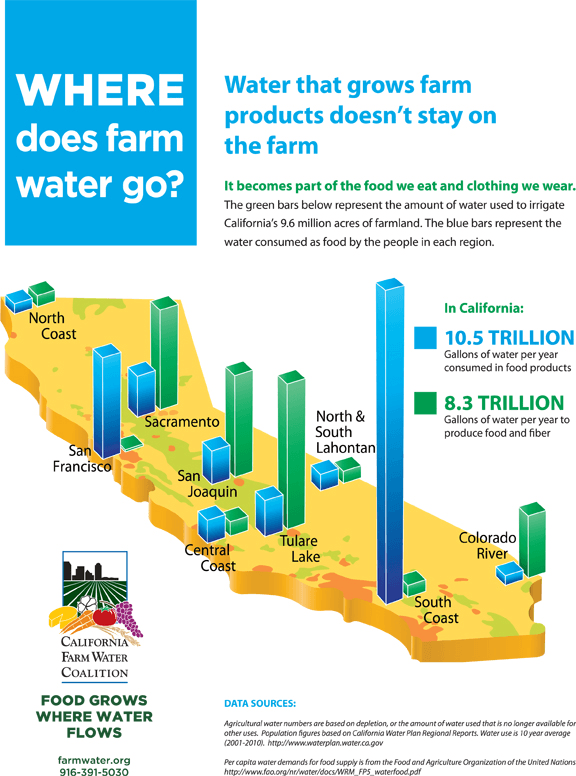
That’s important to all of us because farmers grow the food that ends up at the grocery store. Simply put, the water that farmers use to grow our food is water that we all consume in the food we eat.
Getting through the drought won’t be easy and we’re all in it together. California’s farmers are going to be working hard to make the most of the sunlight, soil… and the water they have, to continue producing the fresh California farm products we want for our families.
According to data from the California Department of Water Resources and the Food and Agriculture Organization of the United Nations, California farmers actually use LESS water than the amount required to meet all of California’s food supply needs.
Farmers and consumers share a unique relationship. The California drought is helping people understand how important it is for farms to have the water they need to grow the food we all find at the grocery store. Serious water supply cuts affect our food supply as well as the people in rural communities who depend on agriculture for their jobs.
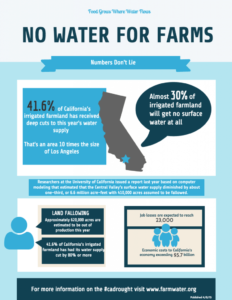
Over 41 percent of California’s irrigated farmland will lose 80 percent or more of its normal surface water allocation this year, according to a new survey by the California Farm Water Coalition.
The survey of agricultural water suppliers conducted the first week of April shows that 3.1 million acres, or 41.6 percent of California’s irrigated farmland, is expecting deep cuts to the water delivered in a normal year. That is an area 10 times the size of Los Angeles.
Info graph – 2015 farm water supply cuts
The survey also revealed that almost 30 percent of the irrigated farmland in the state, 2.2 million acres, will get no surface water deliveries this year.
Because of significant agricultural water supply cuts that have happened over the past two years, large amounts of land going unplanted will occur in 2015. According to the survey, approximately 620,000 acres are estimated to be fallowed this year. Associated job losses could reach 23,000 with an economic hit to the state’s economy exceeding $5.7 billion.
California farms have taken a severe hit to water supplies for two years in a row. Researchers at the University of California issued a report last year based on computer modeling that estimated the Central Valley’s surface water supply diminished by about one-third, or 6.6 million acre-feet with 410,000 acres estimated to be fallowed.
Some farmers last year received no surface water deliveries at all and turned to groundwater pumping to offset the losses. Recent levels of groundwater pumping are expensive and not sustainable.
Farmers have been the first to feel the effects of the drought because of mandatory water supply cuts. Last year saw an unprecedented amount of farm water cuts – zero water – for vast parts of the state and 2015 will be worse. Stories like this don’t often make the news but the U.S. Bureau of Reclamation has already announced that over 2 million acres of agricultural land that receive Central Valley Project water will receive zero supply again this year. That is an area roughly two and a half times the size of the Los Angeles Basin. Farms that receive water from the State Water Project have been cut by 80 percent. In 2014 a study on the impacts of the 2014 drought by UC Davis economists estimated 429,000 acres statewide were fallowed. The study cited a $2.2 billion loss to the state’s farming industry and a loss of over 17,000 on-farm jobs.
Governor Jerry Brown on ABCNews This Week commented:
“If you don’t want to produce any food and import it from some other place, of course you could do that. But that would displace hundreds of thousands of people and I don’t think it’s needed.”
Water transfers are a stop gap measure
Farmers with other water sources have experienced similar reductions. Transfer water from other sources come with a high price tag, up to $2,000 per acre-foot. Significant amounts of groundwater were also pumped last year because farmers had no alternative. That is not sustainable. Water supply cuts on the farm often lead to fallowing, which means crops aren’t being planted. But fallowing is also a tool to reduce water demand in one region to make water supplies available to transfer to more parched areas of the state. Rice farmers in the Sacramento Valley are often willing partners in helping to solve this water supply imbalance by fallowing their fields to make water available for transfers. But droughts can also have a negative effect on waterfowl and other wildlife. California Rice fields provide essential habitat for nearly 230 wildlife species.
Water use efficiency has helped stretch existing supplies
At the same time, California farmers are investing in upgrading irrigation systems. From 2003 through 2013 farmers throughout California have spent about $3 billion to install more efficient irrigation systems on almost 2.5 million acres, or about a third of the state’s irrigated farmland. That’s an investment one and one-half times the amount spent by Southern California water users to build Diamond Valley Lake near Hemet.
We enjoy a bounty of fresh fruits, vegetables and nuts grown on California farms – farms that produce about half of the fresh food in the U.S. But food only grows where water flows. California’s aging water system has put our economy, farmers and fresh food production at risk. Help California farmers continue to feed families and keep our state’s economy strong by supporting solutions for a more reliable water supply.
Buy Local and Put Money in Your Pocket
American consumers benefit financially from irrigated agriculture. In the U.S., consumers spend just 6.2 percent of their disposable income on food and non-alcoholic beverages compared to 10.2 percent on average in 28 other high-income countries. https://farmwater.org/food_cost_results.pdf
To the average American family this represents a savings $3,820 each year in comparison to food costs paid by families in other countries.
As consumers we have choices on where we spend our money. Efficient farming practices have helped keep food costs low while providing hundreds of healthful and affordable farm products at the grocery store. Lower food costs means money that would otherwise be spent to feed our families can instead be used to enrich our lives through recreation, music, philanthropy and even ballet lessons.
Innovation = Lower Food Costs
From north to south, California farmers use innovative practices to boost water use efficiency. Over time, improvements in the way water is stored and delivered allows farmers to grow more food while using less water. That stretches resources and helps keep costs low for consumers.
From 2003 through 2013 San Joaquin Valley farmers invested about $3 billion upgrading their irrigation systems on 2.5 million acres of farmland. That investment circulates through the economy by creating jobs and economic benefits for on-farm and farm-related businesses.
Food Safety is Our Highest Priority
Consumers trust California farm products because they’re grown under the most stringent regulations governing pesticide use, health and safety, and worker protections. Wages often exceed State and federal minimum standards. It is comforting to know that the food we provide our families comes from families just like ours – produced by farmers who care about the environment; about food safety; and about the people working to bring the crops to market.
Statement by Mike Wade, Executive Director: Illegal diversions, wasteful water use threatens water supply
“We applaud Governor Brown for taking more decisive steps toward increased water conservation and improving water management among all water users during this unprecedented drought.
Mike Wade, Executive Director California Farm Water Coalition
“Identifying illegal diversions and wasteful use of water will benefit the state’s overall water supply. Whether on the farm or in urban areas, illegal water diversions and wasteful use must stop. We have a system of water rights in California that everyone should abide by. Anyone who is circumventing the law should be identified and face the consequences.
“The Governor has increased the requirements for agricultural water use reporting and water management planning. That adds to the number of districts that will be submitting water management plans. Roughly two-thirds of farm water suppliers are already meeting previous reporting requirements.
“Farmers have already taken steps to conserve the amount of water they use. They have spent $3 billion since 2003 to install more efficient irrigation systems, one and a half times the amount Southern California water users spent building Diamond Valley Lake for new water storage. The use of drip, micro and subsurface irrigation more than doubled from 1991 to 2010, from 16 percent of the state’s irrigated acreage to more than 42 percent today.
“These activities and more have become an everyday practice on California farms and will continue as farmers maintain their commitment to provide a safe and reliable supply of food for consumers.”
Today’s announcement that farmers in the Sacramento and San Joaquin valleys will receive zero percent of their contracted supplies from the federal Central Valley Project is a tragic repeat of last year. In 2014 the state’s farm economy lost more than $2 billion and more than 17,000 jobs as a direct result of water shortages, according to a report by the University of California. Another zero allocation means impacts to California are expected to be as bad or worse this year.
Farmers in Los Banos gather to hear news about their 2015 water allocation
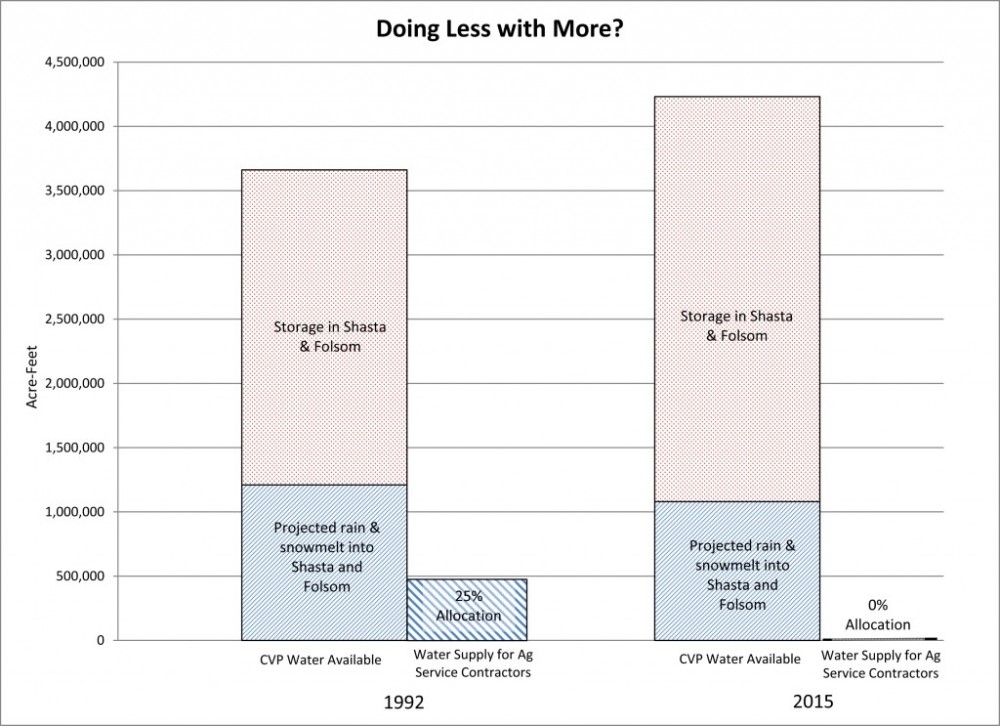
The zero allocation is even more troubling because the amount of water available in past years has been similar to this year, yet farmers still received water on their federal contracts. In 1991 and 1992 Lake Shasta storage was slightly less than it is today and the Bureau of Reclamation delivered 25 percent of the contract allotment to farmers. Today, with a similar amount of water in Lake Shasta farmers will get a zero allocation. There is something terribly wrong with that.
$2.2 billion cost in 2014
Last year UC Davis economists reported on direct and indirect costs, with farmers, ranchers and dairy operators losing $1 billion in revenue. Additional emergency pumping and other economic costs pushed the total to $2.2 billion. Farmers fallowed 428,000 acres of productive farmland, an area almost one and a half times the size of Los Angeles, because they had no water to raise crops.. The economists also estimated 17,100 farm workers would lose their seasonal or full-time work on valley farms.
Those numbers will likely climb this year.
As rural Californians face an uncertain future, their communities will continue to struggle with mounting unemployment and economic hardship brought on by water supply shortages. Many counties, cities and civic groups will strain to meet the growing needs of the unemployed because significant parts of California depend on water that isn’t coming.
Unemployment continues to climb
Many communities are facing unemployment rates between 22 and 31%, while food banks in California’s farm regions have seen a rise in food box deliveries of nearly 925% between May of 2014 and January 2015.
The effects of an upcoming fourth year of drought will be heightened because state and federal regulations prevent existing water flowing through the Sacramento-San Joaquin Delta to be stored south of the Delta for use later this year. The regulations are in place to protect endangered fish but after 20 years of water supply cuts to farms and cities, there is no evidence that they have helped. These regulations need to be rewritten with a common sense approach that benefits people and the environment.
Thousands of farmers and more than 2 million acres of farmland may be impacted by the cutback in water deliveries. That could force farmers to again take land out of production or seek alternate sources of water that too often come with a price tag greater than $2,000 per acre-foot, more than ten times the normal cost for untreated, agricultural water.
Elected leaders urge SWRCB to reverse staff decision denying limited water supply increase
In two separate letters submitted February 11, a bipartisan group of State legislative and congressional leaders, including Sen. Dianne Feinstein, urged the State Water Resources Control Board (SWRCB) to overturn a single staff member’s decision to deny additional water to much of drought parched California.
The letters emphasized that the additional pumping had been approved by five State and federal water and wildlife agencies and cited language from wildlife agencies expressing little or no concern over any potential impacts to threatened or endangered species:
Bipartisan congressional letter to SWRCB
• U.S. Fish and Wildlife Service: “The Service accepts Reclamation’s determination [that the proposed drought actions will result in no additional adverse effects on Delta Smelt or its critical habitat for the months of February and March 2015 beyond those [in] the 2008 BiOp].”
• National Marine Fisheries Service said the proposals “were considered in the underlying analysis of the [salmon BiOp], [and are] not likely to jeopardize the continued existence of [the listed species under the salmon BiOp],” nor “exceed levels of take anticipated [under the salmon BiOp].”
• California Department of Fish and Wildlife confirmed that the proposals are consistent with the California Endangered Species Act and the biological opinions.
Communities are suffering
Also included in the congressional letter were examples of the punishing consequences felt by people in the hardest hit communities, many of whom, “do not even have water for basic necessities like cooking, drinking, and showering, and that some are abandoning their homes and moving out of State.”
California State legislative letter to SWRCB
• Many Central Valley towns have unemployment rates that are triple or quadruple that of the state average of 7 percent due to significantly reduced employment in the agricultural sector. For example, Mendota has 31.6 percent unemployment, and San Joaquin has 28 percent.
• The total number of food boxes distributed state-wide to community food banks increased nearly ten-fold between May 2014 (46,000 boxes) and January 2015 (425,050 boxes).
• At least 1,760 wells have run dry in the State. In the Porterville area, emergency drinking water and shower stations have been in place for the last seven months because wells to people’s homes have failed.
• Total estimated economic loss is more than $1.7 billion.
• South-of-Delta CVP contractors received zero percent allocation of water last year, and are anticipating the same this year.
• Last year, the Bureau of Reclamation was unable to meet its substitute water supply obligation to the San Joaquin River Exchange Contractors and Reclamation gave Friant Water Authority contractors a zero percent allocation – the first time in the 65 year history of the project.
Staff decision contradicts itself
The congressional letter cites contradictory statements by SWRCB Executive Director Tom Howard to justify his denial of additional water supplies. In one instance he wrote, “…it is not clear if [that] monitoring would be adequate to avoid entrainment impacts given the concerns with the accuracy of entrainment estimates …. ” And in the same breath, according to the letter, he denied the export proposal based on an undefined “potential additional risk of entrainment.”
How could Howard assert a “potential” risk of entrainment sufficiently to deny the export adjustment, yet at the same time dismiss the fish agencies’ monitoring as not being sufficiently adequate or accurate?
Sen. Dianne Feinstein
Rep. Kevin McCarthy, 23rd District
Rep. Ken Calvert, 42nd District
Rep. Jim Costa, 16th District
Rep. Jeff Denham, 10th District
Rep. Devin Nunes, 22nd District
Rep. David G. Valadao, 21st District
State signatories
Sen. Jean Fuller, 16th District
Sen. Andy Vidak, 14th District
Sen. Anthony Cannella, 12th District
Sen. Tom Berryhill, 8th District
Assm. Jim Patterson, 23rd District
Assm. Devon Mathis, 26th District
Assm. Shannon Grove, 34th District
Assm. Adam Gray, 21st District
Assm. Rudy Salas, 32nd District
Despite concurrence among five State and federal agencies, a single State employee reversed a plan that would have delivered desperately needed water to most of drought-parched California. The decision is currently costing California water users about 2,000 acre-feet of water per day.
SWRCB Executive Director Tom Howard has placed himself above the experts at five State and federal water and fishery agencies.
A decision yesterday afternoon by State Water Resources Control Board Executive Director Tom Howard is already causing a loss of precious water supplies to two-thirds of California’s population and seven of the top 10 agricultural producing counties. Howard rejected a plan by the State Department of Water Resources and United States Bureau of Reclamation that would have allowed limited increases in export pumping under certain flow conditions in the Delta. The State Department of Fish and Wildlife, U.S. Fish and Wildlife Service and the National Marine Fisheries Service all agreed that the additional pumping did not pose an unreasonable risk to threatened or endangered salmon and Delta smelt.
Increased water called “tradeoffs”
In his rejection Howard said, “…there is not currently adequate information to indicate that this export level is reasonable given the current status of species and their distribution in the Delta…” He further stated that, “…water supply tradeoffs are not clear given the unknown water contract allocations that will occur this year.”
Translated: Not interested in helping Californians south of Delta, whether they be farmers or urban water users because State and federal agencies have not made their full allocation announcements yet. Or, since the projects might get more water allocated in the future, I can prevent them from getting any more now and it will all work out.
More accurately, Mr. Howard is playing chicken with water supplies for a south of Delta agricultural sector that verges on being a grotesque play on the cartoon character Wimpy: “I’ll gladly pay you Tuesday, for the water I take from you today.”
Alas, under the current weather pattern California is suffering under, Tuesday may never come.
State and federal fishery agencies approved of increased pumping
DWR and USBR agreed on a water supply plan for the conditions that exist right now. The water supply for the remainder of the year is contingent on weather, which is uncertain at the very least. Ultimately pumping reductions under this order will affect south of Delta wildlife refuges, urban users, including many disadvantaged communities, and farmers and could be about 2,000 acre-feet of lost water per day.
It is outrageous that one person with no special expertise in science or project operations can ignore the collective decision of FIVE State and federal agencies that have responsibilities for managing ecosystem resources.
Potential loss of $38 million in water supply
Howard said the issue would be open for discussion at the SWRCB’s workshop on February 18, which is 14 days from now. Depending on the weather, about 38,000 acre-feet, or $38 million worth of water could be lost forever.
What will 38,000 acre-feet of water grow? Any of the following: (click to enlarge)

 This year almost one in three acres of California’s irrigated farmland will receive no surface water at all. None.