Response to the State Water Control Board’s Water Quality Control Plan

This project includes the development of additional water that can be used for irrigation and wildlife enhancement purposes and to improve groundwater recharge in the area.

The State Water Resources Control Board has released its Water Quality Control Plan which, if implemented, will cause significant harm to California residents without quantifying any specific environmental benefits.waterboards_logo_high_res
In taking this step, Felicia Marcus, the Board’s Chairwoman noted that San Joaquin River flows have not been updated since 1995. We fully agree it’s time that state policy be aligned with current science which is why we find this proposal so wrongheaded. Science clearly shows that decades of releasing water to the ocean has failed to halt the decline of Chinook salmon and Delta smelt. 

And yet, the Board proposes to flush out to sea enough water to serve the domestic needs of 2 million Californians or produce almost 5.8 billion salads. If we know twenty years of failed efforts won’t do the job, why not try some of the proposed alternatives first? 

Chairwoman Marcus goes on to say that “The issue is not about choosing one over the other. It is about sharing the river because Californians need and want healthy communities, healthy agriculture and a healthy natural environment.” We couldn’t agree more. The only way farmers survive is by being good stewards of the land, and we’re not alone. We hope that the Board will listen to the voices of education officials, health departments, farmers, Latinos, cities, economic development officials and more who have all spoken out about the need to find a solution that works for all instead of continuing to rely on failed strategies. It’s time we moved on to solutions that science tells us will help.

Below, some of the people that will be impacted by this new plan give their thoughts:

Drinking Water Quality and Availability Will Be Negatively Impacted

“Let us be clear. The detrimental impacts of the Board’s plan will be felt strongly by the children that we serve. . . it is unclear why you have not taken the time to study the financial implications to school districts that would be forced to provide bottled water and portable toilets, or relocate schools entirely, as wells go dry. . . Access to drinking water and water for sanitation is a basic requirement for us to fulfill our mandate to provide quality education to the children of our districts.”

Steven Gomes, Merced County Superintendent of Schools
Tom Changnon, Stanislaus County Superintendent of Schools

“Many communities in the Merced area are already experiencing well production problems and drinking water quality issues . . . Over 800,000 people live in the two counties [Stanislaus and Merced]. Groundwater is the primary source of drinking water for the majority of the local population. The plan sorely understates the devastation this recommendation will cause. As an Interim Director of Environmental Health, I am required to ensure that safe, adequate, and dependable water supplies are available for domestic use.”

Vicki Jones, Interim Director of Environmental Health
Merced County Department of Public Health

Jobs and the Economy Will Suffer

“Over 55% of the residents of Stanislaus County are members of minority communities, with a majority of those residents being Latinos. As you know, our economy is largely driven by the agricultural sector, of which Latino workers play a vital role. Our unemployment rates in Stanislaus County are already consistently higher than the state and national averages. There is no doubt that your plan will have devastating economic consequences to an already disadvantaged region.”

Maggie Mejia, President
Latino Community Roundtable

“I am all for protecting the environment to the best of our ability, but not at the expense of our farmers, businesses and citizens. . . When farmers are forced to fallow more land, our food prices go up and the poor in our communities suffer the greatest. This proposal will raise the cost of water and electricity, as well.”

Pamela LaChapell
Modesto

“As the Director of Environmental Resources for the County, I am responsible for the administration and oversight of over 200 public water systems, approximately 2,000 retail food facilities and countless other businesses. This would be devastating to the local economy.”

Jami Aggers, Director of Environmental Resources
Stanislaus County

“We grew up in Stanislaus County and our parents, grandparents, and great grandparents were all farmers. . . We also are grateful that our children were raised here and their children will be raised here . . .Without water there will be many of us who will not be able to farm and those that work the fields and canneries during the harvest will be unemployed and unable to feed their families, buy clothing and supplies in our local stores. Our electricity costs will increase and our ground water will be depleted . . . we implore you to reconsider.”

George and Annemarie Espinola
Hughson

“Food production is a multi-billion dollar industry in our county and adds tremendous value to the State of California. . . Tens of thousands of people are dependent on jobs in agriculture, food processing, and its related industries. Our businesses pay millions of dollars in taxes each year to sustain our state government . . . We ask that you please consider our needs in the Central Valley with others’ needs and wants.”

David White, Chief Executive Officer
Stanislaus Business Alliance

And yet the Board wants to keep doing more of the same even though it has been proven ineffective  

“Simply flushing water down the river in the spring and fall does not work – a fact supported by more than two decades of proven science.”

Robbie Lake
French Camp

“I’ve lived on the Stanislaus for 40 years. Salmon are declining and the striped bass are increasing. What the state is doing is creating the opposite effect of what it says it wants.”

Jeff McPhee
Oakdale

“[The proposed regulation] is yet another demonstration of the complete disregard you hold for the people you are supposed to be serving. . . I encourage you to reduce your personal water use by 35% and pour that extra water into the street and watch it flow away. That is what you would be doing to the people you serve.”

Roxanne Garbez
Oakdale

People Are Asking for Common Sense, Balance and an End to Tactics That Just Make a Bad Situation Worse

“We need a common sense approach to how this water is used. . . In your efforts to help, you are creating a bigger problem than we had before.”

Nancy Petersen
Hughson

“We have worked hard to be good citizens and lower our water usage in the face of this drought. In fact, the Central Valley has led the state in water conservation efforts . . . We implore you to send staff to meet with us and come up with a common sense approach to this situation.”

David White, Chief Executive Officer
Stanislaus Business Alliance

“Why add water to the ocean? Does it need more?”

Suzy Fivecoat
Waterford

“It is time we manage our water resource in a way that is fair to everyone and strikes a balance between water supply and the environment.”

Roseanna Swanberg
Modesto

Statement on the upcoming release of proposed flow standards for tributaries to the San Joaquin River

Flowing River

Statement by California Farm Water Coalition Executive Director Mike Wade on the upcoming release of proposed flow standards for tributaries to the San Joaquin River

California officials are on the verge of releasing new water regulations

waterboards_logo_high_resthat would cause significant harm to California residents without quantifying any specific environmental benefits.

The State Water Resources Control Board is expected to release its Water Quality Control Plan on Thursday, September 15 that would set new requirements for water flowing in tributaries to the San Joaquin River.

The expected result is the direct loss of 350,000 acre-feet of water that is currently used to grow food on 100,000 acres of prime farmland. It is enough water to serve the domestic needs of 2 million Californians or produce almost 5.8 billion salads.

“If implemented, the State Water Board’s rule will have a devastating impact on drinking water, sanitation needs, food production, the economy and jobs for people stretching from the Northern San Joaquin Valley throughout the Bay Area. That’s why this regulation is opposed by schools, health departments, farmers, Latinos, cities, economic development officials and more,” said Mike Wade, executive director of the California Farm Water Coalition.

“It is unbelievable that our government would propose regulations that their own staff say will put farms out of business, reduce water supplies and have negative impacts on groundwater. Yet they can’t tell us what, if anything, this will do to protect the environment.

“The reason they cannot demonstrate benefit is because science clearly shows that decades of releasing water to the ocean has failed to halt the decline of Chinook salmon and Delta smelt. It is time to stop relying on failed strategies and move on to solutions that science tells us will help.”

Amount of idled farmland is five times greater than report states

central valley drought

UC Davis drought report

On August 15 the Center for Watershed Sciences released a UC Davis drought report titled “Economic Analysis of the 2016 California Drought on Agriculture.” The report was a follow-on to reports commissioned by the California Department of Food and Agriculture (CDFA) and released previously in 2014 and 2015.

california droughtOf note in the 2016 report was a statement that approximately 77,000 acres were fallowed this year, which raised questions among many agricultural industry leaders who were aware of fallowing estimates in the range of several hundred thousand acres. CFWC checked with CDFA as well as with researchers at UC Davis to express concerns over the seemingly low fallowing estimates. That communication resulted in the production of an update clarifying the numbers reported in the August 15 report.

Drought accounts for just 21% of expected fallowing

By September 30 according to the update, Central Valley land fallowing is expected to be approximately 370,000 acres, of which 77,000 acres can be attributed to the drought. The remaining 293,000 would be from other factors, including the regulatory restrictions that have delivered a 5 percent water supply to South of Delta CVP contractors and put tremendous pressure on other CVP and State Water Project contractors.

Update clarifies “drought” fallowing

The update, released September 1 and titled, “Estimates of Irrigated Cropland Idled due to the 2016 California Drought: Clarifications and Supplemental Information,” discussed the differences between drought-related land fallowing and the much greater numbers of fallowed acreage due to other factors, including ESA-related regulatory restrictions on water supplies.

From the report: “… our estimates specifically and solely relate to what was caused by the lack of normal precipitation and other climatic events in 2016, building on conditions as we entered the 2016 production season. Crop rotation needs, market conditions, regulatory cutbacks to protect fish and habitat all affect land idling in addition to impacts of water scarcity due to drought.

Most fallowing caused by factors other than drought

It went on to say, “Pumping restrictions in the Delta to prevent reverse flows and operations of the San Luis Reservoir have also affected quantity and timing of water to agricultural users south of the Delta. The combination of these effects contributed to the additional fallowing on top of drought related fallowing. Thus a number of regulatory issues, not directly related to the drought of 2016, have contributed to idled land observed in the Central Valley in 2016.”

Statement by Mike Wade, executive director of the California Farm Water Coalition on the UC Davis Drought Report

“A recent report by UC Davis dramatically understates the amount of California farm land taken out of production this year. Their study only measures the impact of the actual drought – not other factors.

“While roughly 77,000 acres remain idle due to the drought an additional 293,000 acres are fallowed due to rigid bureaucratic reliance on water management practices that we know for a fact have failed to produce their intended results.

“Most of California’s major reservoirs are relatively full this year, but the government agencies that control them stubbornly refuse to release much of that water to cities and farms. Instead, they insist on flushing it out to sea. Decades of this practice have completely failed to save the Delta smelt or winter run Chinook salmon. And yet, this year alone, California has flushed over 1 million acre-feet of water to the ocean, enough to provide 6 million domestic users with water for a year or grow almost 17 billion salads.

“We can survive the drought, but can we survive government agencies that stubbornly ignore good science and common sense?”

#  #  #

Mike Wade • 916-391-5030 (office) • mwade@farmwater.org

Amount of Idled Farm Land Five Times Greater than Report States

california drought

UC Davis drought report

On August 15 the Center for Watershed Sciences released a UC Davis drought report titled “Economic Analysis of the 2016 California Drought on Agriculture.” The report was a follow-on to reports commissioned by the California Department of Food and Agriculture (CDFA) and released previously in 2014 and 2015.

california droughtOf note in the 2016 report was a statement that approximately 77,000 acres were fallowed this year, which raised questions among many agricultural industry leaders who were aware of fallowing estimates in the range of several hundred thousand acres. CFWC checked with CDFA as well as with researchers at UC Davis to express concerns over the seemingly low fallowing estimates. That communication resulted in the production of an update clarifying the numbers reported in the August 15 report.

Drought accounts for just 21% of expected fallowing

By September 30 according to the update, Central Valley land fallowing is expected to be approximately 370,000 acres, of which 77,000 acres can be attributed to the drought. The remaining 293,000 would be from other factors, including the regulatory restrictions that have delivered a 5 percent water supply to South of Delta CVP contractors and put tremendous pressure on other CVP and State Water Project contractors.

Update clarifies “drought” fallowing

The update, released September 1 and titled, “Estimates of Irrigated Cropland Idled due to the 2016 California Drought: Clarifications and Supplemental Information,” discussed the differences between drought-related land fallowing and the much greater numbers of fallowed acreage due to other factors, including ESA-related regulatory restrictions on water supplies.

From the report: “… our estimates specifically and solely relate to what was caused by the lack of normal precipitation and other climatic events in 2016, building on conditions as we entered the 2016 production season. Crop rotation needs, market conditions, regulatory cutbacks to protect fish and habitat all affect land idling in addition to impacts of water scarcity due to drought.

Most fallowing caused by factors other than drought

It went on to say, “Pumping restrictions in the Delta to prevent reverse flows and operations of the San Luis Reservoir have also affected quantity and timing of water to agricultural users south of the Delta. The combination of these effects contributed to the additional fallowing on top of drought related fallowing. Thus a number of regulatory issues, not directly related to the drought of 2016, have contributed to idled land observed in the Central Valley in 2016.”

Let’s Learn from Australia Before It’s Too Late

Lachlan

The California State Water Resources Control board, elected officials and others frequently tout Australia as a model for managing limited water resources. Specifically, Australia’s long history of dealing with drought is seen as a way to help California avoid making the same mistakes – Australia has already been where California is heading.

Hillston New South Wales
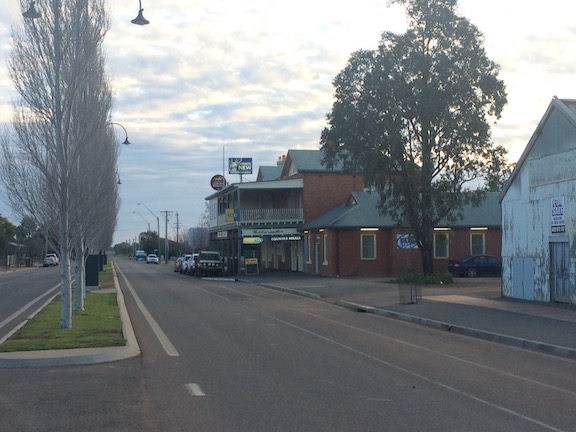
Hillston, NSW, where numerous businesses have closed because of declining commerce due to the purchase of farm water by environmental water rights holders.

On August 16, in a letter to the Murray-Darling Basin Authority, the agency charged with implementation of Australia’s Basin Plan, five prominent Australian farm organizations emphatically argued for a multi-pronged approach to treating environmental issues. The letter cited the economic devastation that results from simply dedicating more and more water exclusively to environmental purposes and expecting that to solve the problem. After listing multiple tactics that can and should be employed, the letter went on to say:

“We submit that the focus on ‘adding more water’ as the singular management tool, under the Basin Plan, must cease. Instead, a dedicated effort must focus on a range of measures that provide an equal balance to food and fibre production, the social and economic outcomes for communities and the environment.”

The California Farm Water Coalition has long argued that continuing to flush more water out to sea, even though there is no evidence this approach has provided measurable environmental benefits, is the very definition of insanity. This year alone, California has flushed over 1 million acre-feet of water out to sea, enough to provide 6 million domestic users with water for a year or grow almost 17 billion salads.

Lachlan
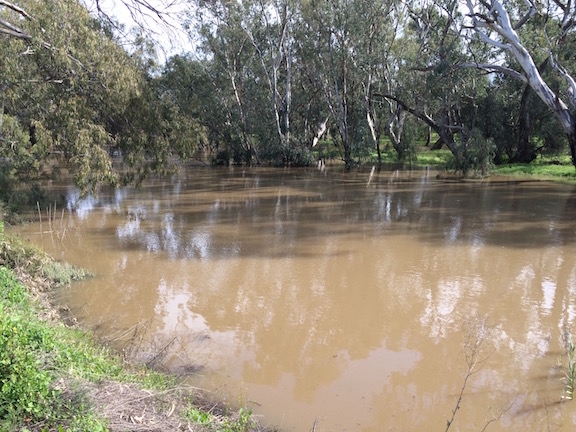
The Lachlan River near flood stage in Hillston, NSW. Muddy water is the result of bottom-feeding invasive carp stirring up the river bottom.

Farmers, fishermen, environmentalists, as well as urban water users should be furious at this reliance on outdated, failed practices that help no one and hurt millions.

Let’s learn from Australia before it’s too late and shift our focus to multi-pronged, common sense and science-based solutions as identified in this Public Policy Institute of California report.


Looking for a good primer on current water use issues?

San Luis Reservoir, August 4, 2016

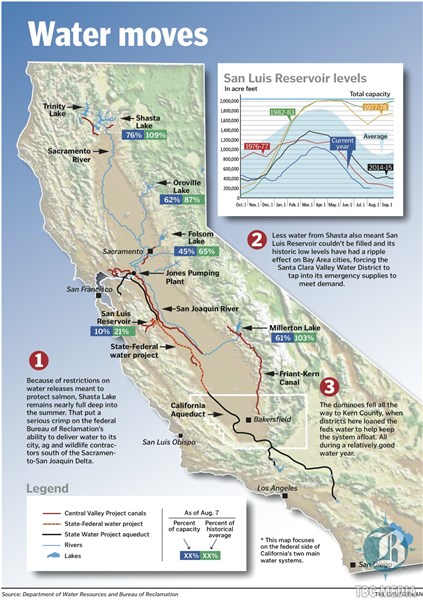
This weekend, Bakersfield Californian columnist Lois Henry published an informative piece on the water management issues that nearly resulted in loss of water to millions of Californians. Henry’s column is well worth a read: in addition to providing a history of this year’s numerous Federal tinkering with water allocation, it also touches on what motivated the tinkering to begin with.

Chart of Federal Water System in California
Federal Water System in California. Originally published in the Bakersfield Californian

What Henry outlines are a series of decisions made without reliance on sound science—decisions made repeatedly, when each time the desired effect is never achieved. Going forward, we should rely on sound decision making that clearly benefits all sectors of California—not just one sector that hasn’t yet been shown to benefit. The efforts of water districts in California as well as the Department of Water Resources to mitigate these unwise Federal choices should be commended. If you haven’t already, please read Lois Henry’s column for a better understanding of the consequences of short-sighted water policy.

More of the Same? Saving the Delta Smelt

More of the Same? Saving the Delta Smelt

More of the same- A record of failure

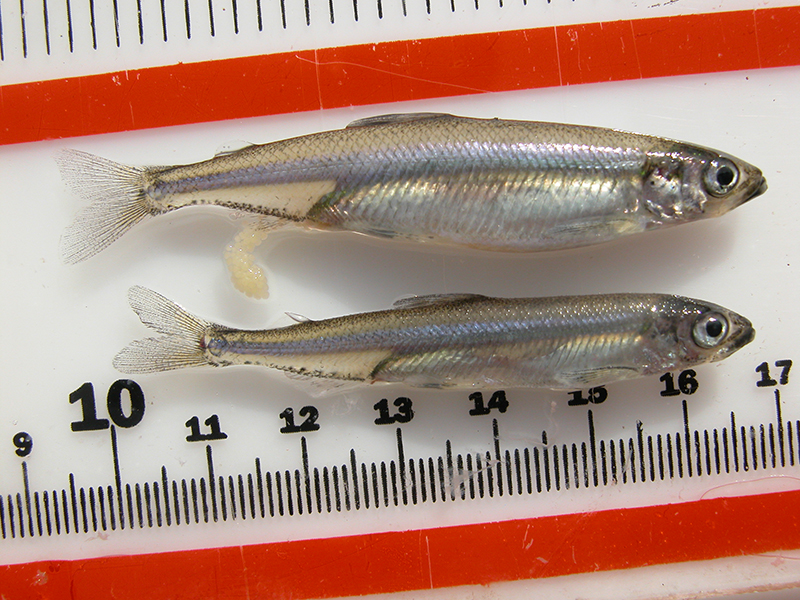
We agree that the San Francisco Bay Estuary needs to be saved. All Californians need a healthy environment in order to thrive and farmers’ very survival depends on it. Being good stewards of the land is what allows us to produce more than 50% of the U.S.-grown fruits, nuts and vegetables.delta_smelt_by_metric_ruler_usfws

What we disagree with is the method being proposed. Decades of releasing billions of gallons of water to the ocean in an attempt to save the Delta smelt has been a proven failure. This year alone, California has flushed over 1 million acre-feet of water out to sea, enough to provide 6 million domestic users with water for a year or grow almost 17 billion salads. Decades old state and federal policies have failed and brought delta smelt to the brink of extinction. The very definition of insanity is doing the same thing over and over again and expecting a different result.

Science shows better strategies exist for saving the Delta Smelt

The good news is that recent science shows that there are strategies available to us that could actually help preserve the fragile delta ecosystem all Californians rely on. We should embrace what independent scientists have been calling for since the beginning: a comprehensive strategy.

Focus on common sense, science-based solutions

Farmers, fishermen, environmentalists, as well as urban water users should be furious at this reliance on outdated, failed practices that help no one and hurt millions. We need to focus on common sense, science-based solutions and we welcome all Californians to join us in working for a balanced approach towards allocating the water that we all need to share.

Guest Blog: Environmental Demands for Water Keep Expanding

By Justin Fredrickson, Environmental Policy Analyst, California Farm Bureau Federation

Asked on the Public Policy Institute of California water blog “how much water nature needs,” the response of Mike Sweeney, the executive director of the Nature Conservancy’s California Chapter, was an attention-getter.

At least it got mine.

“Research,” Sweeney said, “shows that taking more than 20 percent of a river’s natural flow at any given time can negatively impact the river’s function and ecosystem. Today,” he continued, “our rivers receive about half of their historic natural flow. Clearly, we have a problem.”

With 80 percent of available surface water off the table, clearly, we would have a problem!

Last year, there was lots of talk about agriculture using 80 percent of California’s water, but the record was finally set straight. The PPIC notes that average statewide water use “is roughly 50 percent environmental, 40 percent agricultural and 10 percent urban.”

In wet years, according to the California Water Plan, the same environment-ag-urban split becomes more like 60/30/10. And in dry years, it’s more of a 40/50/10 split.

Urban use fluctuates somewhat more across wet, average and dry years than this would suggest—but the real variability comes in environmental and agricultural use.

In wet years, the proportion of agricultural use drops significantly as environmental use rises significantly, while in dry years the proportion of agricultural use goes up as environmental use drops.

Mr. Sweeney’s view is that fish are shorted in all years, but drought years are where he feels the fish are shorted the worst. Variability is nature’s way, according to Mr. Sweeney, but human uses of water upset the kind of variability nature needs.

But if his proposition is that the environmental-ag-urban split should tilt, say, to 80/15/5, then truly, “We have a problem.”

The thing is, farms and cities cannot get by on 15 and 5 percent of our available water supply.

In light of several realities, it’s also problematic to say (as Mr. Sweeney does) that the water he believes nature “needs” should, furthermore, be precisely managed to come down at the times, the temperatures and in something like the volumes in which it would naturally have come down before California had farms, cities, upstream dams, etc.

Managing our system that way would be fairly disastrous: For example, it would mean water we presently capture in reservoirs constructed to catch and store supplies for the rest of the year would instead run to the sea in winter and spring, shrinking reservoirs to piddling mud puddles by midsummer.

And should Mother Nature happen to deal us multiple years of drought? Big problem.

Consider farmers’ experience of the last few years:

  • Surface water deliveries to some users have been at or near zero for three years running—and have been scarcely better for others.
  • Little water was stored or delivered in 2015 as prodigious quantities of water flowed to sea during storms—and yet, when El Niño brought rain and snow in 2016, storage and deliveries remained low.
  • To preserve their livelihoods, sustain regional economies and continue to produce the food and fiber we all take for granted, farmers have been forced to rely on groundwater where it is available. But new groundwater laws may ultimately put more groundwater off-limits too.

As regulatory agencies try ever more draconian ways to save the fish, and as farms go increasingly without water, you have to wonder, “Just where does it all end?”

Unfortunately, the answer seems to be that more and more water will be reallocated to the environment, and less and less will be left over for farming—until, little by little, whole swaths of the choicest food-growing region on the planet are returned to the tumbleweeds.

If all that water produces even a handful of additional fish, Mr. Sweeney and other environmentalists might call that an even trade.

In the meantime, though, it doesn’t appear anyone ever sent the memo to ordinary people that the plan is simply to move California out of the business of growing food.

If ordinary people were told this, would they be actually on board with it?

While something tells me they wouldn’t, the reality is that ordinary people don’t know—and, by the time they do know, it may be too late.

Lest we lose all hope, let’s ask another question: Is there, perhaps, some way we can do better for the fish, and for farms and cities as well?

Must we really push California agriculture offshore in our iron determination to save the fish—while, along the way, damaging sensitive ecosystems in other, less environmentally conscious parts of the globe? Or, if we get creative enough, are there perhaps ways to help the fish and keep our agriculture as well?

Water is a scarce and precious resource. As California farmers know better than anyone, every drop counts.

Heaven knows, farmers are tremendously tough and resourceful. Many urban and suburban residents have cut their water use significantly, too.

Why, then, should environmental water uses be immune to the same scrutiny and efficiency standards applied to farms and cities?

While the clock ticks down, these questions become more urgent, critical and timely.

Guest blog shared courtesy of the California Farm Bureau Federation

Congressional Members Demand Water Supply Answers from Obama Officials

A bipartisan group of 15 Congressional Members sent a letter on June 9 to Obama Administration officials demanding answers to proposed changes in Central Valley Project water operations this year. The proposed changes, supposedly aimed at helping salmon and Delta smelt, contradict one another, put water supplies at risk for farmers who have already planted crops and are an overreach of existing law, according to the letter.

[gview file=”https://farmwater.org/wp-content/uploads/2016/06/2016-06-09-LTR.Members-to-Interior-and-Commerce-re-Operations-issues.pdf”]