Waste and unreasonable use of water

 By Lance Johnson, Madera Irrigation District 

Given three years of drought when every acre-foot of water has to be beneficially used every Californian should be mad as hell about the waste and unreasonable use of water that is occurring under the guise of protecting fish. Consider first that the California Water Code, Division 1, Chapter 1, Section 100, requires that waters of the State be beneficially used for the benefit of the people of California. That waste or unreasonable use, or unreasonable method of use, shall be prevented. And  that “the use or flow of water in or from any natural stream or water course … shall be limited to the water that shall be reasonably required for the beneficial use to be served”. In other words if a use of water is not providing a demonstrable benefit its use is unreasonable and illegal under State law.

Now consider that from 1990–1997 regulatory actions stripped the Federal Central Valley Project of an average of 1,400,000 Acre-Feet/Year (enough to fill Millerton Lake 3X) of water supplies that were previously deliverable to farms and cities to restore Central Valley fish populations. That occurred through increased delta outflow (water lost to the ocean), higher in-stream flows, increased reservoir carryover storage requirements, and delta pumping cutbacks.  Result? Fish populations declined further while average CVP water allocations to farms plummeted 35% and average urban allocations dropped 20%. This period also kicked off spending of $50+ million/Yr by water users and State taxpayers for “fishery enhancement programs”, spending which continues to this day.
Then when fish populations didn’t rebound the Environmental Water Account was created to acquire an additional 185,000 AF/Yr to offset further delta export pumping cutbacks. From 2001-2004 the EWA spent $166.2 million (much of it State General Fund tax payer dollars) on water acquisitions. Result? Not only were EWA acquisitions in direct conflict with historic water transfers for consumptive uses by farms and cities but fish populations continued spiraling downward. Most disturbing, though not surprising, was a 2004 scientific peer review by the CalFed Bay/Delta Program which could not identify where one single fish had been saved by the EWA. Not one! 
Next, in 2006, with delta smelt populations continuing to dwindle, still more restrictions were placed on export pumping.  Result? In 2009, as of July 15, another 628,000 AF was stripped from farms and cities from Tracy to San Diego with west side CVP farmers starting the year with -0- supply and only belatedly getting an abysmal 10% allocation. And numerous cities have been forced to ration water use. Result? One thousand square miles of farm land lie fallowed and abandoned, 40,000+ jobs have been lost and our state and regional economy has lost $ billions. And did that help the fish? No!
Early 2009 also saw farmers served by the CVP Friant Unit for the first time face the specter having Millerton Lake water released to meet the obligations of senior water rights holders. Parties who in the 1930’s exchanged their San Joaquin River water supplies for delta export water that the USBR was not sure it could deliver this year. 
Now comes even more regulatory actions to protect salmon, steelhead, sturgeon and killer whales that will strip away yet another 300,000+ AF per year from delta export supplies beginning next year. And that ever shrinking delta export water supply “pot” doesn’t bode well for the water supply reliability or predictability of CVP Friant contractors, like Madera ID, either.
If the past is prologue, and as two decades of scientific studies have shown, this latest regulatory action won’t help the fish any more than all the other regulatory actions of the last 20 years. What it will do is leave west side farmers to face -0- water allocations, force cities as far south as San Diego to start declaring building moratoriums and leave east side farmers to face the greatly increased likelihood of their Friant water flowing to senior water rights holders.
The facts are these; over the last 20 years $ billions have been spent on Central Valley “fishery enhancement programs”, delta export water supplies have been radically reduced, an area of farm land the size of the State of Delaware has been fallowed or abandoned, tens of thousands jobs have been lost, our Valley’s once vibrant economy is collapsing, and Friant water supplies are now more uncertain than ever before. All that while fish populations keep going inexorably down. If there is some demonstrated beneficial use for the people of California being produced by this it escapes me.
Given that history and set of facts every Californian should be asking two straight forward questions. Is what has occurred and is occurring “demonstrated beneficial use for the benefit of the people of California”? Or is it “waste and unreasonable use”? The later should be obvious.

I Heard It On The Radio

Radio Advertising

Water supply and jobs
Water Supply and food security

Have you heard recently on the radio about California’s water supply crisis and the devastating impacts water supply cuts are having on the people and communities that depend on farming for their livelihoods?  The following statement by Dan Nelson, executive director of the San Luis & Delta-Mendota Water Authority describes the dire situation many people face this year.

Today’s announcement by the United States underscores just how broken California’s water system is.  No water deliveries this year from the federal Central Valley Project to our farmers will deepen the already terrible economic situation in our San Joaquin Valley and have a rippling effect that will extend through California and into the nation.  Less food will be grown and fewer jobs will be available as farmers leave their lands fallow.  Inactivity on the farm will impact demand for otherwise necessary products and services, further depressing our communities, some of which are among the poorest in the country. Estimates from UC Davis economists indicate up to 80,000 jobs will be lost and $1.6-2.2 billion will disappear from the economy in the San Joaquin Valley alone because of the reduced water supplies this year.  Along with the economic decline will come incalculable social consequences.

Though the drought is contributing to this gloomy outlook, the magnitude of the cutback is amplified by our dysfunctional regulatory and water supply systems.  We have had droughts before but never have the effects been so dire.  When this drought breaks, we will still have water shortages in California until we fix our storage, conveyance and management systems.  In the meantime, while we cannot control Mother Nature, there are actions that can be taken now to more efficiently manage the constraints placed upon our water supply system in order to protect endangered species.  We must recognize that this unprecedented human suffering highlights the need to rebalance the use of water for human and environmental purposes
 
“California’s water system was built years ago when California’s population was only half of what it is today.  This delivery system was never intended to serve an ever growing population, provide adequate supplies of water to our farms and meet expanding environmental obligations. Again, lawmakers and regulators must step forward to modernize our infrastructure by increasing reservoir storage, improving conveyance and improving how we manage our limited water supply.”

Find out more at http://www.ourvalleywatercrisis.org

Farm Water and the Big Fix

California’s water supply is broken. Find out who needs to fix it and what needs to be done to provide water supplies for California’s farms, homes and businesses.

Continue reading

CVP today

The CVP Today

The CVP
serves farms, homes, and industry in California‘s
Central Valley as well as the major urban centers in the San Francisco Bay
Area; it is also the primary source of water for much of California‘s wetlands.

In addition
to delivering water for farms, homes, factories, and the environment, the CVP
produces electric power and provides flood protection, navigation, recreation,
and water quality benefits. While the facilities are spread out over hundreds
of miles, the project is financially and operationally integrated as a single
large water project.

The
CVP:

  • Reaches from the Cascade
    Mountains near Redding in the north some
    500 miles to the Tehachapi Mountains near Bakersfield in the south.
  • Is comprised of 20 dams and
    reservoirs, 11 powerplants, and 500 miles of major canal as well as
    conduits, tunnels, and related facilities.  
  • Annually delivers about 7
    million acre-feet for agriculture, urban, and wildlife use.  
  • Provides about 5 million
    acre-feet for farms — enough to irrigate about 3 million acres or
    approximately one-third of the agricultural land in California.  
  • Furnishes about 600,000 acre-feet for municipal
    and industrial use, enough to supply close to 1 million households with
    their water needs each year.


  • Dedicates 800,000 acre-feet per year to fish and
    wildlife and their habitat and 410,00 acre-feet to State and Federal
    wildlife refuges and wetlands pursuant to the Central Valley Project
    Improvement Act (CVPIA).


  • Generates 5.6 billion kilowatt hours of
    electricity annually to meet the needs of about 2 million people.


Source:  Mid-Pacific Region/Bureau of Reclamation; U.S.
Department of Interior

SWP-Recreation

windsurfer.jpgRecreation

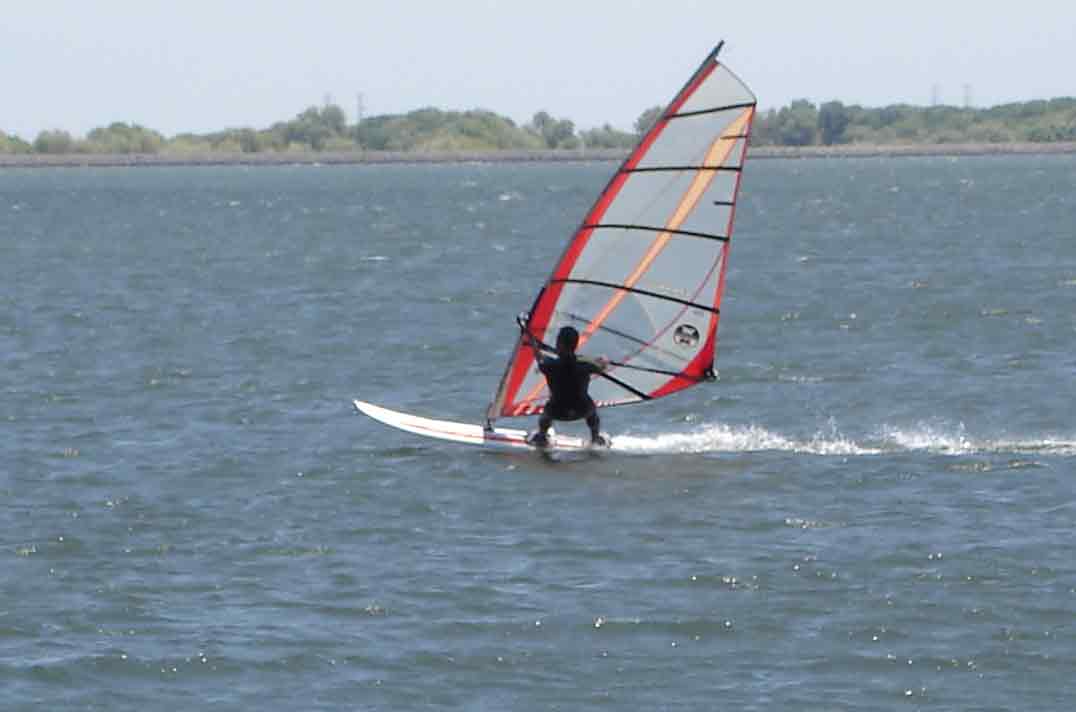
SWP lakes offer a variety of recreational activities. At Project
lakes and reservoirs visitors will find opportunities to swim, picnic,
waterski, boat, fish, hike, bike, camp, and horseback ride.

Plans to construct the SWP included these recreational facilities for the benefit of the public.

Source:  California Department of Water Resources

SWP- Fish and Wildlife Protection

Fish and Wildlife Protection

The Project is operated to
protect the environment. Restricted pumping schedules, fish hatcheries, fish
screens and passages, mitigation agreements, fish surveys and monitoring, a
fish salvage facility, and habitat restoration, are some of the mechanisms for
fish and wildlife protection. The projects are also operated to meet instream
flow requirements in the Feather River, the Sacramento
River
, and Delta channels.

The State Water Project, in cooperation with the federal Central Valley
Project, is operated to limit salinity intrusion into the Sacramento-San
Joaquin Delta and Suisun Marsh. This is accomplished by supplementing
freshwater outflows to the ocean and limiting water exports from the Delta
during specific times of the year.

DWR spends about $20 million annually for various studies, habitat restoration
projects, and fish monitoring programs. These costs also include water
deliveries lost to pumping reductions (during fish migrations through the
Delta) and other operational restrictions.

Source:  California Department of Water Resources

SWP-Flood Protection

Flood Control

One of the SWP’s primary functions is flood control in Northern
California
. A major flood in 1955 was the impetus for the
construction of Lake
Oroville
.

Storage space is provided in Oroville and Lake Del Valle to capture flood flows
and protect areas downstream. Releases are coordinated with other flood control
reservoirs so flows stay within downstream channel capacities.

Floodwater storage space in SWP reservoirs is paid by the federal government,
which regulates how the reservoir space is managed during the rainy season.

Source:  California Department of Water Resources

SWP- Power

Power

The State Water Project requires dependable, economical power to pump water
to areas served by the Project’s contractors. Since 1984 SWP power requirements
have ranged from more than 8 billion kilowatthours a year, as in 1990, to under
4 billion kwh, as in 1995.

Today the SWP is one of California’s
larger energy producers and a major consumer of electricity. How much power SWP
facilities consume depends on contractor requests for water and the amount of water
available for delivery.

The SWP’s flexible pumping operations helps it to manage its power needs. This
flexibility is allowed by Project reservoirs, which temporarily store water
until it is needed to meet the daily and seasonal demands of its contracting
agencies.

Source:  California Department of Water Resources

The Delta

SACRAMENTO-SAN JOAQUIN DELTA


New storage and conveyance will
help provide water for Delta ecosystems and improved water supply reliability
for the state’s farms, homes and businesses.


Water
delivered from the State Water Project originates at Lake
Oroville and flows to the Sacramento River and then through the Sacramento-San
Joaquin Delta before traveling southward via the California Aqueduct.  This flow has been restricted following a
federal

delta.jpg

judge’s 2007 ruling that operation of the Delta pumps endangers a
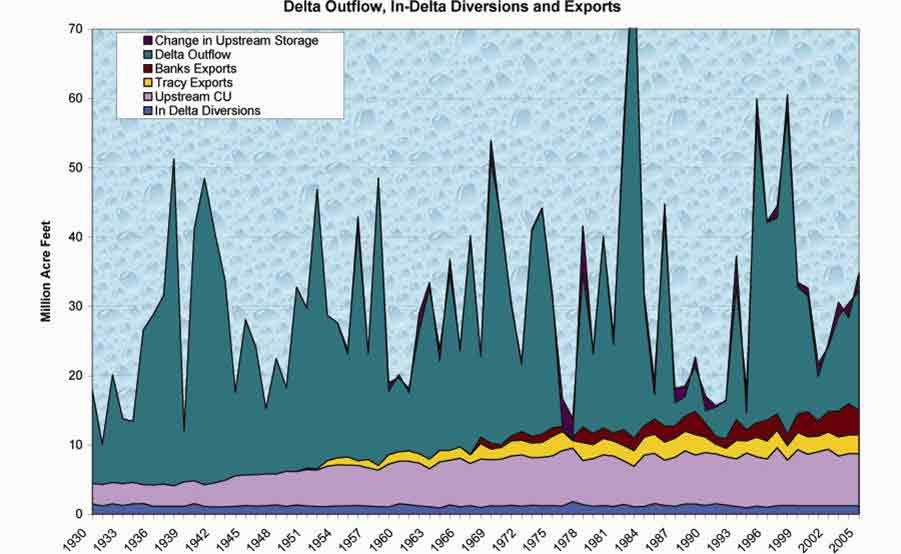
2-inch fish on the threatened list of the Endangered Species Act.  According to the following graph, a portion
of the water that flows through the Delta and to the Pacific
Ocean
in wet years can be captured and used to balance water
shortages in dry years.


A
State-sponsored study is nearing completion that will result in a
recommendation to Gov. Schwarzenegger regarding, among other items, how best to
continue the conveyance of water through the Delta. 


Learn more about the San Joaquin-Sacramento Delta

Delta
Vulnerabilities


Central Valley Project

CENTRAL VALLEY PROJECT (CVP)


Studies must move forward to
provide an increase in the available supply of water from the federal Central Valley Project. 
Current studies feature an increase in water storage from 290,000 acre-feet
to 636,000 acre-feet from Shasta Reservoir by raising Shasta Dam 6.5 feet or
18.5 feet, respectively.


Studies are underway by the U.S. Department of Interior to
determine the feasibility of raising the height of Shasta Dam.  Shasta Reservoir currently features a
capacity of 4.5 million acre-feet of water and that water is delivered to
nearly one-third of all irrigated acres in California, or 3 million acres.  The CVP also provides 600,000 acre-feet of
water to homes and businesses, including 1 million households.

Construction of the CVP water storage facilities stretched
across 42 years, from 1937 to 1979.  The
CVP annually generates enough electrical power to supply the needs of 2 million
people.  CVP facilities also host more
than 3.5 million visitors each year for boating, fishing, camping and
swimming.  Educational tours are
conducted each year at CVP facilities for 50,000 school children.


Source:  Mid-Pacific Region/Bureau of Reclamation; U.S.
Department of Interior


Learn more about the Central Valley Project:

“Water. It’s about water.”

The CVP Today