Smaller tunnel reduces food supply for grocery stores

From News Line, a daily compilation of farm water news distributed to CFWC members and others upon request. To receive News Line, click here.

Alternative to the tunnels

Coalition response…Operations of the twin tunnels with a capacity of 9,000 cfs will be based on the available supply of water, according to the Bay Delta Conservation Plan. When water supply is low in the Sacramento River, the amount of water flowing through the tunnels will be reduced. When the supply is high, the tunnel flows will increase (www.farmwater.org/exportthrottle.pdf). Fears of draining the Sacramento River are simply not based on facts. The actual purpose of the twin tunnels is to move water that is already permitted under rights granted by the State of California to public water agencies. Those agencies serve many farms, homes and businesses that are a vital part of California’s economy. No new project, according to California law, may negatively impact an existing water right, which appropriately safeguards the rights of those in the Sacramento Valley and the Delta.

The 3,000 cfs tunnel, which is actually an NRDC proposal, provides no relief for farmers in the San Joaquin Valley. A recent study indicated that 750,000 acres of productive farmland could be fallowed because the NRDC proposal ignores the water supply needs of thousands of farmers who provide locally-grown food for our grocery stores.
Water users awaiting action in more areas than just salmon

From News Line, a daily compilation of farm water news distributed to CFWC members and others upon request. To receive News Line, click here

Oroville hatchery will spawn fish population in San Joaquin River

Coalition response…Once again while efforts are ongoing to reintroduce salmon to the river, farmers and water agencies are still waiting for the legislated construction of several projects along the river that are necessary to protect adjacent land owners and water agencies’ diversions which allow a continuing supply of water to users. These projects are estimated to cost more than $1 billion (Bureau of Reclamation’s own figures) and there is no sign of getting the federal dollars to complete them in a timely manner. Meanwhile, the necessary mitigation measures that are required in order to safely increase flows down the river have not been completed. In 2010, the BOR created damage to farmland from seepage; BOR paid the landowner for the damages in 2012. Meanwhile, flows in the seepage prone areas cannot resume until mitigation measures are installed. As of this article none have been installed.

Returning salmon to the river is one part of the settlement agreement but taking spring-run salmon from another part of the state where they have a chance to survive and placing them in a hatchery on the San Joaquin River, with no necessary infrastructure completed and therefore no chance of survival, seems wasteful of limited and precious resources. Other areas, including construction projects, seepage and more, are important and water users are waiting to see action taken in these areas that will provide safeguards to landowners.

‘Portfolio’ doesn’t provide sufficient water supply benefits

From News Line, a daily compilation of farm water news distributed to CFWC members and others upon request. To receive News Line, click here.

Two more reasons why BDCP should analyze our proposed conceptual alternative: Law and economics

Coalition response…The Legislature instructed the Bay Delta Conservation Plan to accomplish two goals in its approach to the Delta: Create a reliable water supply and improve the Delta ecosystem. That has been the focus of years of research and study funded by water suppliers. Critics of BDCP attempt to cloud the issue by introducing a proposal that doesn’t provide sufficient water supply benefits for all water users. While important, improving local water supplies, increased conservation and other actions, coupled with an undersized tunnel will simply not meet the state’s future water supply needs.

Introducing a “portfolio” of actions this late in the BDCP process does nothing other than to create delay in achieving a reliable water supply and an improved Delta ecosystem.

Undersized tunnel fails water future

From News Line, a daily compilation of farm water news distributed to CFWC members and others upon request. To receive News Line, click here.

In response: Smaller proposal doesn’t fill big need 

Coalition response…Secretary Laird is correct that California must plan for a dependable water supply in the future. The recent proposal of constructing an undersized, 3,000 cfs tunnel does not provide sufficient water to meet our needs or safeguard our water supply in a time of crisis. According to estimates, this smaller tunnel would cut off the supply of water to more than 750,000 acres of farmland in the San Joaquin Valley. That means the possibility of fewer fresh food choices and higher prices at the grocery store.

Governor Brown’s preferred alternative calls for two tunnels with a capacity of 9,000 cfs. This proposal safeguards today’s water supply and is designed to more adequately meet our water supply needs in the future. Now is not the time to shortchange California with a low-cost proposal that is short on value.

2013 Poster Contest

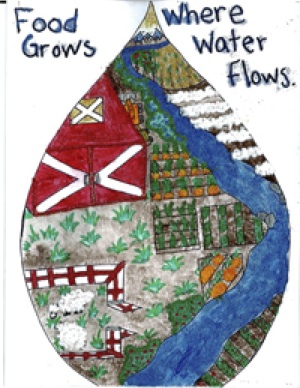
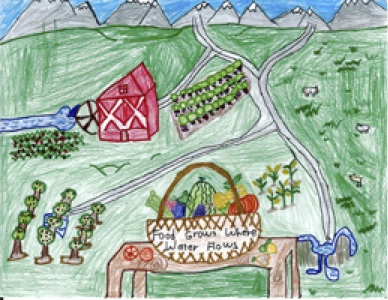
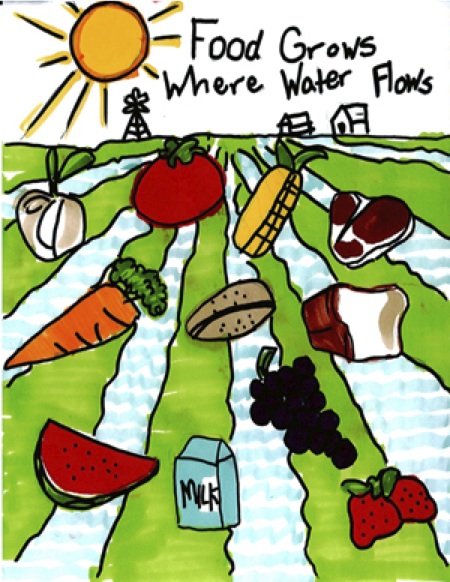
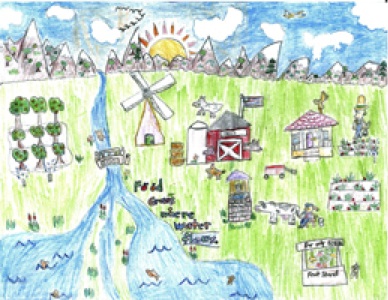
The winner of this year’s Water Awareness Month Poster Contest is a fourth-grade student from Veterans Elementary School, Bakersfield. The contest, sponsored by the California Farm Water Coalition, is open to all fourth-graders in the state. Second place went to a student from Promenade Elementary School, Corona, and third place to a student from Maple Creek Elementary School, Fresno. Scroll down to see how winning students depict water used on California farms:


FIRST PLACE WINNER

Zach – Veterans Elementary School, Bakersfield

Hillary Rawlins, teacher


SECOND PLACE WINNER

Elyssa – Promenade Elementary School, Corona

Mrs. Harris, teacher


THIRD PLACE WINNER

Shailey – Maple Creek Elementary School, Fresno

Carol Smith, teacher


Honorable Mentions (in alphabetical order)


Angelica – Promenade Elementary School, Corona

Mrs. Harris, teacher


Esai – Our Lady of Fatima School, Los Banos

Polly Lemos, teacher


Nicholas – Maple Creek Elementary School, Fresno

Carol Smith, teacher


Zachary – Our Lady of Fatima School, Los Banos

Polly Lemos, teacher


‘New’ proposals fail the test

From News Line, a daily compilation of farm water news distributed to CFWC members and others upon request. To receive News Line, click here.

Californians – find out here where your water comes from

Coalition response…The “effective, affordable solutions” to the Delta that the author refers to is a recycling of ideas that have been studied for years. Along with other groups who have been critical of the current proposal from BDCP that includes an improved conveyance with two tunnels through the Delta, a portion of the new solutions features a single tunnel with a capacity of only 3,000 cfs. The Bay Delta Conservation Plan studied this proposal a year ago and the results of that study can be found here.

No one disagrees that something needs to be done to improve a water infrastructure that was built when the population of our state was millions less. But the 3,000 cfs tunnel would not provide sufficient water to meet both urban and agricultural needs south of the Delta. Adopting this smaller proposal would either leave millions of acres of productive farmland without a reliable water supply, or it would require continued reliance on moving water through the Delta. Continuing the status quo is not a solution because it doesn’t help fish and it doesn’t deliver enough water – the two reasons why a BDCP project is even considered in the first place.

Other elements of the “solutions” offered by the author include development of regional supplies, decreased reliance on the Delta, conservation efforts and more. BDCP does not prohibit these efforts from being undertaken. In fact, others have advocated these measures for years.

Current information essential in discussing conveyance proposal

From News Line, a daily compilation of farm water news distributed to CFWC members and others upon request. To receive News Line, click here.

Talking tunnels

Coalition response…It is important that individuals and groups use updated information when referring to the conveyance tunnels within the proposed BDCP. Too often a capacity of 15,000 cfs is still being attributed to the tunnels but that is outdated information. The most current proposal includes a 9,000 cfs capacity for the tunnels. Further information can be found on the BDCP website by clicking here.

‘Status quo’ costing California in lost water

From News Line, a daily compilation of farm water news distributed to CFWC members and others upon request. To receive News Line, click here.

Delta smelt will be in Fresno court this week

Coalition response…Pumping restrictions to protect the smelt began Dec. 7, 2012, and they are still continuing. According to the biological opinions that govern the rate of pumping, these restrictions will continue into June. And they could get worse.  From the day the restrictions first went into place through Jan. 26, 2013, almost 632,000 acre-feet of water was lost to California’s farms, families and businesses and allowed to flow to the ocean. At a replacement cost of $150 per acre-foot that equates to about $95 million, and that’s just the beginning.  The lost economic opportunity of putting that water to work, according to economists, is in the range of $3.5 – $4.5 billion.  And that number is going up every day. Allowing actions in the biological opinions written years ago, and which have been found unlawful by a federal judge to continue to hammer California’s struggling economy without demonstrating a measurable benefit to fish is a waste we should no longer tolerate.  The time is now to make immediate changes in interim actions that are more reasonable and broad-based while comprehensive solutions to improve the ecosystem in the Delta and restore water supplies vital for California’s economy are finalized in the Bay Delta Conservation Plan.

BDCP critic inflates conveyance size

From News Line, a daily compilation of farm water news distributed to CFWC members and others upon request. To receive News Line, click here.

Brown’s canal proposal bad plumbing: Garamendi

Coalition response…Despite what Rep. Garamendi would have people believe, the current Bay Delta Conservation Plan includes more than a “plumbing system.” It is the result of years of study and research that features Delta ecosystem restoration, an improved conveyance system, restored habitat and more. He also incorrectly cites 15,000 cfs as the size of the proposed conveyance when that number is much smaller at only 9,000 cfs. Recent calls to consider an even smaller conveyance at 3,000 cfs fail to recognize that this lower size has already been studied by BDCP.

Critics of the current BDCP proposal continually raise the rhetoric that the Sacramento River and Delta will be drained. Nothing is further from the truth. Diversions will be closely governed and increased or decreased according to the amount of water available in the system. To view how the system will work, click here.

Securing a reliable water future for our State and at the same time protect the Delta requires thoughtful discussions and committed individuals and organizations seeking the best for all California.

Water future requires reasonable discussion

From News Line, a daily compilation of farm water news distributed to CFWC members and others upon request. To receive News Line, click here.

Getting soaked by Delta water plan

Coalition response…Claiming that water users south of the Delta do not care what happens in the Delta region is a fact less statement that only serves to heighten the rhetoric surrounding efforts to reach a solution to California’s water dilemma. These water users have spent more than $150 million to fund the studies and research that includes Delta ecosystem restoration. California’s water future is deserving of a continuing dialogue but it must be one that is reasonable and absent of statements that serve no purpose.