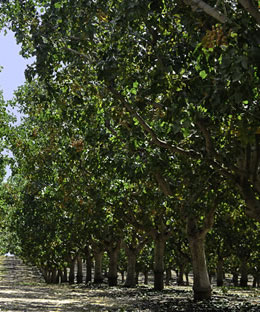
California-grown Pistachios

About Pistachios in the U.S.
 

During the 1880s, imported pistachios were popular in the USA. With immigrants from middle-eastern countries importing the popular nut.

SettonTreesThe pistachio received further distribution through vending machines installed in undergroundtrain stations, bars, restaurants and other common locations. “A dozen for a nickel” soon developed into a familiar slogan.
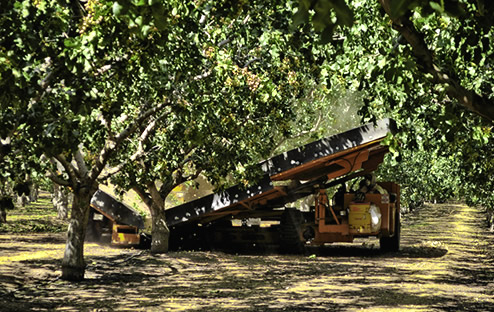
It was recognized that California’s Central Valley – due to its fertile soil, hot, dry climate and moderately cold winters – offered the ideal growing conditions for the nut. In 1929, American botanist William E. Whitehouse journeyed to Persia (modern day Iran) to collect pistachios. This pursuit came to a close in 1930, when he returned to the USA with a collection of approximately 20 pounds (10 kilograms) of individually selected nuts.
 
Did You Know?
 

Growers working on PistachiosPistachios are wind pollinated, as opposed to bee pollinated. Just one male tree is required to pollinate up to 30 female trees.


Pistachio trees take seven to 10 years to mature

There are 850 producers in the United States and the annual “farm gate value” of pistachios represents more than $1.16 billion to the California economy

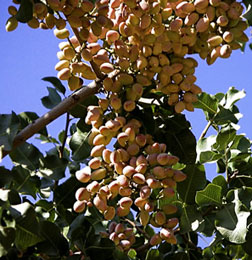
PistachioBunchWEBCalifornia comprises 98.5% of the total with over 250,000 acres planted throughout 22 counties.

In only 36 years, production of pistachios has grown from 1.5 million pounds (680 tons) in 1976, to the record 2007 crop of over 415 million pounds (188,241 metric tons).

Pistachio farmers are more efficient than ever! In 2007 they grew more than 3,615 pounds per acre (on average) – Up from only 1,468 pounds per acre in 1982.

Photo Credit: Setton Farms

For more info visit American Pistachio Growers- http://americanpistachios.org/


New BDCP job study released

Feb. 26, 2013
Release immediate

BDCP PROVIDES 137,000 JOBS TO CALIFORNIA ECONOMY; IMPROVES WATER DELIVERIES

As many as 137,000 new jobs will result from habitat restoration and the construction of twin tunnels as part of the Bay Delta Conservation Plan, according to a study released today by the California Natural Resources Agency.

“The state’s water supply system is in dire need of an upgrade to continue to serve farms, families and businesses,” said California Farm Water Coalition Executive Director Mike Wade. “Adding 137,000 new jobs is an additional benefit that our economy sorely needs.

“Important factors with this project are the co-equal goals established by the Legislature, including a reliable water supply and improved ecosystem in the Delta. Water deliveries in recent years have been a game of roulette with farmers not knowing how much water they would receive before the growing season began.”

The just released study is an update to an earlier job-creation study by the Department of Water Resources that looked at conveyance proposals for 3,000 cubic feet per second (cfs) and 15,000 cfs. That study indicated that job creation would be 70,000 and 130,000 respectively. The capacity of the twin tunnels to move water is 9,000 cfs.

Most of the jobs identified in the new study (http://baydeltaconservationplan.com/Home.aspx) would be 137,000 full-time equivalent jobs in construction, operations and maintenance, and land acquisition for both conveyance and habitat restoration projects. Job creation related to habitat restoration would result in 15,000 full-time equivalent jobs during the first 10 years of activity.

“More jobs for California’s economy is good news,” said Wade. “The potential loss of some farm jobs as a result of habitat restoration in the Delta is unfortunate but a net job increase for the Delta region will result, according to the study.

“Our state cannot afford to move into the future without a water supply that is reliable to farmers and 25 million Californians,” continued Wade. “Part of the answer for California’s future demanded by the Legislature was to eliminate the uncertainty of water supply and to restore the Delta ecosystem for habitat and fish.

“The benefits to the entire state mean that BDCP is the solution for California’s water supply and environmental future.”

###

Farmers receive disappointing water delivery announcement

Feb. 25, 2013
Release immediate

The following is a statement by Mike Wade, Executive Director of the California Farm Water Coalition, in response to a water delivery announcement made today by the U.S. Bureau of Reclamation.

FARMERS RECEIVE DISAPPOINTING WATER DELIVERY ANNOUNCEMENT  

“Declining water storage levels and a federal guideline that redirected nearly 800,000 acre-feet of water to the ocean from farms, families and business have combined for a disappointing water delivery announcement of only 25 percent to San Joaquin Valley farmers receiving water from the federal Central Valley Project.

“The water sent to the ocean was supposed to protect Delta smelt, an endangered species. Yet, federal water managers have failed to provide scientific evidence that the action had any measurable benefit to smelt. The only reality from this action is that the water is gone that could have been used later this year to grow fruits and vegetables.

“Despite the heavy rain and snowfall earlier this water year in December, farmers will be receiving less water than last year, which was a dry water year.”

###

Land retirement is not the answer

From News Line, a daily compilation of farm water news distributed to CFWC members and others upon request. To receive News Line, click here. 

Land retirement solves selenium problem

Coalition response…No drainage water from the nearly 100,000 acres of the Grassland Drainage Area south of Los Banos ever flowed to the Kesterson National Wildlife Refuge. The author fails to provide this important fact as she attempts to connect the land, that will send drainage water to the proposed treatment plant, with Kesterson from the 1980s.

A cooperative effort by farmers, local water districts, environmental organizations, and State and federal agencies has resulted in reduced flows of selenium and other minerals into the San Joaquin River. The U.S. Environmental Protection Agency labeled the project a “success story.” Read the EPA report at http://water.epa.gov/polwaste/nps/success319/ca_san.cfm.

The water treatment plant is yet another phase in the overall effort to maintain the viability of the farm acreage. Each year the harvest value from this land totals more than $400 million. Hundreds of individuals are employed year-round and thousands more are added during harvest season. An additional $250 million in economic activity is generated by farming operations that supports local communities.

Taking even more land out of production as suggested by the author would be devastating. A recent look (farmwater.org/watersupplycutshurtusall.pdf) at water lost to 25 million Californians and 3 million acres of farmland reveals that 260,000 acres account for 12,386 farm jobs and could annually produce $873 million in crops. That translates to a $2.2 billion impact to the State’s economy.

Removing land from production could result in less locally-grown fruits and vegetables in our grocery stores and a greater reliance on imported food. Is this what people really want?

Single Delta tunnel means disaster for farmers

Release Immediate
Feb. 21, 2013

SINGLE DELTA TUNNEL MEANS DISASTER FOR FARMERS

Dos Palos farmer Shawn Coburn today told Delta Stewardship Council members that a disaster awaits him and other San Joaquin Valley farmers if a plan featuring a single tunnel to convey water through the Delta becomes a reality.

Coburn pointed out that the single tunnel would cut water deliveries to south-of-the-Delta water users by a third. Farmers within the federal Central Valley Project (CVP) service area, where Coburn farms, would receive about 485,000 acre-feet of water instead of the 1.8 million acre-feet needed to grow their crops.

“We are looking at the potential of 750,000 acres going unplanted,” he said.

Coburn distributed a fact sheet developed by the California Farm Water Coalition that revealed that six out of every 10 acres farmed with CVP water would be in jeopardy. The fact sheet is available at www.farmwater.org/BDCP-NRDC_alt.pdf.

The Dos Palos farmer grows almonds on the valley’s Westside and when water is available, he also grows cannery tomatoes. In recent years when water deliveries have been reduced, he has been forced to forego the tomato acreage in order to divert all his water to almond orchards.  

Coburn stressed that the current twin-tunnel being considered by BDCP provides a reliable water supply that is needed by farmers, families and businesses. Without such a supply, the production of fresh fruits and vegetables that San Joaquin Valley farmers are known for would be in jeopardy.

###

Even John Muir supported Sierra waters for Valley farmland

From News Line, a daily compilation of farm water news distributed to CFWC members and others upon request. To receive News Line, click here.

Merced River protection should be kept

Coalition response…The viewpoints of this author are well documented with his past writings. Reasonable individuals approach the issue of raising the New Exchequer Dam spillway at Lake McClure from a factual viewpoint and not one that is influenced by personal opinion or emotion.

Chronicle readers should realize that construction of New Exchequer Dam was completed in 1967. Twenty years later in 1987 the Wild and Scenic River Act encroached on the hydroelectric project boundary on the Merced River. The proposal to raise the spillway, not the dam, by 10 feet would inundate the last 1,800 feet of the 122-mile stretch of the Merced River, far from Yosemite, for two to eight weeks every few years. That’s 1/350 of the protected stretch of the river.

In wet years, about every three years, Merced Irrigation District would store an additional 70,000 acre-feet of water that could be carried forward into a dry year. This additional water would be stored and later used to produce food on farms in the region. Even John Muir advocated the use of Sierra waters to irrigate the rich farmland in the Valley.

The pending congressional legislation does not negate the Wild and Scenic River Act. Instead, it provides increased water supplies that will result in multiple benefits.

Opinion ignores National Academy of Science conclusion

From News Line, a daily compilation of farm water news distributed to CFWC members and others upon request. To receive News Line, click here.

Trouble brewing in the marriage of science and policy in the Bay-Delta

Coalition response…The author’s reference that Delta smelt are “being sucked out of their habitat” by export pumps with no other mention of factors identified by scientists for the cause of the smelt’s population decline is disingenuous. The prestigious National Academy of Science, a collection of scientists from around the United States, spent months looking at the cause of species decline in the Delta. Their conclusion was many causes exist that influence the decline and taking action directed at only one factor is doomed to failure. The scientists clearly stated that it would take a multiple-prong approach to resolving population issues of species in the Delta. Those other factors, as they relate to smelt, include predation, water quality, loss of habitat, and more. The Bay Delta Conservation Plan’s current proposal to construct twin tunnels through the Delta will relocate the intakes to an area where Delta smelt do not exist.

Starting point: Water system isn’t working

From News Line, a daily compilation of farm water news distributed to CFWC members and others upon request. To receive News Line, click here.

Delta pipes pitch less than perfect

Coalition response…In any discussion of Governor Brown’s plan to provide water supply reliability for California it is important to start with a fundamental fact: The current system isn’t working for fish and it isn’t working for water users. The San Francisco Bay Area depends on the Delta for two-thirds of its drinking water supply. The Bay Area is susceptible to the same earthquake risk to its water supply as southern California, which is why the City of San Francisco went to extensive efforts at seismic upgrades to its Hetch Hetchy water supply system.

Concerns over record water exports in 2011 should be weighed against the fact that 2011 was a tremendously wet year. There was sufficient water in the system to support moving and storing excess water for a future when supplies aren’t plentiful. That’s how the system is supposed to work.

BDCP provides water supply and ecosystem benefits designed to meet California’s water and environmental needs far into the future. For the sake of salmon, Delta smelt, Bay Area water supply and the food farmers grow for the grocery store, BDCP represents the best alternative for California.

California deserves more than single tunnel

From News Line, a daily compilation of farm water news distributed to CFWC members and others upon request. To receive News Line, click here.

A rare alignment

Coalition response…The single tunnel conveyance would be a disaster for San Joaquin Valley farmers. The normal water supply delivered to these farmers would be cut by a third, leaving about 750,000 acres of farmland with no water supply in a normal year. This is not what California needs as it continues to recover from a struggling economy. Consumers would be faced with a declining locally-grown food supply and an increasing reliance on more imported products to feed their families. They deserve better than that.

Single tunnel option threatens local food supply

From News Line, a daily compilation of farm water news distributed to CFWC members and others upon request. To receive News Line, click here.

Shore up the state’s imperiled water supply

Coalition response…This editorial correctly explains the importance of moving forward with a two-tunnel conveyance project in the Sacramento-San Joaquin Delta. This project would separate a water supply that goes to 25 million Californians and several million acres of farmland from ecological concerns in the Delta, including the Delta smelt.

Farmers, families and businesses are still losing water because of the conflict in protecting the smelt. The loss of more than 775,000 acre-feet of water as of Feb. 13, which is more than 250 billion gallons, could have grown nearly a billion dollars in fresh fruits and vegetables or served the household needs of 4.5 million people for a full year. Instead, it went unused to the ocean with no proof of any benefit to the ecosystem. More information of the economic impacts of this lost water can be found at farmwater.org/watersupplycutshurtusall.pdf.

Critics of the two-tunnel conveyance project argue that a single tunnel would do the job for California at a much lower price. A single tunnel would cut San Joaquin Valley farmers’ water supplies by a third, leaving roughly 750,000 acres of farmland with no water supply in a normal year. Locally-grown food production would decline, leaving consumers to rely on more imported products to feed their families. Is that the California we want?