Skip to content

STATEMENT: Powerful Coalition Keeps Radical Water Rights Changes from Advancing in the Legislature

STATEMENT: Powerful Coalition Keeps Radical Water Rights Changes from Advancing in the Legislature

When the California Legislative session began last January, farmers were facing formidable efforts to upend our system of water rights. Four different pieces of legislation took direct aim at the stability that water rights provide to farms, cities, businesses, rural communities, and the environment. Each entity must make plans based on how much water will be made available to them, and it’s our system of water rights that makes planning possible.

Taken together, this legislation would have handed wide-ranging powers to the State Water Resources Control Board, stripping away many of the checks and balances on the system and undermining due process for water rights holders. These bills would have empowered the Board to adopt sweeping and permanent regulations, not just emergency orders, and put the burden of proof on water rights holders to defend their existing claims.

Given the makeup of the California legislature, with nearly a third of the legislators in their first term, the possibility of stopping these changes seemed challenging at best as the session began. However, a formidable coalition including agriculture, public water agencies, the business community, and labor organizations, came together and succeeded in stopping, or significantly modifying, these serious threats.

At the time this article is being published, two of these bills have been amended to address the concerns of many, though not all, legal and policy experts in the coalition and both may see further amendments when the legislature returns in mid-August. The other two pieces of legislation failed to get out of committee and are now considered two-year bills which will be worked on again next year.

Coalition partners included:

  • Association of California Water Agencies
  • California Building Trades Association
  • California Business Properties Association
  • California Alliance for Jobs
  • California Chamber of Commerce
  • California Manufacturers & Technology Association
  • California Municipal Utilities Association
  • Friant Water Authority
  • Kern County Water Agency
  • Kings River Conservation District
  • Northern California Water Association
  • San Joaquin River Exchange Contractors Water Authority
  • San Luis & Delta-Mendota Water Authority
  • Southern California Water Coalition
  • Valley Ag Water Coalition

Here are summaries of the legislation.


Assembly Bill 460

While the bill’s stated intent was to make it easier for the State Water Board to discourage, and stop, illegal water diversions, it went much further than needed. The powers granted the Board would have

allowed it, or interested third parties, to halt water diversions while limiting constitutionally protected rights to judicial review. The State Water Board would have been able to immediately issue an interim relief order before holding a hearing if it made certain findings. According to one opposition letter, AB 460 “would have the State Water Board serve as prosecutor, judge, jury, and executioner in deciding whether an interim relief order is warranted.” The bill would have allowed an interim relief order to remain in place for six months, an entire irrigation season, and deprived water rights holders of meaningful and timely judicial or administrative review.

Status as of August 1, 2023: This bill was stopped in committee and will be discussed again next year.

Assembly Bill 1337

This legislation sought to provide a vast expansion of the State Water Board’s curtailment authority, giving it power to curtail diversions of all water users, including riparian and pre-1914 water rights holders, in “all hydrologic conditions.” It would further have allowed the State Water Board to do by regulation what it currently can only do by adjudication. Opponents of the bill claimed, “AB 1337 proposes no less than to strip every water right holder in California of their state and federal constitutional guarantee of due process.” For the system to be fair, there must be a process for impacted parties to provide evidence and be heard by a neutral arbiter, and AB 1337 would have taken that away.

Status as of August 1, 2023: This bill was stopped in committee and will be discussed again next year.

Senate Bill 389

Flipping our justice system on its head, this bill would assume someone is guilty until proven innocent, instead of the other way around. It would have authorized the State Board to “drag any water rights holder before the Board to defend its claim of right. . . would stack the deck against all right holders forced into these proceedings by providing minimal due process protections and placing the burden of proof on the right holder.” It would have also authorized the State Water Board to conclude water rights have been forfeited even without a conflicting claim, as is the case under current law. This would have pushed water users to consume as much water as possible in order to reduce the risk of forfeiture at the exact time when the State should be encouraging greater conservation.

Status as of August 1, 2023: This bill has been amended to clarify the authorities of the State Water Board, making them consistent with some legal experts’ perception of existing case law. After the legislation was amended, a number of organizations in the coalition shifted their opposition to a “watch” position. It will be considered by the Assembly Appropriations Committee when the legislature returns in mid-August.

Assembly Bill 676

Claiming to strengthen the directive that the highest use of water in California is for domestic purposes and the next highest use is for irrigation, what it really would have done is add confusion and create litigation risk. By statutorily adopting existing regulations and case law, AB 676 would have opened the door for uncertainty in one of the few areas of water law that is relatively clear.

Status as of August 1, 2023: This bill has been amended to clarify existing regulations in statute and coalition opposition has been removed. It will be considered by the full Senate when the legislature returns in mid-August.

While much work remains to be done, the achievements this legislative session cannot be understated. At a time when farms and farmers seem to be continuously under attack, this coalition effort presents a bright spot in a sometimes daunting landscape of challenges.

Our Food Supply at Risk: White Paper on the Importance of Alfalfa Production in the American West

Our Food Supply at Risk: White Paper on the Importance of Alfalfa Production in the American West

With drought conditions continuing to blanket the Western U.S., and farmers struggling to find adequate water supplies, competing interests are pressuring the federal government to cut the water supply farmers are using to grow our food, including alfalfa, which is a foundational food chain crop.

In response, the Family Farm Alliance and California Farm Water Coalition have produced a White Paper titled, “Our Food Supply at Risk; The Importance of Alfalfa Production in the American West” detailing the valuable role alfalfa plays as a principal feed source for the nation’s livestock and diary industries, its environmental benefits, and contribution to effective drought management.

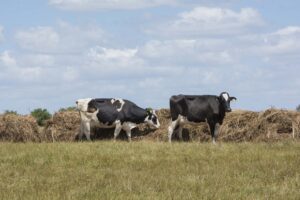
Dairy cows eating alfalfa hay and ration

Family Farm Alliance Executive Director, Dan Keppen, said reducing the acreage devoted to alfalfa may seem like an easy fix to save water, but a decision to do so has bigger ramifications for our nation’s food supply.

“Alfalfa is grown as livestock feed for the beef and dairy industries, both of which contribute to a balanced diet, including high protein foods, such as beef, milk, and milk products, such as yogurt, butter, cheese, ice cream, and cottage cheese,” said Keppen. “At a time when consumers are facing record inflation and sticker shock every time they to go to the grocery store, it makes no sense to aggravate the problem and drive prices even higher by cutting out a vital component of our food supply.

Mike Wade, executive director of the California Farm Water Coalition, said that Arizona and California lead the nation in per-acre production of alfalfa.

“With crop yields that are double the per-acre yields in most other states, the ability to make-up lost production from Arizona and California is very unlikely, which would lead to shortages, higher feed costs for producers, and the loss of more family farms when so many are already struggling,” he said.

The report outlines many of the additional benefits that come from alfalfa production, including enhanced soil health because of deep rooting and the nitrogen alfalfa naturally adds to the soil during its growth cycle. This reduces the amount of chemical fertilizers that have to be used to grow crops that follow alfalfa during crop rotation.

Alfalfa also contributes to the health of pollinators, such as bees, when it grows because of the crop’s prolific flower production. Bees use alfalfa for honey production, more of which comes from alfalfa farms than any other source in the U.S.

And alfalfa is an efficient water user, producing a crop year-round in warmer climates, but is also able to survive droughts as well as intentional “dry down” to make water available for other so-called high-value crops, including fruits, nuts, and vegetables, that face drought-driven water shortages.

RELEASE: Our Food Supply at Risk: White Paper on the Importance of Alfalfa Production in the American West

With drought conditions continuing to blanket the Western U.S., and farmers struggling to find adequate water supplies, competing interests are pressuring the federal government to cut the water supply farmers are using to grow our food, including alfalfa, which is a foundational food chain crop.

In response, the Family Farm Alliance and California Farm Water Coalition have produced a White Paper titled, “Our Food Supply at Risk; The Importance of Alfalfa Production in the American West,” detailing the valuable role alfalfa plays as a principal feed source for the nation’s livestock and diary industries, its environmental benefits, and contribution to effective drought management. 

Family Farm Alliance Executive Director, Dan Keppen, said reducing the acreage devoted to alfalfa may seem like an easy fix to save water, but a decision to do so has bigger ramifications for our nation’s food supply.

“Alfalfa is grown as livestock feed for the beef and dairy industries, both of which contribute to a balanced diet, including high protein foods, such as beef, milk, and milk products, such as yogurt, butter, cheese, ice cream, and cottage cheese,” said Keppen. “At a time when consumers are facing record inflation and sticker shock every time they to go to the grocery store, it makes no sense to aggravate the problem and drive prices even higher by cutting out a vital component of our food supply.

Mike Wade, executive director of the California Farm Water Coalition, said that Arizona and California lead the nation in per-acre production of alfalfa.

“With crop yields that are double the per-acre yields in most other states, the ability to make-up lost production from Arizona and California is very unlikely, which would lead to shortages, higher feed costs for producers, and the loss of more family farms when so many are already struggling,” he said.

The report outlines many of the additional benefits that come from alfalfa production, including enhanced soil health because of deep rooting and the nitrogen alfalfa naturally adds to the soil during its growth cycle. This reduces the amount of chemical fertilizers that have to be used to grow crops that follow alfalfa during crop rotation.

Alfalfa also contributes to the health of pollinators, such as bees, when it grows because of the crop’s prolific flower production. Bees use alfalfa for honey production, more of which comes from alfalfa farms than any other source in the U.S.

And alfalfa is an efficient water user, producing a crop year-round in warmer climates, but is also able to survive droughts as well as intentional “dry down” to make water available for other so-called high-value crops, including fruits, nuts, and vegetables, that face drought-driven water shortages.

Keppen will be presenting the report as part of his remarks to the World Alfalfa Congress Symposium on November 14-17 at the Town and Country Resort in San Diego.

Wade will be presenting the report as part of his remarks to the Columbia Basin Development League Conference on November 17 in Moses Lake, Washington.

With drought conditions continuing to blanket the Western U.S., and farmers struggling to find adequate water supplies, competing interests are pressuring the federal government to cut the water supply farmers are using to grow our food, including alfalfa, which is a foundational food chain crop.

In response, the Family Farm Alliance and California Farm Water Coalition have produced a White Paper titled, “Our Food Supply at Risk; The Importance of Alfalfa Production in the American West,” detailing the valuable role alfalfa plays as a principal feed source for the nation’s livestock and diary industries, its environmental benefits, and contribution to effective drought management. 

Family Farm Alliance Executive Director, Dan Keppen, said reducing the acreage devoted to alfalfa may seem like an easy fix to save water, but a decision to do so has bigger ramifications for our nation’s food supply.

“Alfalfa is grown as livestock feed for the beef and dairy industries, both of which contribute to a balanced diet, including high protein foods, such as beef, milk, and milk products, such as yogurt, butter, cheese, ice cream, and cottage cheese,” said Keppen. “At a time when consumers are facing record inflation and sticker shock every time they to go to the grocery store, it makes no sense to aggravate the problem and drive prices even higher by cutting out a vital component of our food supply.

Mike Wade, executive director of the California Farm Water Coalition, said that Arizona and California lead the nation in per-acre production of alfalfa.

“With crop yields that are double the per-acre yields in most other states, the ability to make-up lost production from Arizona and California is very unlikely, which would lead to shortages, higher feed costs for producers, and the loss of more family farms when so many are already struggling,” he said.

The report outlines many of the additional benefits that come from alfalfa production, including enhanced soil health because of deep rooting and the nitrogen alfalfa naturally adds to the soil during its growth cycle. This reduces the amount of chemical fertilizers that have to be used to grow crops that follow alfalfa during crop rotation.

Alfalfa also contributes to the health of pollinators, such as bees, when it grows because of the crop’s prolific flower production. Bees use alfalfa for honey production, more of which comes from alfalfa farms than any other source in the U.S.

And alfalfa is an efficient water user, producing a crop year-round in warmer climates, but is also able to survive droughts as well as intentional “dry down” to make water available for other so-called high-value crops, including fruits, nuts, and vegetables, that face drought-driven water shortages.

Keppen will be presenting the report as part of his remarks to the World Alfalfa Congress Symposium on November 14-17 at the Town and Country Resort in San Diego.

Wade will be presenting the report as part of his remarks to the Columbia Basin Development League Conference on November 17 in Moses Lake, Washington.

With drought conditions continuing to blanket the Western U.S., and farmers struggling to find adequate water supplies, competing interests are pressuring the federal government to cut the water supply farmers are using to grow our food, including alfalfa, which is a foundational food chain crop.

In response, the Family Farm Alliance and California Farm Water Coalition have produced a White Paper titled, “Our Food Supply at Risk; The Importance of Alfalfa Production in the American West,” detailing the valuable role alfalfa plays as a principal feed source for the nation’s livestock and diary industries, its environmental benefits, and contribution to effective drought management. 

Family Farm Alliance Executive Director, Dan Keppen, said reducing the acreage devoted to alfalfa may seem like an easy fix to save water, but a decision to do so has bigger ramifications for our nation’s food supply.

“Alfalfa is grown as livestock feed for the beef and dairy industries, both of which contribute to a balanced diet, including high protein foods, such as beef, milk, and milk products, such as yogurt, butter, cheese, ice cream, and cottage cheese,” said Keppen. “At a time when consumers are facing record inflation and sticker shock every time they to go to the grocery store, it makes no sense to aggravate the problem and drive prices even higher by cutting out a vital component of our food supply.

Mike Wade, executive director of the California Farm Water Coalition, said that Arizona and California lead the nation in per-acre production of alfalfa.

“With crop yields that are double the per-acre yields in most other states, the ability to make-up lost production from Arizona and California is very unlikely, which would lead to shortages, higher feed costs for producers, and the loss of more family farms when so many are already struggling,” he said.

The report outlines many of the additional benefits that come from alfalfa production, including enhanced soil health because of deep rooting and the nitrogen alfalfa naturally adds to the soil during its growth cycle. This reduces the amount of chemical fertilizers that have to be used to grow crops that follow alfalfa during crop rotation.

Alfalfa also contributes to the health of pollinators, such as bees, when it grows because of the crop’s prolific flower production. Bees use alfalfa for honey production, more of which comes from alfalfa farms than any other source in the U.S.

And alfalfa is an efficient water user, producing a crop year-round in warmer climates, but is also able to survive droughts as well as intentional “dry down” to make water available for other so-called high-value crops, including fruits, nuts, and vegetables, that face drought-driven water shortages.

Keppen will be presenting the report as part of his remarks to the World Alfalfa Congress Symposium on November 14-17 at the Town and Country Resort in San Diego.

Wade will be presenting the report as part of his remarks to the Columbia Basin Development League Conference on November 17 in Moses Lake, Washington.

With drought conditions continuing to blanket the Western U.S., and farmers struggling to find adequate water supplies, competing interests are pressuring the federal government to cut the water supply farmers are using to grow our food, including alfalfa, which is a foundational food chain crop.

In response, the Family Farm Alliance and California Farm Water Coalition have produced a White Paper titled, “Our Food Supply at Risk; The Importance of Alfalfa Production in the American West,” detailing the valuable role alfalfa plays as a principal feed source for the nation’s livestock and diary industries, its environmental benefits, and contribution to effective drought management. 

Family Farm Alliance Executive Director, Dan Keppen, said reducing the acreage devoted to alfalfa may seem like an easy fix to save water, but a decision to do so has bigger ramifications for our nation’s food supply.

“Alfalfa is grown as livestock feed for the beef and dairy industries, both of which contribute to a balanced diet, including high protein foods, such as beef, milk, and milk products, such as yogurt, butter, cheese, ice cream, and cottage cheese,” said Keppen. “At a time when consumers are facing record inflation and sticker shock every time they to go to the grocery store, it makes no sense to aggravate the problem and drive prices even higher by cutting out a vital component of our food supply.

Mike Wade, executive director of the California Farm Water Coalition, said that Arizona and California lead the nation in per-acre production of alfalfa.

“With crop yields that are double the per-acre yields in most other states, the ability to make-up lost production from Arizona and California is very unlikely, which would lead to shortages, higher feed costs for producers, and the loss of more family farms when so many are already struggling,” he said.

The report outlines many of the additional benefits that come from alfalfa production, including enhanced soil health because of deep rooting and the nitrogen alfalfa naturally adds to the soil during its growth cycle. This reduces the amount of chemical fertilizers that have to be used to grow crops that follow alfalfa during crop rotation.

Alfalfa also contributes to the health of pollinators, such as bees, when it grows because of the crop’s prolific flower production. Bees use alfalfa for honey production, more of which comes from alfalfa farms than any other source in the U.S.

And alfalfa is an efficient water user, producing a crop year-round in warmer climates, but is also able to survive droughts as well as intentional “dry down” to make water available for other so-called high-value crops, including fruits, nuts, and vegetables, that face drought-driven water shortages.

Keppen will be presenting the report as part of his remarks to the World Alfalfa Congress Symposium on November 14-17 at the Town and Country Resort in San Diego.

Wade will be presenting the report as part of his remarks to the Columbia Basin Development League Conference on November 17 in Moses Lake, Washington.

With drought conditions continuing to blanket the Western U.S., and farmers struggling to find adequate water supplies, competing interests are pressuring the federal government to cut the water supply farmers are using to grow our food, including alfalfa, which is a foundational food chain crop.

In response, the Family Farm Alliance and California Farm Water Coalition have produced a White Paper titled, “Our Food Supply at Risk; The Importance of Alfalfa Production in the American West,” detailing the valuable role alfalfa plays as a principal feed source for the nation’s livestock and diary industries, its environmental benefits, and contribution to effective drought management. 

Family Farm Alliance Executive Director, Dan Keppen, said reducing the acreage devoted to alfalfa may seem like an easy fix to save water, but a decision to do so has bigger ramifications for our nation’s food supply.

“Alfalfa is grown as livestock feed for the beef and dairy industries, both of which contribute to a balanced diet, including high protein foods, such as beef, milk, and milk products, such as yogurt, butter, cheese, ice cream, and cottage cheese,” said Keppen. “At a time when consumers are facing record inflation and sticker shock every time they to go to the grocery store, it makes no sense to aggravate the problem and drive prices even higher by cutting out a vital component of our food supply.

Mike Wade, executive director of the California Farm Water Coalition, said that Arizona and California lead the nation in per-acre production of alfalfa.

“With crop yields that are double the per-acre yields in most other states, the ability to make-up lost production from Arizona and California is very unlikely, which would lead to shortages, higher feed costs for producers, and the loss of more family farms when so many are already struggling,” he said.

The report outlines many of the additional benefits that come from alfalfa production, including enhanced soil health because of deep rooting and the nitrogen alfalfa naturally adds to the soil during its growth cycle. This reduces the amount of chemical fertilizers that have to be used to grow crops that follow alfalfa during crop rotation.

Alfalfa also contributes to the health of pollinators, such as bees, when it grows because of the crop’s prolific flower production. Bees use alfalfa for honey production, more of which comes from alfalfa farms than any other source in the U.S.

And alfalfa is an efficient water user, producing a crop year-round in warmer climates, but is also able to survive droughts as well as intentional “dry down” to make water available for other so-called high-value crops, including fruits, nuts, and vegetables, that face drought-driven water shortages.

Keppen will be presenting the report as part of his remarks to the World Alfalfa Congress Symposium on November 14-17 at the Town and Country Resort in San Diego.

Wade will be presenting the report as part of his remarks to the Columbia Basin Development League Conference on November 17 in Moses Lake, Washington.

With drought conditions continuing to blanket the Western U.S., and farmers struggling to find adequate water supplies, competing interests are pressuring the federal government to cut the water supply farmers are using to grow our food, including alfalfa, which is a foundational food chain crop.

In response, the Family Farm Alliance and California Farm Water Coalition have produced a White Paper titled, “Our Food Supply at Risk; The Importance of Alfalfa Production in the American West,” detailing the valuable role alfalfa plays as a principal feed source for the nation’s livestock and diary industries, its environmental benefits, and contribution to effective drought management. 

Family Farm Alliance Executive Director, Dan Keppen, said reducing the acreage devoted to alfalfa may seem like an easy fix to save water, but a decision to do so has bigger ramifications for our nation’s food supply.

“Alfalfa is grown as livestock feed for the beef and dairy industries, both of which contribute to a balanced diet, including high protein foods, such as beef, milk, and milk products, such as yogurt, butter, cheese, ice cream, and cottage cheese,” said Keppen. “At a time when consumers are facing record inflation and sticker shock every time they to go to the grocery store, it makes no sense to aggravate the problem and drive prices even higher by cutting out a vital component of our food supply.

Mike Wade, executive director of the California Farm Water Coalition, said that Arizona and California lead the nation in per-acre production of alfalfa.

“With crop yields that are double the per-acre yields in most other states, the ability to make-up lost production from Arizona and California is very unlikely, which would lead to shortages, higher feed costs for producers, and the loss of more family farms when so many are already struggling,” he said.

The report outlines many of the additional benefits that come from alfalfa production, including enhanced soil health because of deep rooting and the nitrogen alfalfa naturally adds to the soil during its growth cycle. This reduces the amount of chemical fertilizers that have to be used to grow crops that follow alfalfa during crop rotation.

Alfalfa also contributes to the health of pollinators, such as bees, when it grows because of the crop’s prolific flower production. Bees use alfalfa for honey production, more of which comes from alfalfa farms than any other source in the U.S.

And alfalfa is an efficient water user, producing a crop year-round in warmer climates, but is also able to survive droughts as well as intentional “dry down” to make water available for other so-called high-value crops, including fruits, nuts, and vegetables, that face drought-driven water shortages.

Keppen will be presenting the report as part of his remarks to the World Alfalfa Congress Symposium on November 14-17 at the Town and Country Resort in San Diego.

Wade will be presenting the report as part of his remarks to the Columbia Basin Development League Conference on November 17 in Moses Lake, Washington.

Summer Campaign Takes the Water Shortage and Food Security Message to the Public

Summer Campaign Takes the Water Shortage and Food Security Message to the Public

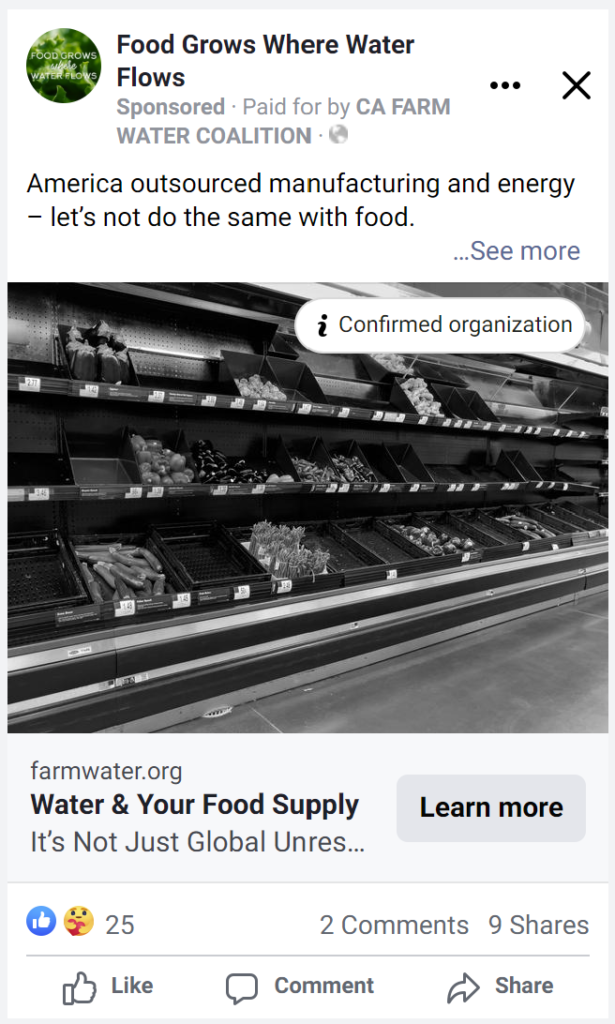
In a campaign aimed at publicizing the threat to the nation’s food supply, the California Farm Water Coalition partnered with the Family Farm Alliance and Klamath Water Users Association to show consumers how water policies are contributing to food shortages and rising prices.

Beginning April 2 with a full page ad in the Wall Street Journal, the campaign progressed over the summer with paid social media posts aimed at consumers aged 18 to 44. Ads were written to inform readers that food supplies are at risk and that prices are expected to rise, which they did- to record levels.

Readers were also encouraged to click a link to learn more at a special landing page on the CFWC web site with information on the connection between water and food security. https://www.farmwater.org/food-security-and-water/

To date, the campaign has generated over 7 million impressions with almost 210,000 people clicking the link to visit the web site where major points with supporting information included:

By refusing to recognize the importance of a safe, affordable food supply and restore balance to their water policies, bureaucrats are endangering America’s food supply chain.

Western agriculture cannot simply be moved elsewhere. The unique combination of climate, soil, and other factors give it the ability to provide a diverse array of crops in quantities that cannot be replicated in other regions.

Current water policy is creating deserts where food used to be grown, which helps perpetuate the cycle of drought and wildfires, and makes climate change worse. Irrigated farmland helps slow the effects of climate change.

We can do something about it. We must move quickly to build new infrastructure that has been funded at both the federal and state levels to capture additional water in wet years to make available during the next drought.

“This campaign has been a huge success by helping drive the public discussion on the risk to our nation’s food supply through policies that deny water to our farms,” said CFWC Executive Director Mike Wade. “We will continue hitting this issue through the election and beyond, with the goal of holding elected officials and government appointees accountable for their actions.”


Today’s World is Full of Uncertainties. Your Food Supply Shouldn’t be One of Them

Today’s World is Full of Uncertainties. Your Food Supply Shouldn’t be One of Them


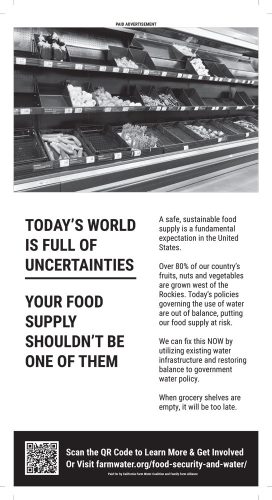
Our ad in the 4/2/22 Wall Street Journal

The war in Ukraine and all the global unrest it is causing has focused American’s attention on just how uncertain a world we inhabit.

Inflation was already wreaking havoc on family budgets and now gas prices are also skyrocketing.

Which is exactly why our government should be doing everything it can to reduce reliance on foreign sources for our basic needs, especially food.

Unfortunately, that is the exact opposite of what is happening.

Through out-of-balance regulatory policies and a failure to prioritize western farming, our government is putting our safe, affordable, domestic food supply at risk.

Over 80% of our country’s fruits, nuts and vegetables are grown west of the Rockies and simply cannot be moved elsewhere. Without that supply, Americans will see shortages at the store, even higher prices, be forced to rely more heavily on increasingly unstable foreign sources, or all of these at the same time.

Learn More

When you make a salad, have fruit for breakfast, eat a hamburger with cheese, or put tomato sauce and garlic on a pizza, odds are that at least some of those products came from California.

But without a reliable water supply, that farmland simply cannot produce what our country needs.

It doesn’t have to be this way.

In some western states, the government is holding on to existing water supply, rather than release it to farms to grow food. In California, we must move more quickly to build and repair infrastructure that will help us store more water in wet years for use in dry ones like this one. And in general, water policy has become unbalanced in ways that penalize the farms trying to produce our food supply.

Farmland without a water supply increases the risk to our food supply.

California farmers are doing their part and have reduced water use by double digits since 1980. Throughout the West, farms are also important in the battle against climate change because crop production helps remove carbon dioxide from the air. If things continue the way they are, our government is essentially creating deserts instead of food production, which will only perpetuate the cycles of drought and wildfires we’d like to avoid.

Food price increases in 2022 are now expected to exceed those observed in 2020 and 2021. Without changes in water policy, it will continue to get worse.

It has never been more important that U.S. consumers insist on domestically grown food in our stores.

Learn More

Exceptional drought hit Central Valley California, threaten national food security and global food chain at large

CFWC Executive Director, Mike Wade, appeared on China Central Television (CCTV) recently to talk about California’s drought and the need for further investments in California’s water supply infrastructure. Also appearing in the story were San Joaquin Valley farmer, Joe Del Bosque,, Almond Board of California President and CEO, Richard Waycott, and Caitlin Boyer of the Department of Water Resources. A transcript of the voice-over is below. Images and video clips from the story are here: https://bit.ly/3D4k7Y0

VO:Recently, the western region of the United States has experienced continuous high temperature and dry weather. California, located in the western United States, is an important agricultural state, where the production of various crops accounts for an important proportion in the United States and even the world. The continued high temperature and drought this summer have brought severe challenges to local agriculture. Recently, a CCTV reporter visited farms in central California. 

VO:Joe Del Bosque’s farm is located in Joaquin County, California’s central valley. This farm was founded in 1985 and now has 2,000 acres (about 810 hectares) of land. Due to the continuous high temperature and dry weather and the shortage of agricultural irrigation water, the planting situation here is quite bleak this year, and many vast fields are left fallow. Joe’s farm is often able to grow at least five crops every planting season, but due to the severe high temperature and dry weather this year and the lack of water storage the previous year, he only planted three crops this year: melons, almonds and cherries. 

VO: Due to factors such as uncontrollable natural precipitation and insufficient popularity of rainwater harvesting technology, agricultural planting in California generally relies on the snow pack of northern mountains, and in the coming year, the agricultural irrigation water is obtained according to the advance allocation. 

Standup: Due to the continuous reduction of water storage in the upstream reservoir, the water level of the canal called St. Louis, which is mainly used for agricultural irrigation, has been below the safety line, and eventually the diversion canal that flows to the farmland is also seriously short of water. 

Standup:As indicated on the farm side sign, no water means no job, as is the case with Joe’s farm, which has suffered from a shortage of water for agricultural irrigation due to extreme heat and drought this year. The number of workers can only be one-third to one-half of previous years, which has caused many people to lose their jobs. 

VO: We drove about 50 kilometers north to the St. Louis Reservoir, which provided water for Joe’s farm. This is the largest reservoir in the United States that has no tributaries and is completely converged by artificial water pipelines, providing agricultural water for thousands of farms in central and southern California and other downstream areas. 

VO:We can see the dire situation California agriculture is facing this year in a chart that records the annual water storage capacity of the St. Louis Reservoir, which is only 47% full. With less than half of the water in the reservoir, many farms are left to find their own solution. 

VO:Almonds are one of the representative crops of California agriculture. The annual output of California almonds accounts for 80% of the world’s total. The California Almond Association has been established for more than 70 years and has been helping growers better connect with the market and sell their products to worldwide. Association CEO Richard said California agriculture, which has a long tradition, has faced unprecedented difficulties this year. 

VO:In addition, because the continuation of the new crown epidemic has brought severe challenges to global logistics, for agricultural products, the value of agricultural products accumulated in warehouses or in containers at port terminals can only be depreciated again and again. The impact is particularly severe for crops such as California almonds, which are exported in large quantities. 

VO:The 2022 drought will cost the U.S. economy more than $3 billion, according to the California Agricultural Water Alliance. The inflationary pressure brought by the tight global supply chain to various countries is also directly reflected in all aspects of agricultural production. Transportation and packaging costs are increasing, which will eventually be passed on to consumers, allowing consumers to directly feel the price increase. 

Abandoning Established Water Law Does Nothing to Produce or Save One Drop of Water and Puts Our Food Supply at Risk

Abandoning Established Water Law Does Nothing to Produce or Save One Drop of Water and Puts Our Food Supply at Risk

In times of crisis, drastic measures born out of panic almost always make things worse, and the same applies to dealing with California’s current drought.

There is no doubt that people, farms, our communities, and the environment are suffering. And there is a theory being floated among the state’s water bureaucracy that if we abandon our long-established system of water rights, our problems will be solved.

They won’t. Water rights are not the cause of California’s changing weather patterns and neither discarding this long-established law, nor fighting the legal battles that would result from trying to do so, will move, store, or create one drop of water. 

Water rights provide stability during dry times

Water rights, a form of property rights, lend some predictability to water users in times of scarcity. Cities, businesses, farms, and rural communities all need some idea of available supply during a drought in order to plan and adjust.

In addition, it’s important to understand that even under existing water rights, regulators have sufficient flexibility to alter water deliveries in critical situations. In 2021 and 2022 those powers were used to make drastic cuts to most farms and some cities, with many farms receiving none of their normal allocation.

A safe food supply is a matter of national security

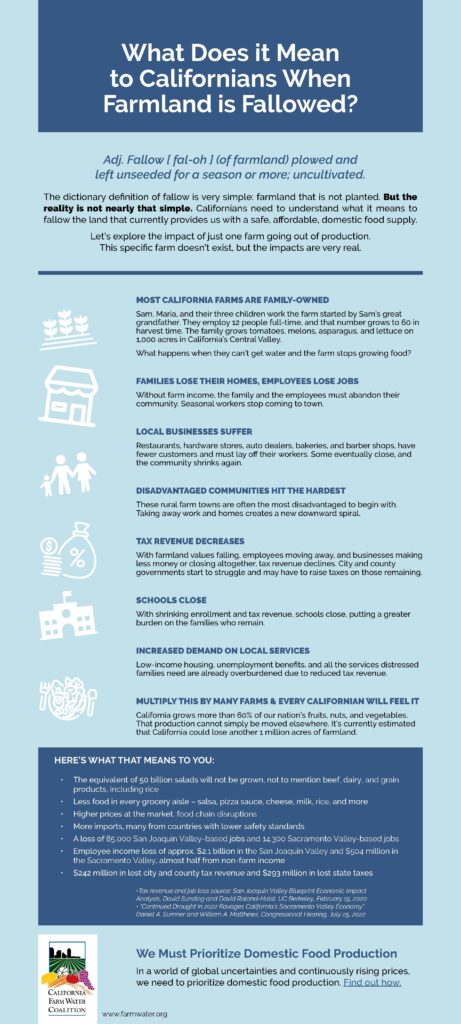
Under the state constitution, all water, no matter the rights attached to it, must be put to “beneficial use.” We argue that maintaining a healthy, abundant, and safe food supply is also a matter of national security. Sixty percent of our nation’s fruits, nuts and vegetables come from California and that production cannot simply be moved to other states. If we abandon California farms, we’re accepting food shortages, higher prices, and more imports from foreign countries, many with significantly lower safety standards. To put it in perspective, for every acre that is left unplanted because of a lack of irrigation water, it is the equivalent of 50,000 salads that would not be available to consumers.

And while most calls to eliminate water rights are aimed at farmers, upending the system would impact all Californians.

Some of the most senior water rights holders are water agencies in major metropolitan areas such as San Francisco and other Bay Area cities serving more than 1.8 million Californians.

We can store more water in wet years without harm

The inconvenient truth for all Californians is that our state has not moved quickly enough to deal with the impacts of climate change. For some time, climate scientists have been telling us that precipitation in the form of rain instead of snow is the new normal. That means we must build additional storage for both above and below ground water in order to capture water when Mother Nature delivers it. A recent policy brief by the Public Policy Institute of California (PPIC) echoed the need for more storage saying, “. . .it is possible to do a better job of storing water during wet years—both above and below ground—without doing harm.”

The kind of projects needed include new or expanded reservoirs that can serve as environmentally-friendly water storage. New canals and pipelines would help distribute floodwater to areas in California’s Central Valley and also help recharge groundwater basins. PPIC estimates increasing storage could allow us to capture between 400,000 and 800,000 acre-feet of water each year, enough to serve hundreds of thousands of homes for a year or grow literally millions of salads.

There is money to pay for projects right now

And we have the money to do this. The federal government passed a huge infrastructure bill last year and California’s government currently has a $100 billion surplus.

Difficult times call for balanced, collaborative solutions, not drastic measures like upending water rights, which solves nothing and could make things worse for all Californians.