News Line – November 24, 2014

News Line – November 24, 2014

Read the latest news about issues affecting agriculture and farm water in California.

No Coalition Responses Today

   Other News

Water Bond

From: J. Coleman & K. Tiegs, Sacramento Bee

For California water managers, 2014 has been one for the record books. Reservoirs have dropped to near-record lows, surface water deliveries have been slashed and some communities are rationing water to keep supplies in reserve for next year.But amid these challenging conditions, California voters opened the door for long-term solutions when they passed Proposition 1 on Nov. 4. The $7.5 billion bond measure provides a much-needed infusion of funding for water projects and programs at a pivotal time in California.

From: Barton Thompson, San Francisco Chronicle

On Nov. 4, Californians overwhelmingly approved Proposition 1, California’s $7.5 billion water bond. Its passage was never really in doubt: Enduring a third year of drought, Californians found solace in Prop. 1’s promise of new storage facilities, conservation, recycled water, desalination and general drought preparedness. Whether Prop. 1 delivers on its promise, however, depends on what happens next.One danger is that Prop. 1 will lull Californians into believing that we have solved our water troubles. We haven’t. Nothing that Prop. 1 can do will redress the current drought. Even in the longer run, Prop. 1 is only a part of the solution to California’s water challenges.

Water Supply

From: Carolyn Lochead, San Francisco Chronicle

Sen. Dianne Feinstein’s abrupt decision to yank a water bill she had spent more than four months negotiating came just as the California Democrat and Central Valley Republicans appeared on the brink of a deal.The surprise climax shocked Republicans, avoided a potentially embarrassing split between Feinstein and her fellow California Democratic senator, Barbara Boxer, and proved a rare retreat by a veteran lawmaker famous for her deal making and persistence.

From: Al Smith, Fresno Bee

The news that U.S. Sen. Dianne Feinstein, D-Calif., has withdrawn from discussions regarding drought-fighting legislation is a bitter pill for our community to swallow. Despite good intentions, her departure leaves dozens of California communities without a solution to the crippling drought that has devastated our region.Although policymakers say they will take up the issue next year, that simply starts another clock ticking, and is not a guarantee that anything will be accomplished. Our communities have already gone too long without solutions. We call on our elected officials to come together and craft a legislative solution to the water predicament, before Congress adjourns in December.

From: Staff, Fresno Business Hub

Senator Feinstein’s recent decision to delay the drought legislation until 2015 is devastating news to local communities and businesses in light of the economic hardship that is occurring due to the zero water allocation. This press conference will be held to provide an opportunity for those most impacted by this situation to speak to the harm that is occurring.

Salton Sea

From: Staff, Imperial Valley Press

This iteration of the Imperial Irrigation District Board of Directors hasn’t been without its share of criticism, from us and others. At times, its actions can come off as aggressive, even confrontational and a little lone-wolfish.


But make no mistake, the board also operates from a position of cohesion, strong-willed and assertive when it feels it is right. The board members are very united, and they believe the Valley comes first above all else, and they are not afraid to show it.

From: Staff, Associated PressThe Imperial Irrigation District has asked the state water board to intervene to help prevent further deterioration of the Salton Sea.The Los Angeles Times reported in Saturday’s edition that district officials want the state to meet its obligation to provide water for the shrinking lake. They sent a plea to officials at the State Water Resources Control Board this week to help avert a “looming environmental and public health crisis.”

From: Tony Perry, Los Angeles Times

The Imperial Irrigation District has sent a plea to a state water board to help avert a “looming environmental and public health crisis” at the Salton Sea.In a letter this week to officials at the State Water Resources Control Board, the irrigation district asked that the board sponsor negotiations to get the state to fulfill its obligation to stop the deterioration of the sea caused by the sale of Imperial Valley water to San Diego County.

Food News

From: David Pierson, Los Angeles Times

The gnarled zinfandel grapevines on Rich Czapleski’s land have borne fruit for more than 100 years, producing dark, intense wines that exemplify the special growing conditions in this coveted winemaking region..Over that time, the vines have weathered some of California’s worst droughts – including the last three years with little difficulty.

News Line – November 21, 2014

News Line – November 21, 2014

Read the latest news about issues affecting agriculture and farm water in California.

No Coalition Responses Today

   Other News

Water Supply

From: Michael Doyle, McClatchy DC

Democratic Sen. Dianne Feinstein of California on Thursday pulled the plug on secret, high-stakes negotiations over a water bill for her drought-plagued state, saying she and fellow lawmakers will try again next year.

Feinstein’s unexpected move ends, for now, what had become an increasingly contentious fight over ambitious drought-fighting legislation whose details few people have seen.

From: Kevin Freking, Associated Press

Sen. Dianne Feinstein said Thursday that congressional efforts to provide drought relief to Central Valley farmers and communities are dead for the year. She vowed to try again in 2015, but the outcome could be even less certain because Republicans will control both houses of Congress after they retook the Senate in this month’s midterm elections.

“Although we have made progress, it has become clear that we will be unable to present an agreed-upon proposal before Congress adjourns this year,” Feinstein said in a statement.

From: Kitty Felde, KPCC

After months of secret negotiations and without a single public hearing, a bill that would have built dams and reservoirs in California – and rolled back environmental laws – has been shelved. At least for now.

California’s record drought prompted both the House and Senate to pass their own version of water bills. The House version – cosponsored by the entire CA GOP delegation – would roll back environmental protections and rewrite water contracts.

From: Allison Floyd, Growing Georgia

A drought in California could lead farmers in the Southeast to consider new crops, a Georgia horticulturalist says.”Some of the larger vegetable growers in Georgia, particularly eastern Georgia, are being asked by their buyers to diversify,” said Tim Coolong, a vegetable specialist with the Extension Service. “The primary driver is concerns over water in California.”

Drought

From: Cary Blake, Western Farm Press

All California farmers and water districts want for Christmas this year is a slow, rainy winter – with perhaps a timely rain tucked in the stocking hanging from the fireplace.While the winter rain scenario will be determined in the weeks and months ahead, three California agricultural water leaders have plenty to say about the California drought, and how the lack of moisture from the sky and regulator intervention on the environment have placed farmers in financially perilous situations.


News Line – November 20, 2014

News Line – November 20, 2014

Read the latest news about issues affecting agriculture and farm water in California.

No Coalition Responses Today

   Other News

Water Supply

From: Staff, Los Angeles Times

California made extraordinary progress on water policy in this severe drought year, largely under the guiding hand of Gov. Jerry Brown. The governor’s master stroke was to initiate the conversation and then back away, allowing various interests – agribusiness, urban areas, environmentalists, people who favored building tunnels to move water from north to south, people who vigorously opposed them – to fight it out.

From: Staff, Sacramento BeeSen. Dianne Feinstein and House Republicans have been secretly negotiating drought relief legislation that could severely alter California water policy. She should know better.Any legislation on the topic of water would have far-reaching implications, and ought to receive a full public airing before a congressional vote.

From: Tom Philpott, MotherJones.comSen. Dianne Feinstein (D-Calif.) is negotiating a behind-closed-doors deal with Republican lawmakers to pass a bill that would ostensibly address California’s drought-an effort that has uncorked a flood of criticism from environmental circles.Feinstein’s quiet push for a compromise drought bill that’s palatable to Big Ag-aligned House Republicans has been in the works for six months, Kate Poole, a senior attorney with the Natural Resources Defense Council, told me. And it has accelerated recently, as the Senator hopes to pass it by year end, during the “lame duck” period of the outgoing Democratic-controlled Senate.

Water Storage

From: J. Lund, A. Taghavi, M. Hall, A. Saracino, & L. Winternitz, UC Davis Watershed Sciences & Bechtel FoundationCalifornia’s approval of a $7.5 billion water bond has bolstered prospects for expanding reservoirs and groundwater storage, but the drought-prone state can effectively use no more than a 15 percent increase in surface water storage capacity because of lack of water to fill it, according to a new analysis released Nov. 20.The report by water engineers and scientists with the University of California, Davis, The Nature Conservancy and three prominent water consultants, said California could potentially use up to 6 million acre-feet in combined additional surface and groundwater storage – about a third more capacity than Shasta Reservoir. Exceeding this expansion runs into limits of available precipitation and the ability to transport water.

Water Transfers

From: J.N. Sbranti, Modesto Bee

A briefing of the Stanislaus County Water Advisory Committee on the state’s proposals to reduce river diversions for agriculture quickly turned into a pointed discussion about Oakdale Irrigation District’s determination to pump groundwater for its farmers while selling surface water to agencies outside the region.

Food News

From: H. Miller & R. Cornett, Forbes“Sustainable” has become a buzzword that is applicable not only to agriculture and energy production but to sectors as far afield as the building and textile industries. Some universities offer courses or even degrees in “sustainability.” Many large companies tout the concept and boast a sustainability department, and the United Nations has hundreds of projects concerned with sustainability throughout its many agencies and programs.But as with many vague, feel-good concepts-“natural” and “locavorism” come to mind-it contains more than a little sophistry. For example, sustainability in agriculture is often linked to organic food production, whose advocates tout it as a “sustainable” way to feed the planet’s expanding population.

California groundwater pumping impacts preventable

CBS News recently focused on the impacts of groundwater pumping in California, but the causes were avoidable. Improving the reliability of surface water to avoid extracting groundwater from aquifers was a primary goal of California’s water projects. The reality is, California groundwater overdraft impacts were preventable.

We applaud 60 Minutes for discussing the important issue of groundwater depletion. However, the report missed a very important factor relative to California – the amount of water taken from food production to prop up failing environmental policies. Thanks to the Endangered Species Act over a million acre-feet of water per year that was once used to grow food now flows to the Pacific Ocean with no measurable environmental benefit. For some it has been a 20-year drought brought on by misguided environmental regulations. Failed government policies are having the effect of making farmers MORE dependent on groundwater rather than less. It’s not surprising that they’re pumping groundwater to stay in business. The same thing happened a century ago and it was the federal and State water projects that put a halt to groundwater overdraft by providing plentiful surface water supplies. Many farmers today no longer have the reliable water supplies that were once delivered by these projects. That will ultimately affect consumers with fewer choices and higher prices at the grocery store.

There might be a tradeoff if vulnerable fish species were recovering but they’re not. That’s because the real causes of fish death aren’t being addressed, such as overfishing, invasive species and undertreated wastewater discharges into California’s largest estuary, the Sacramento-San Joaquin Delta. Instead federal environmental water managers are treating the problem by dumping more and more water into a system that isn’t responding because it’s the wrong solution. Agricultural and urban water suppliers are required to complete efficient water management plans to assure that water is being used as efficiently as possible. It’s time that environmental water managers do the same.

News Line – November 19, 2014

No Coalition Responses Today

   Other News

Water Supply

From: M. Doyle & M. Grossi, Fresno Bee

California’s water future is boiling below the surface this week.Only the chosen few have a clue about details. Bill documents, currently about 50 pages, are stamped “confidential draft language, do not distribute.” Capitol Hill doors are shut, congressional timetables are opaque and negotiators are strictly mum.

From: Staff, Merced Sun-Star

In September, when the Sun-Star’s editorial board asked Jeff Denham about the secret drought-relief negotiations going on in Congress, he objected, saying they weren’t secret at all. Not secret? Then they must be “top secret.”The only people who know the details around negotiations going on this week are those in the room – including people no one has elected. Westlands Water District general manager Tom Birmingham is said to be at the table, as are representatives of the vast Metropolitan Water District.

Water Transfers

From: J.N. Sbranti, Modesto Bee 

The Oakdale Irrigation District plans to sell $3.9 million worth of water to out-of-area buyers in 2015, has begun negotiating potential sales, and is considering offering local farmers financial incentives to fallow their land so additional irrigation water can be marketed to others.


“These water transfers are necessary to the district meetings its goals,” OID General Manager Steve Knell told his district’s board of directors Tuesday. “Funding for our capital (infrastructure) projects comes from water transfers.”

Salton Sea

From: Chris Nichols, San Diego Union-TribuneImperial Valley water officials on Tuesday urged the state to help “avert an emerging environmental and public health crisis at the Salton Sea,” or otherwise consider restricting a massive water transfer deal that benefits San Diego.

In a formal petition to the California Water Resources Control Board, the Imperial Irrigation District said the state has not lived up to its obligations to restore the inland lake, which straddles Imperial and Riverside counties.

From: Antoine Abou-Diwan, Imperial Valley Press

The Imperial Irrigation District is calling on the state of California to live up to its commitment to restore the ailing Salton Sea as, IID officials say, a public health threat looms on the horizon.

“Today, the Imperial Irrigation District submitted a petition to the State Water Resources Control Board to enforce the Quantification Settlement Agreement in its entirety by holding the state to what the IID board believes is its statutory obligation to select, fund and implement a restoration plan for the Salton Sea,” said IID Board President Jim Hanks, addressing the public at Tuesday’s board meeting.

Clean Water Act

From: Chris Adams, McClatchy DC 

The administrator of the U.S. Environmental Protection Agency was taken aback by parts of the response to a proposed clean-water rule that has riled agriculture interests nationwide.In a wide-ranging Monday morning roundtable discussion sponsored by The Christian Science Monitor, EPA Administrator Gina McCarthy said she expected some of the push-back on what is known as the “Waters of the United States” proposal. But not all of it.

From: Staff, EPA

The U.S. Environmental Protection Agency today announced a settlement with Edward Lynn Brown, a canned food and nut wholesaler in Modesto, Calif. for destroying nearly 33 acres of wetlands, known as vernal pools, north of Merced, Calif. The settlement requires Brown to pay a $160,000 penalty and purchase and endow a conservation easement valued at $1 million.”California’s vernal pools are key to the survival of native plants and animals found nowhere else on the planet,” said Jared Blumenfeld, EPA’s Regional Administrator for the Pacific Southwest. “In a time of drought and climate change, it is more important than ever to protect these endangered habitats from irreversible destruction.”

Drought

From: Mark Hume, Globe and Mail

When California Governor Jerry Brown declared a statewide emergency in January, there was hope water conservation and increased pumping from aquifers could blunt the impact of a withering drought.Now, as the driest year in the state’s history is coming to a close, the aquifers are so overdrawn there are concerns about long-term damage – and the National Weather Service is predicting a fourth year of drought.

News Line – November 18, 2014

Groundwater

From: Lesley Stahl, CBS News

It’s been said that the wars of the 21st century may well be fought over water. The Earth’s population has more than doubled over the last 50 years and the demand for fresh water — to drink and to grow food — has surged along with it. But sources of water like rainfall, rivers, streams, reservoirs, certainly haven’t doubled. So where is all that extra water coming from? More and more, it’s being pumped out of the ground.
Coalition response… We applaud 60 Minutes for discussing the important issue of groundwater depletion. However, the report missed a very important factor relative to California – the amount of water taken from food production to prop up failing environmental policies. Thanks to the Endangered Species Act over a million acre-feet of water per year that was once used to grow food now flows to the Pacific Ocean with no measurable environmental benefit. For some it has been a 20-year drought brought on by misguided environmental regulations. Failed government policies are having the effect of making farmers MORE dependent on groundwater rather than less. It’s not surprising that they’re pumping groundwater to stay in business. The same thing happened a century ago and it was the federal and State water projects that put a halt to groundwater overdraft by providing plentiful surface water supplies. Many farmers today no longer have the reliable water supplies that were once delivered by these projects. That will ultimately affect consumers with fewer choices and higher prices at the grocery store.There might be a tradeoff if vulnerable fish species were recovering but they’re not. That’s because the real causes of fish death aren’t being addressed, such as overfishing, invasive species and undertreated wastewater discharges into California’s largest estuary, the Sacramento-San Joaquin Delta. Instead federal environmental water managers are treating the problem by dumping more and more water into a system that isn’t responding because it’s the wrong solution. Agricultural and urban water suppliers are required to complete efficient water management plans to assure that water is being used as efficiently as possible. It’s time that environmental water managers do the same.

Other News

Water Supply

From: Bob Egelko, San Francisco Chronicle

The U.S. Supreme Court on Monday allowed environmentalists to challenge the government’s renewal of 41 long-term contracts for irrigation water from the Sacramento-San Joaquin Delta, in a lawsuit seeking greater protection for the endangered delta smelt.Water districts had asked the justices to review a ruling in April by a federal appeals court in San Francisco. That ruling reinstated a suit by the Natural Resources Defense Council and other groups claiming the U.S. Bureau of Reclamation should have consulted with government biologists before renewing contracts with farms and water districts for as long as 40 years. The justices denied the districts’ request on Monday.

Drought

From: Matthew Green, KQED

Despite a few recent downpours, California remains stuck in one of the most severe statewide droughts on record.But it’s far from just California’s problem. The state produces a huge percentage of the nation’s agriculture – nearly half of all fruits, vegetables and nuts, by some estimates. And that requires a massive amount of water: farms here use about 80 percent of the state’s developed water supply.

From: Reed Fujii, Stockton Record

California’s almond crop is smaller than expected, hurt by the state’s ongoing drought, while the predictions of a record walnut harvest seems to be coming true, industry experts said.But in both cases, laws of supply and demand, and in particular shifts in global market conditions, have led to softening prices. Almonds and walnuts are San Joaquin County’s top two cash crops, together valued at more than $900 million in 2013. Both are heavily exported.

Groundwater

From: Angela Greenwood, KGPE

A “60 Minutes” piece is drawing some sharp criticism from parts of the local agriculture community. The 13-minute report detailed issues with groundwater and how quickly it’s drying up.  It focused largely on the Central Valley and the surge in well drilling, but some are taking issue with the report.

The 60 Minutes report titled ‘Water’ aired Sunday night highlighting critical water issues around the country, the world and most specifically right here in the Central Valley. Fresno County based well driller Steve Arthur was among those interviewed for the piece but when he watched it on TV,  he says he wasn’t very happy.

From: Denise Robbins, Media Matters For America

A 60 Minutes report on groundwater depletion brought attention to a critical issue that many regard as a national security threat, but failed to mention the inherent connection between water scarcity and climate change.The November 16 edition of 60 Minutes featured a segment on the threat of groundwater scarcity titled “Depleting the Water.” In it, host Leslie Stahl covered the severe droughts around the world that are leading people to extract fresh water from the ground at unsustainable rates, warning that “the wars of the 21st century may well be fought over water.”

Bay Delta Conservation Plan

From: Scott Smith, Associated Press

A huge conservation project that includes building two massive tunnels to carry water to California farms and communities can only be funded if local water agencies agree to make fixed payments – even during dry periods when deliveries are reduced, state officials said Friday.The information was provided as the state treasurer’s office released a financing plan for the proposed Bay Delta Conservation Project. The treasurer’s independent study offered no opinion on whether the project should be built but said the tunnels would only be feasible if water agencies adopted set annual payments.

From: Sharon Bernstein, Reuters

California farmers would pay more to irrigate their crops under a proposal to build tunnels under the San Joaquin-Sacramento River Delta to funnel water to the state’s agricultural breadbasket, officials said on Friday.The analysis released by state Treasurer Bill Lockyer said regional water suppliers and the farmers who purchase water from them would be able to handle the increased costs, even though the price of water could more than double once the price of paying for the project is included.

From: David Bienick, KCRA

Customers of California’s proposed twin-tunnel water project would have to make billions of dollars in fixed payments each year, even during dry periods when water levels run low, state officials said Friday. The information was provided as the state treasurer’s office released a financing plan for the $25 billion Bay Delta Conservation Project and said it would only be feasible if water agencies adopted a set yearly payment plan.”The conclusion that we reached is that it’s affordable, both on the agricultural side and on what’s called the municipal and industrial side,” said Tim Gage, one of the consultants hired to conduct the study.

From: Staff, KXTV
Everyone from Silicon Valley to Southern California, and farmers in between, depend on water from the San Joaquin Delta. The proposal for two enormous tunnels through the San Joaquin Delta may be the next big water war in California.Gov. Jerry Brown’s plan is to build two tunnels that are 40 feet wide and 30 miles long to carry Sacramento River water to Southern California. Barbara Barrigan-Parrilla, executive director of the Restore the Delta coalition, opposes the plan.

From: Peter Fimrite, San Francisco Chronicle
California’s plan to build tunnels and siphon huge amounts of water from the delta will jack up costs for water users, including 3 million Bay Area residents, but farmers will be hit the hardest, according to a financial analysis released Friday.The report, by state Treasurer Bill Lockyer, says costs could double for some water customers if the Bay Delta Conservation Plan goes through, but it concludes that the overall $25 billion price tag is “within the range of urban and agricultural users’ capacity to pay.”

Fisheries

From: Sharon Bernstein, Reuters

The annual fall migration of Chinook salmon has been delayed by warmer water temperatures and slow-flowing streams in parts of California as the state’s three-year drought drags on, hatchery officials said Monday.Cool November temperatures usually bring thousands of adult salmon from the Pacific Ocean into streams and rivers to spawn. But this year, fish have been slow to migrate up the American River to the state’s hatchery near Sacramento, said William Cox, manager of the fish production and distribution program at the California Department of Fish and Wildlife.

Farming News

From: David Willis, BBC

I have a neighbour, Deborah, and ever since I’ve lived here, her front lawn has been luxuriant and green. But wandering by the other day I did a double take. Mounds of earth were piled up where the grass had once been, and an army of workmen had set about installing succulent plants and ground cover, and the kind of prickly cactus you normally see in children’s cartoons.

By the time Deborah had finished explaining why she was doing it, I could hardly believe I hadn’t done the same thing myself.

From: Alex Breitler, Stockton Record

In the very place where the verdant Valley meets the dry, rolling foothills, longtime farmer Kenny Watkins climbed out of his truck one morning last week to examine an orchard of peach trees planted just last February.

The trees are already taller than the farmer. “It’s virgin ground,” Watkins said. “Just unbelievable.” During this drought, much has been written about the rapid conversion of vegetable row crops to more profitable fruit and nut orchards, given California’s tenuous water supply.

Westlands Water District: Straight Talk About Agriculture, Saving Water and Drainage

The Los Angeles Times recently published an intensely critical article about  Westlands Water District, which recited many of the false, misleading, or outdated claims made by some of its critics over the years. The Times’ editors refused to print an Op-Ed that the District offered in response. As a result the District has taken out a full-page advertisement in the Times to provide readers with a better understanding of the issues facing Westlands and how they are addressing them.


Statement from Don Peracchi, President of Westlands Water District

As the largest public irrigation district in the United States, Westlands Water District draws a lot of attention as well as the criticism that sometimes comes with its successes. This year, one of its most persistent critics, George Miller, is retiring after 40 years in Congress, and to mark the occasion, the Times’ recently unpacked a trunkload of his oft-repeated complaints and concerns about the District.

Some parts of this catalog identify serious issues that were long ago resolved. Others involve legitimate problems which we are still trying to address. And, like many things involving California water, a few are pure, political invention.

The article’s fundamental charge is that Westlands is simply “in the wrong place.” One might make the same complaint about dredging natural marshes in California’s Delta to grow crops in the middle of a saline estuary. Or attack the folly of installing vast farms on the desert lands of the Coachella and Imperial valleys. Or stranger still, decry building a great city on the arid plain where Los Angeles now stands. The point is, these endeavors and dozens more helped to create the prosperity of California by linking our communities together with a modern water system.

The reality is that Westlands is in the ideal place. Indeed, the Central Valley of California occupies the only Mediterranean climate in North America. Weather conditions, rich soils, and the arrival of water in the mid-1960s, have transformed the area into the most productive farming region in America. The communities that have grown there as a result, the thousands of businesses and tens of thousands of people whose livelihoods depend upon agricultural productivity, are not “in the wrong place.” They are at home.

The most persistent criticism of Westlands’ role in this transformation has to do with the influence of “corporate agriculture.” That may remain a concern for some parts of California, but not in Westlands or any of the other farming region served by the federal Central Valley Project. When Westlands was created in 1952, major industrial interests, including Standard Oil of California and Southern Pacific Railroad, did indeed own large tracts of land within its water service area.

But that ended in 1982 with the passage of Congressman Miller’s Reclamation Reform Act. That act redefined the qualifications for receiving water from a federal reclamation project; as a result, large corporate entities sold out, the large tracts were broken up, and today in Westlands there are nearly 2,250 landowners and the average farm size is 710 acres.  “Corporate agriculture” has lost its meaning. Any corporate structure for today’s family farmers in Westlands is likely to have a mom as its vice president and her child as its treasurer.

Water use remains a constant concern for our farmers. That’s why farmers in Westlands have invested more than $1 billion in water saving techniques and technology. Indeed, even Westlands’ harshest critics have acknowledged that the men and women who today farm in Westlands are among the most efficient users of irrigation water in the world. Westlands is a leader in water conservation, and agricultural experts from all over the world come to the District to learn how its farmers are able to accomplish so much with the limited, and often uncertain, water supplies they have to work with.

Our interest in water use efficiency has become even more important in the 22 years since Congressman Miller’s Central Valley Project Improvement Act, and a host of new regulatory restrictions redirected more than a third of the water that cities and farms used to receive from the federal project, dedicating it instead to serve a wide range of new environmental purposes. Today, on an annual basis, the federal project manages more than 1.5 million acre-feet of water for fishery flow, waterfowl habitat, to protect listed species, and other environmental uses.

In hopes of restoring reliability to the water system as a whole, Westlands is working with the Metropolitan Water District of Southern California and other public water agencies throughout the state to support Governor Brown’s Bay Delta Conservation Plan.

Drainage was a major issue on the westside of the San Joaquin Valley for decades before Westlands’ creation. That is why when Congress authorized the construction of the San Luis Unit of the Central Valley Project, it mandated that the Bureau of Reclamation provide Westlands with both a water supply and a drainage system. Initially federal officials planned to dispose of the drain water in the Delta. But Congress stopped that project when the drain being built by Reclamation reached Kesterson, and it was Washington as well that decided to designate this new terminus for agricultural waste as a wildlife refuge.

The resulting biological catastrophe should have been predictable. In the years since, the drainage system in Westlands has been plugged, and not a drop of drain water has left Westlands after 1986. Instead, Westlands has helped to fund the development of new methods for recycling drain water. And it has taken nearly 100,000 acres of the most vulnerable farmland out of production. Some of those lands are being converted to solar power development, with the support of numerous environmental organizations.

The drainage problem, however, persists. Federal courts, including the Ninth Circuit Court of Appeals, have repeatedly ordered that federal officials fulfill their obligation to provide drainage. But even though Westlands farmers pay every year for drainage service, the government has done nothing to resolve the problem in Westlands. And the government is facing a mandatory injunction, which it estimates will cost more than $2.7 billion to satisfy.

To avoid that cost, the government approached Westlands to assume the responsibility to manage drainage water within its boundaries. In addition, Westlands would compensate those landowners who have been damaged by the government’s failure to act. As part of a settlement, which is not yet final, Westlands would receive some financial consideration, albeit significantly less than the cost of performing the obligations that Westlands would assume. But there is nothing secret about either the negotiations or the proposed settlement. In fact, federal officials and Westlands have briefed interested Members of Congress and non-governmental organizations on the proposal. And there is no process that is more public than the process that federal officials and Westlands will have to pursue to obtain the congressional authorization needed to implement the proposed settlement.

We remain hopeful that these ideas can still form the basis for a long-term resolution of the drainage debate. This would put an end to more than fifty years of litigation, relieve the federal taxpayers of a substantial obligation, and enable us to move forward with an environmentally sustainable approach to the problem.

Whether that happy outcome would also put an end to the criticism of Westlands, however, is not for us to say.

Don Peracchi was born in Fresno, California to second generation Northern Italian immigrants. His family has lived and worked in Central California over 100 years. He has been farming since 1982 alongside his wife, two sons and daughter in Westlands. He has been involved in career-related board positions including banking, insurance, agriculture and water. He currently is the Board President of Westlands Water District.

Farming accounts for 40.8% of state’s water demand

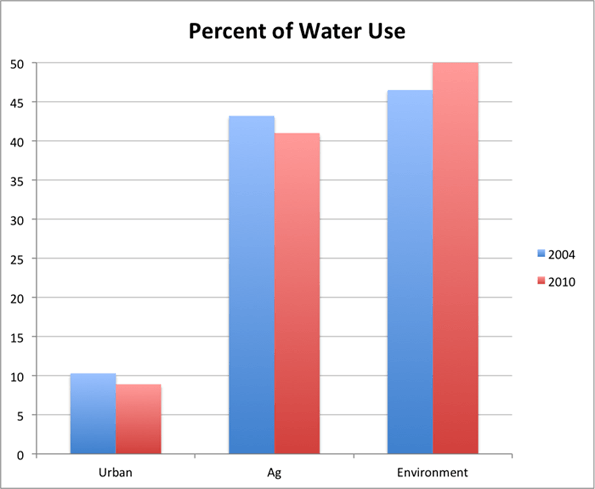
Farms account for 40.8 percent of California’s water demand according to the California Water Plan (Bulletin 160-13). Farmers are often mischaracterized as using 80 percent of the state’s water supply, but that’s simply not true, based off of numbers published by the California Department of Water Resources (DWR).

The largest water user in California is the environment, using 50% of developed supply. The amount of water dedicated to environmental purposes is on the rise and continues to be the largest water user in the state. At the same time, water going to farms and to meet domestic needs has declined over the past decade.

Statewide Water Use – Depletion

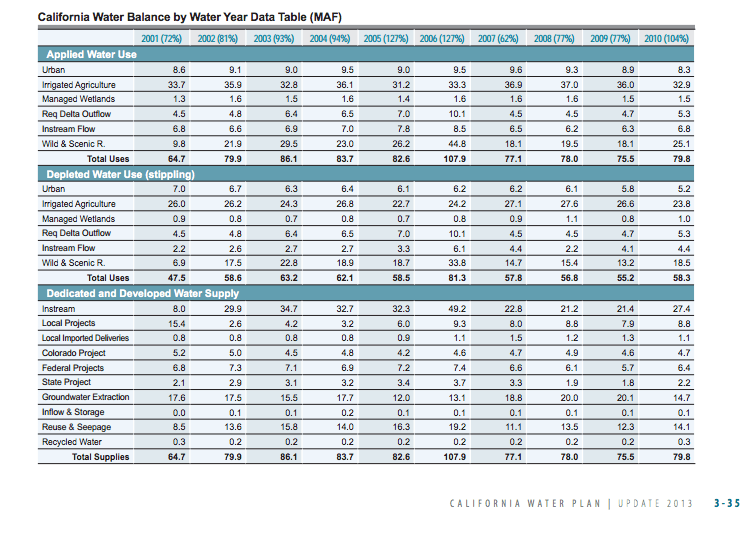
DWR lists amounts for both applied water and depletion. According to DWR depletion is water use that is an irrecoverable supply, such as water consumed through evapo-transpiration, water flowing to salt sinks (saline aquifers or the ocean), or water otherwise not available as a source of supply for other uses.

Ten years ago urban water accounted for 10.3 percent of the state’s water use, or depletion. By 2010 urban use had declined to 8.9 percent. Farms in 2004 used 43.2 percent, which declined to about 41 percent by 2010. Environmental water use (depletion) in 2004 was 46.5 percent of the supply. That’s water that was unavailable for other uses. By 2010 environmental water use actually increased to just over 50 percent of the state’s supply. That’s not surprising considering the environmental regulations, such as the salmon and Delta smelt biological opinions that came to be in the middle of this time period.

DWR water chart
California Water Balance Table

Environmental water is often mischaracterized as simply being part of California’s natural system and therefore should not be counted. That is incorrect. The State rightly accounts for all water uses including developed water set aside by laws and regulations for environmental uses. It is there because of the decisions we made to set it aside for environmental purposes. No one can argue against sound environmental water policies. It is just a matter of fact that we account for environmental water as part of the state’s overall supply.


LA Times’ Westlands Article Incomplete

A recent L.A. Times article on Westlands Water District misses the full story and instead portrays Westside farmers as bad actors in their struggle to grow food.


The article begins by repeating the myth that agriculture uses three-quarters of the water in our state. A recent example of this by The Hamilton Project titled “Nine Economic Facts About Water in the United States” displayed a large graphic showing agriculture consuming 80 percent of California’s water. In fact, the report included a footnote that echoed long-published information by the Department of Water Resources that on-farm use of developed water is only 41% when environmental water is taken into account. Why is it so hard for writers to admit that reality?


New technology pioneered on the San Joaquin Valley’s Westside proved that crops are able to flourish in soils where salinity levels might spell doom in other areas. The Grasslands area encompasses about 100,000 acres that is flourishing with high value crops because farmers, government agencies and environmental organizations worked together to reduce problem drainage into the San Joaquin River. Even the EPA called the project “a success story.”


Surface water has been delivered through the federal Central Valley Project for decades and until the early 1990s, it also served to halt the subsidence of lands due to groundwater overdraft. Government officials and the public recognized the importance of continuing farming in an area that produces a bounty of food. But federal regulations that restrict water deliveries to Westside farms, when combined with drought conditions, have forced farmers to increase groundwater pumping. The result is a return to periodic land subsidence in areas affected by the surface water restrictions.


In 1992 an Act of Congress (CVPIA) removed a million acre-feet of water from farmers each year and redirected it to environmental purposes. What Congress didn’t do at the time was find a solution to Westside drainage problems and the problem continues. The failure of federal agencies to provide a statutorily mandated drainage service to the lands along the Westside is compromising valuable farmland. This obligation has multiple solutions. Some are more expensive than others and taxpayers deserve a cost effective solution to the problem. After all, they have a vested interest in their pocketbooks and the ability of the land to continue to produce food.

Farmers Need This To Grow Our Food

What is it?  Water.

Farmers and consumers share a unique relationship. Many of the same sources of water meet the domestic needs of millions of Californians as well as the irrigation needs of the farmers who grow our food. And without California’s local farms, we would have a greater dependence on foreign food sources along with uncertain farm practices that can affect food safety.

California is home to one of only five Mediterranean climates on earth. Our cold, wet winters and hot, dry summers provide perfect growing conditions for over 400 crops. The three things necessary for plant growth are sunshine, soil and water and California has them all. Moving water from the wet, northern part of the state to the dry central and southern regions makes it possible for farmers to grow delicious fresh fruits, nuts, vegetables and many other crops. It would be difficult to grow the abundant produce that goes into a salad if farmers had to depend on just the local, natural rainfall to water their fields. By capturing water in the winter and storing it in a reservoir, we can save it for the summer when farmers use it to grow the fresh food we all find at the grocery store.

DSC_0066