Farmers throughout the Central Valley have been working hard and assuming huge personal risks in support of the Sacramento River Temperature Management Plan to protect salmon and still provide water to their farms.
“Hundreds of millions of dollars worth of water is being loaned to the United States Bureau of Reclamation, National Marine Fisheries Service, water districts, communities and individual farmers to stretch every drop available to protect California’s protected salmon and valued agriculture,” said Executive Director Mike Wade of the California Farm Water Coalition.
“Water was purchased or conserved by farmers in prior years and currently resides as an emergency supply in San Luis Reservoir,” he explained. “It is this water targeted for the ‘loan’ program and any decision by the State Water Resources Control Board that would interfere with the complex set of agreements struck since mid-May could cost the agricultural industry as much as $4.5 billion and bankrupt thousands of farmers.”
In a show of cooperation among a diverse set of irrigation and water districts, the water would be “loaned” to the Bureau of Reclamation to meet senior water supply demands in the San Joaquin Valley. In exchange, Reclamation would commit to pay back that water out of supplies stored in Lake Shasta as soon as temperature goals for winter run Chinook salmon are met.
The water is being “loaned” to fulfill multiple water supply and environmental objectives, which include the provision of a small amount of summer water supply for agriculture south of the Delta, refuge management for numerous listed terrestrial species like the Giant Garter Snake, and temperature management goals by Reclamation and the State Water Resources Control Board.
Farmers involved in the “loan” program own land on the Westside of the San Joaquin Valley, Sacramento Valley rice farmers who fallowed land this year to make supplies available for transfers and Friant-area farmers seeking to augment a zero supply for the second year in a row.
“The State Water Resources Control Board should facilitate this complex and unprecedented collaboration and allow Reclamation to release water as soon as possible to pay back what has been borrowed to protect salmon,” Wade added.
Water agencies in the Sacramento and San Joaquin valleys provided estimates to Reclamation indicating the total cost of lost water and farm production if the water board does not approve the payback provision would be in the range of $3.5 billion to $4.5 billion and an additional 485,000 acres of farmland fallowing.
Today’s (6-12-15) curtailment order by the State Water Resources Control Board to shut off water supplies to pre-1914 users with permits that began in 1903 or later was not completely unexpected. However, this order demonstrates the seriousness of the current drought gripping our state and the damage being felt by rural communities.
Today’s curtailment order comes on the heels of previous orders that halted users from diverting water from the watershed of the Sacramento and San Joaquin rivers. This process of curtailment orders proves that the existing system of water rights in California is working.
…it is still troubling news for farmers in those areas that have invested years of time and money to grow the food sought by consumers.
While the latest curtailment order was not a complete surprise, it is still troubling news for farmers in those areas that have invested years of time and money to grow the food sought by consumers. Farmers will now be forced to shift their cropping patterns in order to stretch their reduced water supplies.
For some farmers this will likely mean an abandonment of crops already planted this year under the assumption that their water supplies were more secure.
California farmers provide half of the nation’s fresh fruits and vegetables and now that supply is in jeopardy. Hundreds of thousands of acres of permanent crops are being under-irrigated. As a result of the latest water cutback, consumers may feel the pinch with fewer choices this summer and possibly higher prices at the grocery store.
Recording artist Moby has a lot to say in Rolling Stone about the way California farmers grow food. We’re using this post to address six of his most egregious errors.
1. Moby says “very few of the things we do as humans actually create benefit for anyone.”
Farmers use the water they have to do something amazing: They grow food. Of all the things we do as humans, producing food that sustains life seems pretty important. Water that grows farm products doesn’t stay on the farm. It becomes the food we buy at the grocery store.
2. Moby thinks if we stopped eating beef, dairy, and almonds, we’d be just fine.
That’s just not a practical solution to the drought. Farmers have chosen their crops based on what grows most efficiently and sells best. Even if a farmer chose a less controversial crop, there would need to be a market and price that would support the investment needed to switch.
3. Well, let’s just grow “thirsty” crops somewhere else.
Okay, where? California has the only Mediterranean climate in the country, making it the only efficient place to grow almonds in the US. Dairy can be imported from other states but dairy products like milk and cheese can spoil quickly. Transporting them long distances also raises the cost. Milk has a short shelf life. Do you want its life spent in a truck on the road or on the shelf in your fridge?
4. Uh, but Moby says farms use eighty percent of our water…
No, not really. The California Department of Water Resources has determined that agricultural water use is only 40 percent of California’s water use. Half of California’s water is used to protect the environment—meaning it’s designated for things like managed wetlands, wild and scenic rivers and stored water used to push salt water back to the San Francisco Bay.
5. But farming is such a small part of the economy!
Some say it’s as small as two percent but two percent of the world’s eighth-largest economy is still pretty big. And that two percent is just the value of the raw farm products, not the jobs and products they create in transportation, processing, packaging, wholesale, retail, port jobs, etc. Every on-farm job supports an off-farm job in a related industry. All told, farms contribute over $112 billion to California’s economy.
6. Moby also says we give farmers subsidies to send our water out of state via exported foods.
He says Californians are sending their money and water to China in the form of alfalfa. The fact is that we live in a global economy. Moby’s smart phone likely came from China along with its associated water footprint. In fact, California imports twice as much water in the products coming here than it does in the ones we export.
Want more in-depth water talk? Check out more at farmwater.org.
Assembly Member Rudy Salas (D-Bakersfield) has introduced AB 1201, a legislative bill that would require the California Department of Fish and Wildlife to develop and initiate a science-based approach that helps address predation by non-native species on Delta species. According to analysis prepared by Assembly Water, Parks and Wildlife Committee staff, the bill would accomplish two primary goals:
1) Makes findings related to the decline of native fish species in the Sacramento-San Joaquin Delta (Delta) and the potential for predation by nonnative species on those at-risk fish species.
2) Requires DFW, by June 30, 2016 to initiate a science-based approach that helps address predation by non-native species upon species in the Delta listed as threatened and endangered under the California Endangered Species Act (CESA).
A list of supports and opponents as of 5-29-15 is available here.
Fish eat fish.
(Originally published January 20, 2015)
In the Seinfeld episode, “The Watch,” Jerry Seinfeld says to a woman in a restaurant, “You know why fish are so thin? They eat fish.”
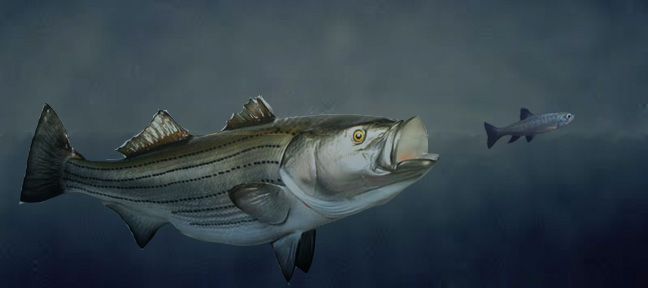
Despite their diets all fish aren’t thin. Take bass, for instance. They eat fish. They eat a lot of fish. Bass in California’s Sacramento-San Joaquin Delta eat a lot of baby salmon and dining season is coming up fast. You see bass, according to the California Department of Fish and Wildlife, will begin to increase their fish consumption in the next few months.
Bass eat endangered salmon
Non-native stripers and largemouth bass consume large numbers of threatened and endangered fish each year in the Delta.
According to “Striped Bass Fishing Tips” on the California Department of Fish and Wildlife website, spring is when bass – an invasive species introduced to provide recreational fishing in the Delta — start their annual feeding frenzy on native salmon.
During the winter, striped bass are spread from San Francisco Bay throughout the Delta and fishing is generally poor because stripers do not feed actively when the water is cold. Fishing success improves as the water warms up in March. Stripers that winter in the bays start moving upstream to fresh water for spawning. During the spring, the bulk of the legal population is spread throughout the Delta and as far north as Colusa and Princeton on the Sacramento River.” http://goo.gl/fzr9ex
Federal government cuts water supply to farms
On January 1 the federal National Marine Fisheries Service (NMFS) instituted a management action that reduced water deliveries to 25 million Californians and millions of acres of farmland in the name of protecting salmon. In its December 30, 2014 announcement, NMFS justified its decision by saying the bulk of the migrating salmon move into the Delta by the end of December. Reducing export pumping at that time, according to NMFS, “…would protect a sizeable proportion of the winter-run (salmon) population that has already entered the Delta region.”
Then the very next sentence in the announcement says, “These fish will distribute themselves within the Delta and are expected to rear for up to 3-4 months before continuing their emigration to the marine environment.”
That is if they survive the journey.
During these months, bass increase their fish consumption at the same time baby salmon are rearing in the Delta, growing in size in preparation for the remainder of their migration to the ocean. Good luck, baby salmon! You’re likely to become a meal.
Salmon slaughter
The March 2009 issue of Western Outdoors Magazine article titled “Save a Salmon, Catch a Striper” says it all:
“You see, the peak of the baby salmon’s downstream journey corresponds with the spring spawning run of striped bass. Somewhere along the line, the two migrations crash headlong into one another. It’s a one-sided blood bath, and when the spray and foam settles, the stripers emerge fat and happy while the Chinook suffer heavy loses.” https://farmwater.org/salmonslaughter.pdf
A 2010 article by Alistair Bland in the East Bay Express titled, “The baby salmon feeding frenzy in San Pablo Bay” pointed out that bass fishing party boats target areas where hatchery salmon smolts are released into the bay because the fishing is so good.
Bass fishermen can get their limits in “just minutes” and when the bass are cleaned and filleted their stomachs often contain from one to six salmon smolts. http://goo.gl/vWnAn1
What, if anything, is NMFS doing to protect salmon from predatory bass at the same time that it ratchets down export pumping? Twenty years of data show that pumping has had no long-term impact on salmon populations. However, a federal study released in 2013 demonstrated that 93 percent of juvenile salmon on the Tuolumne River are consumed by predators while attempting to migrate to the ocean. http://goo.gl/p0zeA
What is the logic in not addressing that? Where is the outrage from the commercial salmon industry?
The real problem gets ignored
Why are other stakeholders and regulators willing to accept the status quo and reject real reform that will restore the Delta to its former productive salmon fishery? At the same time a handful of bait shops profit from the salmon-gobbling bass industry. ESPN and others broadcast high-dollar bass tournaments. And bass fishing advocates continually say that it’s the farmers of the San Joaquin Valley that are destroying the Delta.
Are we really using too much water to grow food in California? The simple fact is that it takes water to grow food no matter where in the world you till the soil. Critics claim that the consumption of California farm products is somehow contributing to the drought. That is an unwise assertion and here’s why.
California produces about half of the nation’s fresh fruits, nuts and vegetables and does it more efficiently and responsibly. They’re the kinds of foods that nutritionists say we should be eating as part of a healthy lifestyle. Consumers want choices and California’s 400 different commodities gives them exactly that. California also produces food products more efficiently than anywhere else in the U.S. and more specifically the world. California is one of only five Mediterranean climates on earth and the only one in the United States. Growing what we grow here simply isn’t possible in most other places.
California is the natural place to grow food
Factors such as wet winters and dry summers, soil characteristics and the right number of days with the right number of frost-free temperatures that make California the food producer that it is. Massachusetts, for example, will never be able to compete with California in terms of food production. And no amount of genetic engineering will be able to sufficiently get around the climate and soil type advantage that California enjoys.
Finding other states to replace California farm production isn’t practical and importing more of our food supply from other countries has its own share of risks and problems. California already imports twice as much “virtual water” in the products consumed here than is exported in the things we produce. Increasing the amount of food imported from other countries contributes to this imbalance.
California is the efficient place to grow food
What we should focus on is growing food in places where it can be produced as efficiently as possible. Artichokes, lettuce, spinach and many other vegetables are produced year-round thanks to seasonal differences from the Imperial and Coachella valleys in the south through the San Joaquin and Salinas valleys northward. The Sacramento Valley grows all of the sushi rice produced in the U.S. An amazing 85 percent of the U.S.-produced fresh citrus comes from California. Tree fruits and nuts that require cold winters and hot summers grow better in California than anywhere else as well. It simply makes more sense to grow food where it can be produced efficiently and transport it to consumers where they live. The alternative is to struggle to grow food on the wrong soils or in the wrong climate where production efficiencies are lower and water, labor and pest control inputs are higher.
The solution proposed by California’s farm critics- that we look elsewhere for our food supply- would mean that millions of consumers have fewer selections, lower quality and higher prices for the kinds of healthy choices they want for their families.
In May of 2015, almost 75% of farms had sustained cutbacks of 80% or more in water supplies. Learn more about the 2011-2017 California drought in this Drought Fact Sheet, dated May 26, 2015.
There are far bigger issues affecting the Delta than water exports and returning to a time prior to Western development is unrealistic.
To describe the Delta as altered is to say that New York City is populous or California water politics contentious. Since the 19th century when locals began to reclaim the marshlands, dike the rivers, and develop settlements on the rivers- the history of the Delta has long been one of change. California’s largest river delta, the Sacramento – San Joaquin Delta has been forever altered by human habitation. Little remains of the complex estuary network of tidal wetlands, freshwater rivers and recurring saline incursions.
Beyond the edges of these islands ongoing dredging of channels for deepwater shippingto the inland port cities of Stockton and Sacramento applies greater pressure to the species looking for shallow water habitat.
The Delta today is one of artificially fresh water- held far to the west of pre-project development, flows originating in the state’s network of reservoirs now support in-delta diversions for use by in-delta agriculture, cities as near as Stockton and as far away as San Diego. It is used to grow avocados on small farms near San Diego and organic cantaloupee near Firebaugh, among more than 300 other types of food and fiber that rely on water flowing through the Delta. as well as providing water to more than 25 million Californians.
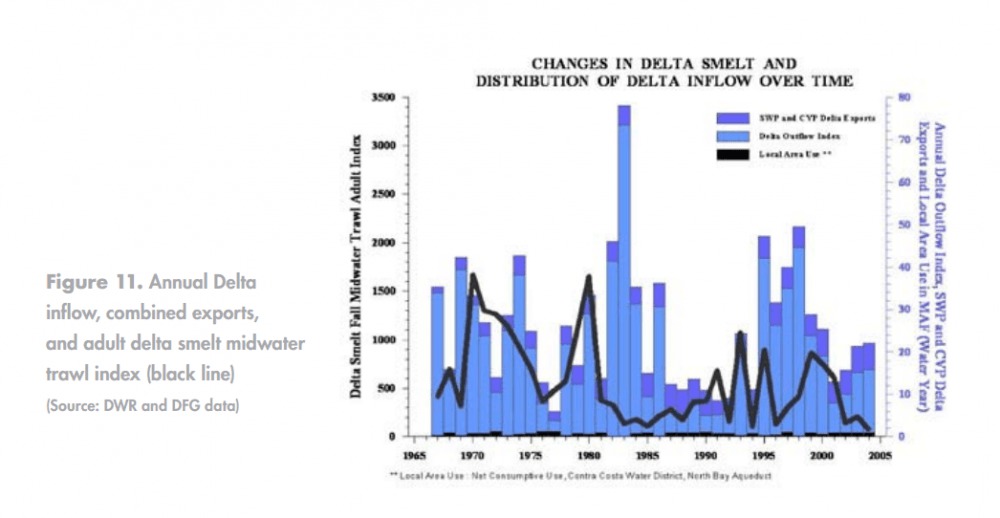
The National Marine Fisheries Service has stated that predation by non-native bass on winter-run salmon is a “major stressor,” while widespread invasive Asian clams and other species continue to alter the delta’s complex food network. Industrial chemicals being found in species at the mouth of the bay are also tied to what has been called Pelagic organism decline by researchers studying the health of the Delta.
Suggested changes to the Delta export facilities, intended to reduce possible impacts to threatened and endangered species while restoring reliability to water supplies remain under review, and could allow the Delta to return to a more natural condition, while restoring water supply reliability to more than 25 million Californians and millions of acres of the most productive farmland on the planet.
In April of 2015, farms in California had sustained multiple years of severely restricted water supplies, and went unmentioned in a declaration by Governor Brown requiring mandatory conservation among California’s urban water users. Recognizing the significant efforts by agriculture, Governor Brown rebuked attacks that he hadn’t asked enough from California’s farms and rural communities in a national interview with ABC News. During the interview he recognized the many thousands of acres fallowed, and the threat to rural communities.
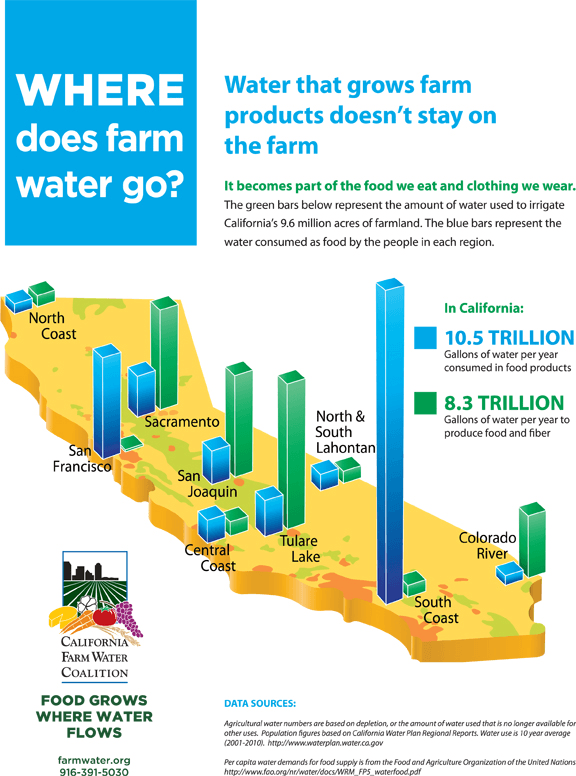
Water that grows farm products doesn’t stay on the farm.
It becomes part of the food we eat and clothing we wear, making consumers the true end users of farm water. California farms consume 8.3 trillion gallons of water in a normal year but farmers aren’t using water frivolously on their lawns or taking long showers, according to California Governor Jerry Brown. “They’re providing most of the fruits and vegetables of America to a significant part of the world,” he said on April 5, 2015 during an interview on ABC’s “This Week.” Download the info graph here: https://farmwater.org/wheredoesitgo.pdf
According to data from the California Department of Water Resources (www.waterplan.water.ca.gov) and the Food and Agriculture Organization of the United Nations (www.fao.org/nr/water/docs/WRM_FP5_waterfood.pdf), California farmers actually use LESS water than the amount required to meet all of the Golden State’s food supply needs. California farmers use about 8.3 trillion gallons of water on 9.6 million acres of irrigated farmland. The water required to grow all of the food consumed by California’s population is equal to about 10.5 trillion gallons.
California exists in a global economy.
The state’s farm production feeds more than just its own population. Farm products are imported and exported, based on consumer demand, to provide a variety of food choices throughout the year all around the world. However, if California farm production was limited to meeting only the needs of California residents it would fall short by over 26 percent. As productive as California farmers are, they simply don’t have access to enough water to grow all of the food consumed by California’s population of 38.8 million people.
The food we eat here in California takes water to grow.
California’s farms are among the most efficient in the world, often producing substantially more food per gallon of water than the global average. How much water does it take to grow the food we eat? Check out the breakdown for a few menu items produced using California-grown produce.