Response to Governor Brown’s State of the State Address
We are encouraged by Governor Jerry Brown’s comments in his State of the State address recognizing the need for increased water storage in California. Coupled with his recognition that all avenues for water management must be explored, it appears a water plan benefitting all water users may be on the horizon. It’s true: pitting farmers against fish gains no ground for either. The best way to ensure this does not continue in the future is to base environmental decisions–especially those in the Delta– on science, not unsubstantiated fear.
Better science is needed for a healthy Delta
In just the last two weeks another 83,000 acre-feet of water that could have been stored for use later in the year instead went to the ocean. For 25 years regulators have diverted water away from farms for the purpose of helping threatened and endangered salmon and Delta smelt but those and other fish continue to struggle. It is long past time to revisit the decisions that have led to these failed ecosystem policies. Governor Brown is in a position to urge federal fishery managers to do a better, more comprehensive assessment of the real problems plaguing the Delta. Only then will California begin to recover and meet the co-equal goals of a more reliable water supply and improved ecosystem.
NRDC’s “Drought Report Card” gets an “incomplete” for using a flawed report as the basis of its poor grade for agriculture. NRDC’s 2014 report, “The Untapped Potential of California’s Water Supply: Efficiency, Reuse, and Stormwater,” cowritten with the Pacific Institute, was used as the basis for its recent “report card.”
Old Data
Much of the agricultural section of its 2014 report is actually based on a 2009 Pacific Institute Report. At the time, the Pacific Institute estimated that 3.4 million acre-feet of water savings were attainable through improved irrigation scheduling. That number was based on a 1997 DWR survey of just 55 farmers who claimed a 13 percent savings in applied water by incorporating CIMIS data into irrigation scheduling. The Pacific Institute also assumed back in the 2009 report that only 20 percent of farmers were using some sort of irrigation scheduling, so it applied the 13 percent savings to the remaining 80 percent in each of California’s hydrologic basins to arrive at its 3.4 MAF number. That’s quite a stretch.
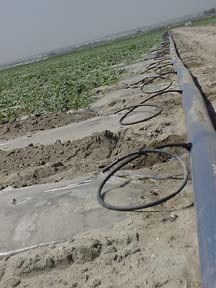
Subsurface drip irrigation in watermelons. Similar systems have been installed on millions of acres of California farmland at a cost of over $3 billion since 2003.
A much better benchmark for agricultural water savings took place a year later. In 2010 the Agricultural Water ManagementCouncil also surveyed farmers about water use efficiency. The AWMC survey included 414 farmers statewide and found that 57 percent used CIMIS data or an irrigation consultant to schedule their irrigation.
Yet today, 15 years after DWR’s small survey of 55 farmers, we see reports like this using the same tired and speculative numbers to justify criticism of agricultural water use efficiency.
Cherry Picking
NRDC and the Pacific Institute were happy to cite estimates from DWR in a 2013 report that said applied water might be higher in agriculture than previously thought (California Simulation of Evapotranspiration of Applied Water and Agricultural Energy Use in California PDF). At the same time they ignored DWR’s assessment elsewhere in the report about evolving cropping patterns in California toward higher-value crops and high-efficiency irrigation. DWR stated, “As a result of these trends in irrigation methods, the adoption and usage of ET information for scheduling has increased considerably.
At the same time they ignored DWR’s assessment elsewhere in the report about evolving cropping patterns in California toward higher-value crops and high-efficiency irrigation. DWR stated, “As a result of these trends in irrigation methods, the adoption and usage of ET information for scheduling has increased considerably.
The CalFed Bay-Delta Program assessment, mentioned in the 2014 NRDC/Pacific Institute report, uses DWR’s “Projection Level 6” (PL-6), or the maximum possible investment in water use efficiency to attain 4.3 million acre-feet in water savings. DWR’s estimated cost for that was $1.6 billion per year.
Unrealistic Estimates
In the 2009 California Water Plan Update, DWR stated, “Projection Level 6 is “unrealistic” and “impractical.” The Department went on to say, “Projection Level 6 represents a perfect irrigation system and management performance not attainable in production agriculture.” The CalFed Bay-Delta Program’s 2006 Comprehensive Evaluation also said that Projection Level 6 “…was intended to serve as a reference point, or bookend, to evaluate other projection levels and should not be part of the planning document.”
The CalFed Bay-Delta Program’s 2006 Comprehensive Evaluation also said that Projection Level 6 “…was intended to serve as a reference point, or bookend, to evaluate other projection levels and should not be part of the planning document.”
Yet the Pacific Institute’s reported Ag Water Conservation and Efficiency Potential takes CalFed’s PL-6 even further and applies a 100 percent efficiency level, rather than CalFed’s more realistic 70 percent level. Only by stretching the CalFed numbers and applying them to 100 percent of California’s agricultural land are they able to arrive at their grossly inflated 6.6 MAF estimate of conservation potential that NRDC used as the basis for its “report card.”
Rather than stretching the facts about agricultural water use, let’s let the public decide if water for food and fiber is a good deal.
Learn from the Australian experience. Indeed…don’t make our mistakes!
By Hayden Cudmore and Stefanie Schulte, New South Wales, Australia
Water reform has been ongoing in Australia for some 35 years. The advent of the 2007 Water Act in legislation and subsequent Murray Darling Basin Plan (MDBP) very much accelerated the process beyond reason. Although still maturing, Australia has the most advanced water trade markets in the world. A recognition this far, that irrigators have a water entitlement “Property Right” which lead to voluntary buybacks from irrigators by government as well as government investment in modernising water use efficiency measures on farm and irrigation supply networks returning saved water for environmental purposes (with the exception of compulsory reductions without compensation to groundwater/bore licences some years ago). Americans should learn from the Australian experience. Don’t make our mistakes!
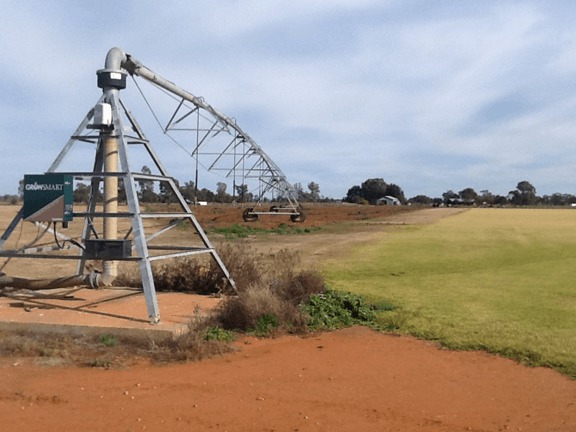
Hayden Cudmore’s irrigated farm near Griffith, Australia
The MDBP was borne out of political expediency and (poor) decisions were made at a time of extreme drought. Compounding drought as a result of low or no water allocations was irrigator’s financial duress. The ongoing effects to agricultural support business and beyond are still being felt today. However now, with reduced water in the farm sector, these businesses cannot return as they were, which would have been the case following drought. A permanent drought if you will. Decisions were made when irrigators and communities were vulnerable.
The Basin Plan adjustment process has been too short a time period for communities and irrigated agriculture to adjust. There has been a dramatic shift in water use without a commensurate shift in land use. While there has been environmental benefit, the legacy of the MDBP for communities is a huge setback for economic and social activity regionally.
Water has always been of crucial importance for irrigated agriculture and many rural communities in Australia. According to the Australian Bureau of Statistics, the total value of irrigated agricultural production in Australia is over $13 billion with a significant portion of that produced in the Murray-Darling Basin. At the height of Australia’s millennium drought, overall water use in irrigation decreased to about 30% of pre-drought levels. As a consequence, the gross value of irrigated agriculture production, employment and the economic activities in rural communities decreased significantly. For example, rice production fell to nearly zero in 2007/01 and employment in cotton shrunk by 42% in the years between 2001 to 2006. Many farmers did not make it through Australia’s millennium drought and those who did often carry significant debt more than a decade after the drought broke.
Irrigation production directly influences employment, economic growth and prosperity across Australia’s inland region. The drought and the subsequent removal of productive water through Australia’s water reform process has, and is having, a direct and long-lasting effect on the economic and social fabric of irrigation communities. More importantly, each of these communities have different tipping points beyond which the environmental water recovery by the Australian Federal Government causes irreversible damage to that economic and social fabric.
Despite a number of positive aspects of the Australian Water reform process since the millennium drought, there have been many negative impacts on irrigators and Basin communities, which pose an ongoing risk to these communities. The cost burdens associated with the water reform process are significant, ongoing and will likely increase with increased Federal Government environmental water holdings.
The ultimate removal of 2750GL (2.23 million acre-feet) of productive water will cost the Australian economy between $5 and $7 million dollars a day in lost irrigated agricultural production every day into the future. — Stefanie Schulte, NSWIC
This value is the lower bound of the cost of the Basin Plan as the loss in irrigated agricultural production has a continued effect to rural communities through loss of employment and revenue to local economies. It is estimated that in some instances that ‘multiplier effect’ could be as large as seven times the farm-gate value.
To date the Australian authorities have done little to identify these impacts despite the overriding imperative of the Federal Water Act to be implemented against a triple bottom line objectives of optimising the social and economic outcomes as well as the environmental objectives of the water reform process.
It is imperative that it is recognised that Australia’s millennium drought caused a lot of harm for irrigated agriculture and rural communities and the additional impact of the subsequent water reform process has not yet been fully estimated and assessed. It is important that policy makers listen to all those individuals who are directly impacted by the reform process to understand the impacts the reform has on these rural communities.
Hayden Cudmore is a farmer in New South Wales, Australia
Stefanie Schulte is the Policy Manager for New South Wales Irrigators’ Council
Australia’s water rights reform caused problems for farmers
At the peak of Australia’s Millennial drought, lawmakers sought to resolve water shortages by overturning their historic water rights system with the 2007 Water Reform Act and put water management into the hands of their federal government. Nearly a decade on, the Act and subsequent Murray-Darling Basin Plan have led to fallowed farmland, unemployed farmworkers and struggling businesses in rural communities—the same problems California’s Central Valley is already facing. Australia’s drought solutions are no answer for California
California lawmakers seek solutions to the drought
As California lawmakers spend time in Australia on a fact-finding mission to help combat our own multi-year drought, they need to be aware that the adoption of Aussie-type reforms may only make California’s water supply situation worse, at least for our state’s food producers. Those participating in the tour include Democratic Senate President Pro Tem Kevin de León of Los Angeles, Assembly Minority Leader Kristin Olsen of Modesto and Assembly Member Marc Levine of San Rafael.
Australia’s attempt to resolve many of its own water supply issues are creating the same scenarios that already exist in the parched Central Valley – unemployment and the economic ripples that affect farm jobs and the businesses that depend on them.
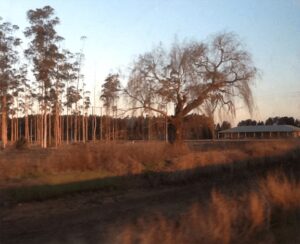
Under the 2007 Water Reform Act water management shifted from the States to the federal government. As an excuse for a national water management plan, then-Prime Minister John Howard said, “The old ways of managing the (Murray-Darling) Basin have reached their used-by-date.”
Sound familiar? How many times have we heard that California’s “antiquated system of water rights” is overdue for change. The trouble with change is…things change. In Australia, farmers ended up with less water. According to Australian Broadcasting Corporation (ABC) news reports, community impacts have been severe. The community of St. George lost over 42,000 ace-feet of water with no socio-impact assessments to determine how the community would be affected.
Aussie communities lost water to outside sales
The changes in water rights and subsequent transfers have caused vast quantities of irrigation water to be sold out from under local communities with devastating effects. Mayor Donna Stewart of Balonne Shire said in an ABC news report that water sales authorized by water rights reform act have had the effect of creating a permanent drought in rural communities.
Sounds a lot like Firebaugh, East Porterville, Mendota, and other Valley communities.
According to Stefanie Schulte, Policy Manager at the New South Wales Irrigators’ Council, what started out as a 10-point plan and US$8 billion investment, “has transformed into a complex and confusing framework that often does not achieve its “environmental” objectives but leaves farmers and rural communities with significantly less productive water to grow food and fiber.”
California needs grassroots solutions that protect farms and our food supply
If California politicians seeking answers in Australia bring anything back with them it should be a better understanding that solutions must come from the bottom up and include farmers and the rural communities. Wholesale changes to California’s water rights system is the wrong way go about solving our water crisis. Simply rearranging the water rights we currently have will undoubtedly create winners and losers, just like it did in Australia.
That is bad news for the farmers who grow our food and in the long run, for the families who want to buy California’s fresh bounty at the grocery store.
The Westlands Water District settlement agreement with the Department of Interior’s Bureau of Reclamation solves an obligation by Reclamation to provide drainage services to farmland on the San Joaquin Valley’s Westside. With the planned expansion of the Central Valley Project in 1962 it was understood that along with irrigation water, a drainage system would be needed to carry away salts and minerals that would ultimately be harmful to farmland. Drainage is not a new problem to this area. In fact, over 4,300 years ago Mesopotamian farmers suffered the same fate by irrigating land without an effective way to drain away excess water and salts. Cuneiform tablets from the era provide a record of crop damage that Mesopotamians knew were the result of salt build-up.
When science took a back seat to politics in the 1980s, the planned 207-mile San Luis Drain was prematurely terminated at Kesterson Reservoir. It was believed by State and federal biologists that water supplying Kesterson would be a benefit to local wildlife. Sadly, the same evaporation of water that doomed Mesopotamian farmers also occurred at Kesterson, leaving behind salts and minerals that poisoned wildlife. The 82-mile completed portion of the drain was closed, leaving Reclamation with no solution to its contractual obligation to provide a drainage system for that part of the Central Valley Project. For the last 30 years courts have agreed that Reclamation is obligated to provide a drainage solution. Current estimates put that cost at $3.5 billion.
2) Why is this good for the public?
Numerous court decisions are clear stating that Reclamation must provide a drainage solution to the Westside. It is a scientific fact that was well known when the water supply project was built. But solving the drainage dilemma may not involve constructing an actual canal or pipeline to carry drain water away from the region, which was the original plan. Several options have been proposed and evaluated based on their costs, effectiveness and community impacts. According to the Department of Justice, which approved the settlement agreement, meeting Reclamation’s contractual obligation would cost American taxpayers $3.5 billion. With Reclamation’s entire annual federal budget in the neighborhood of $1 billion, http://www.usbr.gov/facts.html, it’s simply not feasible to expect a $3.5 billion solution.
Under the existing settlement terms Reclamation has agreed to forgive a $350 million debt owed by Westlands for its share of Central Valley Project infrastructure. That alone is a 10-1 payoff in favor of taxpayers when compared to the potential drainage solution cost. Reclamation will also transfer ownership of a limited number of pumping plants, canals and pipelines originally built to serve the area covered by the settlement, a customary practice.
Westside water supply and unemployment
3) How much farmland is being retired and why?
Without a proper system in place to accommodate known drainage issues, other options must be considered. Individuals
and organizations with no connection to farming have suggested retiring 200,000 acres or more of currently food-producing farmland. That alone could cost $2.8 to $3.6 billion, based on the current market value of farmland if Reclamation chose to buy out the landowners. The downside of that option is the harm to local economies and jobs that depend on farming. There is a direct correlation between land fallowing and unemployment.
As fallowing increases, so too are the costs that are shifted to local communities through unemployment, reduced access to health care, increased dependence on social welfare programs and diminished school enrollment.
Local food banks have seen dramatic increases in the number of families they serve in the last three to four years as a result of water supply cuts and drought.
“One out of three children in the Central Valley goes hungry every day, and the state’s drought conditions have only worsened the problem,” said Andrew Souza, president and CEO of Fresno-based Community Food Bank. “It is no longer just the poor and the homeless who are hungry; working families are also struggling to make ends meet.” http://prn.to/1hGm8wG
4) How is the drainage problem being solved?
Without construction of a physical drain or the permanent retirement of large swaths of farmland, other solutions must be used to effectively meet Reclamation’s drainage obligations. Westlands has agreed to fallow a minimum of 100,000 acres of farmland, or about 20 percent of the District to reduce the amount of drainage-impaired farmland in the area.
Adjacent to Westlands Water District is the San Joaquin River Salinity Management Program, operated by the Panoche Drainage District and Firebaugh Canal Water District. This project, identified as a “success story” by the EPA, reuses drain water from almost 100,000 acres of productive farmland to irrigate salt tolerant crops. By recycling saline drain water through various crops, including Jose tall wheat grass, alfalfa and pistachios, the project has been able to reduce the amount of selenium, salt and boron by up to 95 percent in water flowing out of the district. This recycled drainage water has been producing marketable crops for over 10 years.
With advanced water treatment, including already successful solar desalination, 100 percent of unwanted salts and minerals will be removed from the system. The cost to implement this technology could be hundreds of millions of dollars and will be the responsibility of Westlands. If the results are unsatisfactory, Reclamation will have the option to end water deliveries to the District.
5) How much water will Westlands get in the future?
Under the proposed agreement, Reclamation will reduce its contracted delivery of CVP water to Westlands by 25 percent to a total allotment of 895,000 acre-feet. The priority for water deliveries remains the same as before. In a year when water supplies are short and Reclamation delivers less than 100 percent, Westlands will share in the shortage the same as it has since CVP water deliveries began to fluctuate as far back as 1977.
This solution returns a level of certainty back to farms on the San Joaquin Valley Westside, while Reclamation and other federal agencies retain the right to manage the CVP with all of the current environmental protections under the Endangered Species Act.
6) Do Westside farms matter to me?
All farming regions in California are important. That’s what gives us the diversity and quality of food products in the market. Each part of California plays an important role in our food supply because of the different climates and growing seasons. While we grow tomatoes in many parts of the state, they aren’t all grown at the same time, which wouldn’t be good for the market. Instead, food production follows the climate as it changes across the state throughout the year. When farmers harvest crops on the Westside they’re filling a place in the market that isn’t being filled with crops from somewhere else, either in California or across the country. That keeps fresh food available at the store when we want it and at a price that’s still affordable.
Westlands Water District produces $1 billion in food and fiber products each year with a corresponding $3.5 billion impact on the local economy. Rural communities depend on farms as a source of jobs and also as customers for local services, such as fertilizer sales, equipment sales and repair, fuel services and others. When farm water supplies are short the ripple effect can be felt throughout the region as businesses suffer and unemployment rises.
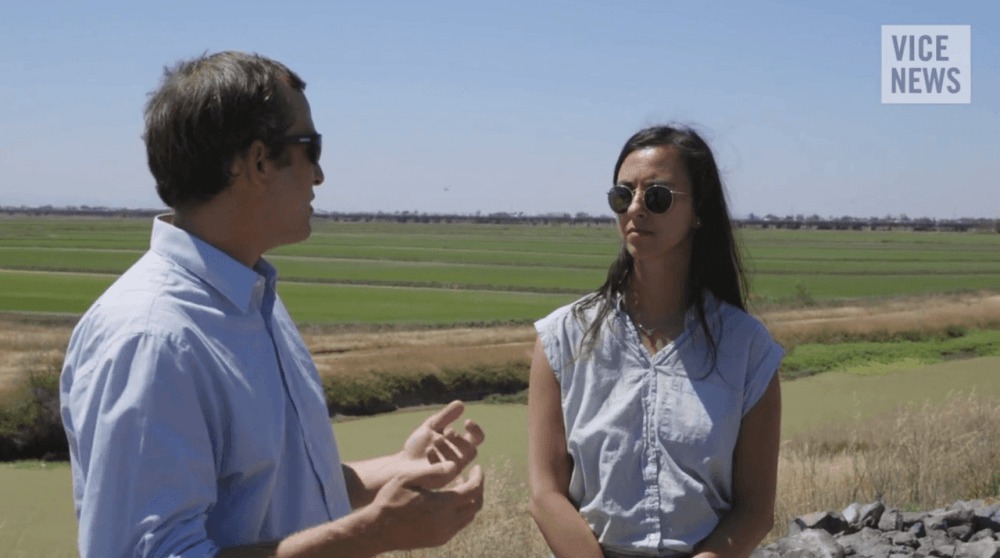
In a twelve-minute video about farming, VICE News devoted just one minute to talking to a farmer. Yesterday’s VICE News “Race to the Bottom” video aims to be an in-depth piece about agricultural water use during the drought, but instead spends eleven of its twelve minutes providing misinformation about how California farmers actually grow our food.
Misleading
VICE opens its video in a rice field, discussing flood irrigation with a lawyer from the Natural Resources Defense Council. Both VICE and the NRDC would have you believe that all farmers flood their fields for every crop—that’s just not true. Some farmers do use what’s more accurately called gravity irrigation…for certain crops, at certain times. Gravity irrigation has been on the decline for years, being replaced with pressure-based systems, such as drip lines and micro-sprinklers, Add that to the fact that California’s farmers have invested more than $3 billion in drip irrigation systems in the past dozen years and you begin to realize that VICE either didn’t do its homework or chose to ignore the facts.
California agriculture is diverse
The pattern continues at the Oakland Institute with Anuradha Mittal, who trots out the oft-repeated half-truth that “[California] is predominantly a desert.” Some of California is a desert, but the 800-plus miles of California from north to south include a variety of climates, including North America’s only Mediterranean climate, which is ideal for growing food like almonds and other stone fruit. In fact, this diversity of climate allows California to grow over 400 crops in all, with 14 being grown exclusively in California. Once again, VICE doesn’t question the assertion. It simply accepts what it has been told for what appears to be the predetermined narrative for its story.
Throughout the video, VICE News attempts to convey the message that farmers are corporate fat cats hell-bent on flouting environmental measures for personal gain, but it’s simply not true. The demonized rice fields that opened the story are in fact some of the most important feeding and resting grounds that exist for millions of migratory waterfowl traveling the Pacific Flyway. Many farms do their part to manage water to avoid waste. It is often recycled through fields as many as seven times, producing the food, fiber and nursery products that are important to consumers around the corner and around the world.
Responsible journalism should be objective
Having heroes and villains makes for a nice story, but a documentary (what VICE News purports to be) should assure that its content is objective. “Race to the Bottom” casts California farmers as villains without questioning the motivations of the “heroes” they have cast themselves.
(The following is a statement by Mike Wade, Executive Director of the California Farm Water Coalition, in response to the North Valley Regional Recycled Water Program that is planned to deliver treated recycled water to farmers.)
SACRAMENTO—“The California Farm Water Coalition applauds the cities of Turlock and Modesto as they celebrate the certification of the Environmental Impact Report for the North Valley Regional Recycled Water Program (NVRRWP). The partnership of the cities with Del Puerto Water District will provide a new source of both agricultural and environmental water. The partnership should be seen as an example of the benefits that can result from working together where possible for the shared goal of providing for California’s citizens, its wildlife, and its farms.
“The current drought has been disastrous for many farmers: with no surface water allocation and groundwater supplies dwindling, providing the crops that keep Californians fed has become a challenge. With strengthened alliances and innovative technologies, the partners of the NVRRWP have identified an innovative way to recycle water and provide for all of the region’s stakeholders. Improving water management across regions in a basin helps to ensure water resources are being responsibly overseen and that critically important basin-level efficiency is enhanced.
“Farmers in the area, and across the state, have sought other sources of surface water where possible, through transfer agreements between regions with available water to areas of need. Locally, farmers continue to expand the use of water smart technology for use on their farms, improving not only the water efficiency, but often the market quality of the products being demanded by consumers. Farmers are not only accelerating the installation of drip irrigation systems, but use automation-assisted tractors to aid in planting and growing, and are adopting scientific irrigation scheduling and soil moisture monitoring that assist farmers in knowing when and how much water to apply to their crops.
“The North Valley Regional Recycled water Program is a good model of urban, agricultural, environmental, and regulatory cooperation on water supply issues.”
Americans have confirmed their support for farmers’ use of water to produce food and fiber during times of scarcity in a recent poll by AP-GfK.
The drought now affecting California and other Western states has captured the public’s attention, with the majority of those polled (56 percent) noting that they are following news about the drought somewhat, or extremely/very closely. With the eyes of the nation on California’s problems, the public recognizes that our states’ farms are being threatened-with 74 percent believing that water for agriculture should be a priority, more than any other water use.
This renewed focus provides a unique opportunity to share the care and effort taken by farmers in growing our farm products. California’s farmers are committed to producing food and fiber in ecologically-sensitive ways, investing heavily in improvements in water use efficiency systems like soil moisture sensors, irrigation scheduling and automation, and precision drip irrigation.
Farmers recognize that water is precious, and recycle and reuse water whenever possible. For decades farmers in California have captured unused water from one field for reuse on nearby fields. As technologies improve, other emerging opportunities for water recycling also show promise. Farmers are already using purified urban runoff and wastewater that has been treated to remove impurities to supplement fresh water, and expanding use of solar stills to desalinate water and remove other troublesome minerals is already in the works.
Recent criticism of consumers’ food choices has argued that growing food in California using these and other sophisticated agronomic practices demands vast sums of water to be grown in California, but the truth is, for many crops, California is exactly the right place.
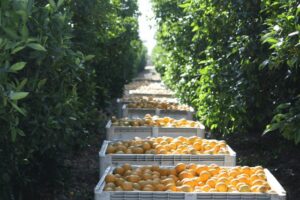
California is unique in our ability to grow more than 400 different types of food and other farm products. This variety comes courtesy of California’s sheer size: Roughly 800 miles north to south, California is home to a diverse range of growing conditions. Making sweeping generalizations about California’s suitability for agriculture ignores just how diverse the state really is.
The years of water supply instability prior to the drought challenged farmers’ ability to produce our food Overcoming the challenges of nature require us to identify solutions that benefit us all. Right now, however, we are struggling against bureaucracies and regulations that are contrary to the will of the people.
“Might, May, If:” Parsing the guesses, assumptions, and half-truths of the Food and Water Watch report
Earlier this week, Food and Water Watch along with partners Restore the Delta and the California Water Impact Network issued a document, their commissioned report, about retiring farmland in the San Luis Unit of the federal Central Valley Project in the San Joaquin Valley.
The 21-page document from ECONorthwest uses generalizations, decades-old information, and outright guessing to argue in favor of forcing farmers to stop growing food and fiber on their land. This is not a responsible way to make environmental choices, and would reduce available locally-grown food for the people of California.
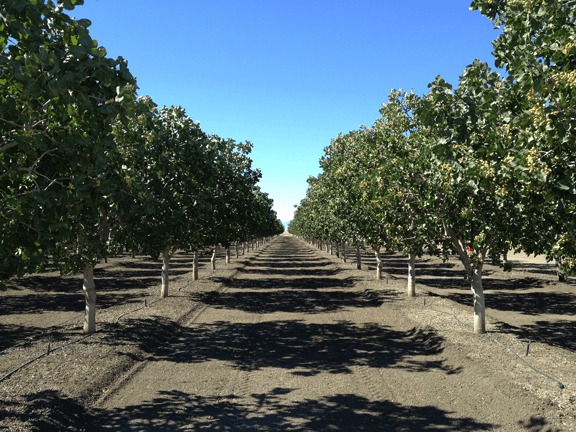
High-value pistachios growing on soil that would be considered for retirement under the Food and Water Watch strategy
ECONorthwest, at the behest of their clients, has extrapolated what it might cost to “retire”—that is, stop farming—land that they think has high salt content or an increased presence of the naturally occurring mineral selenium. Adding insult to injury, the simplified calculations used by ECONorthwest would offer pennies on the dollar for growers to abandon their farms. These unrealistic, below-market-value prices, it claims, would fairly compensate farmers. At a third or less of the actual price for farmland in the area, their estimates cannot be taken seriously.
It is no coincidence that retiring farmland is exactly the result Food and Water Watch and partners are pushing for. By cherry-picking decades-old data, these groups are attempting to manipulate public opinion.
Stopping the growth of food and fiber on these farmlands would mean the loss of jobs for farm workers and the food processing industry, forcing their families to again stand in food lines- as they have done in recent years. The proposal by Food and Water Watch would not only disrupt the economies of rural California, but also tear at the basic fabric of the communities that depend on agriculture.
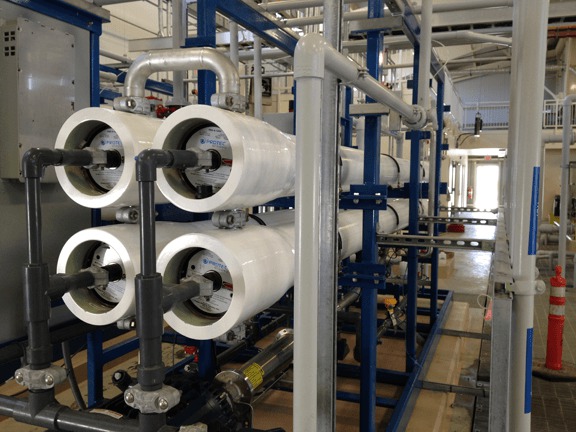
Prototype recycling facility near Firebaugh that provides high-quality water and marketable minerals from irrigation drainage water
The trouble is, there is no evidence that all of the land ECONorthwest and their clients are talking about is actually “distressed.” The twenty year old reports they cite do show increased salt and the mineral selenium, but since that time studies and projects have been underway to remedy the issues of drainage water and to help prevent it from reaching the Valley’s waterways. This drainage water is being reused irrigating valuable salt-tolerant crops. This effort has been the result of State and federal agencies, environmental organizations, farmers and public water agencies working cooperatively. Their work has been lauded by the Environmental Protection Agency. Modern approaches like the recycling program at Panoche Drainage District are part of the future of drainage management, improving water use efficiency and protecting the environment. Perhaps when ECONorthwest couched their recommendations in the tentative language of “if” and “could,” it was because the authors knew their information was outdated and incomplete.
It is unfortunate that the authors failed to reach out to the numerous experts, individuals, and organizations that specialize in agricultural production issues for more current information. If they had, they would have learned that the San Luis Unit is one of the most productive farming regions in the world, and that land retirement as a solution is an outdated notion in today’s science-based agricultural arena.
Peltier to succeed Nelson as Authority Executive Director
Mike Stearns, Chairman of the San Luis & Delta-Mendota Water Authority, announced that Jason Peltier will take over as Executive Director of the organization, replacing Dan Nelson who will retire at the end of 2015. Stearns indicated that Peltier was named the successor to Nelson as part of a Succession Plan that was developed after Nelson announced his intention to retire earlier this year. The Plan calls for Peltier to begin his employment with the Authority in mid-August as a Deputy to Nelson, then taking over the reins on Jan. 1, 2016.
Nelson will leave after 24 years as the Executive Director of the Authority and has been the only Executive Director for the Authority since its formation in 1992.
“Dan was a major part of the formation and development of an agency that we are all proud of. He has led us through some pretty tough times, has held us together and has positioned us well for the challenges ahead. We are very grateful for his leadership and wish him the very best,” noted Stearns.
Nelson added, “It has been an absolute honor working for the Authority, its member agencies and the water users in the region. The Authority is blessed with a great Board of Directors and an incredibly talented staff. Given the diversity of interests represented by the Authority, I’ve been amazed by their professionalism and ability to focus and to work together on common interests. Jason is a great fit for the organization and is the right person at the right time; the organization is in great hands.”
“We have some major challenges in front of us and Jason brings a tremendous amount of experience in western water issues and more specifically all facets of the Central Valley Project. We expect that he will hit the ground running. Jason is well known and well regarded within California and Western water circles. He will be a great leader for the future of the organization,” said Stearns.
Peltier’s experience includes a diversity of positions focusing on water issues. He served as Deputy Assistant Secretary for Water and Science at the United States Department of the Interior. Prior to that he was the manager of the Central Valley Project Water Association and is currently the Chief Deputy General Manager of the Westlands Water District.
Peltier commented, “The confidence of the Board of Directors in my ability to lead this tremendously accomplished organization means everything to me. I salute Dan’s 24 years of leadership in building a first rate outfit and creating a true family among its member agencies. I also must salute every one of the Authority employees as they have repeatedly demonstrated their resourcefulness and commitment to the mission of this organization.”




 Under the 2007 Water Reform Act water management shifted from the States to the federal government. As an excuse for a national water management plan, then-Prime Minister John Howard said, “The old ways of managing the (Murray-Darling) Basin have reached their used-by-date.”






 California is unique in our ability to grow more than 400 different types of food and other farm products. This variety comes courtesy of California’s sheer size: Roughly 800 miles north to south, California is home to a diverse range of growing conditions. Making sweeping generalizations about California’s suitability for agriculture ignores just how diverse the state really is.