2017 Snow Survey Results Off the Charts- Must Improve Water Supplies

Snow Survey Results Off the Charts- Must Improve Water Supplies

When state snow surveyors visited the Sierra Nevada today, they found a snowpack well above average for the date, and the biggest in more than 20 years. California agricultural organizations say they hope that translates into improved water supplies for the state’s farmers and ranchers.

California Snow Survey Results: 173% of Normal, Water Supply Improvements Should Correlate
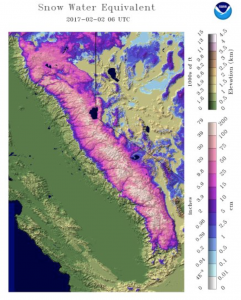
Map showing how much water is in the Sierra snowpack today.

“You would think that a snowpack in the range of 175 percent of average would assure plentiful water supplies, but that link has long ago been severed,” said Tom Nassif, president of the Western Growers Association.

“Wildlife agencies often hold the key to determining how much water is available, because endangered-species laws reserve
water for protected fish.”

WIIN Act Can Help Maximize the Benefits of California Storms in 2017 and Beyond.

Nassif noted the passage of federal legislation called the Water Infrastructure Improvements for the Nation Act,
which included short-term provisions to increase flexibility of the state’s water system.

“Among its provisions, the WIIN Act allows water agencies to capture more water during winter storms and requires them to maximize supplies consistent with law. This winter will be a good test of how agencies adhere to that law,” said Paul Wenger, president of the California Farm Bureau Federation.

Proposition 1 Water Bond Reservoirs Would Save Storm Water for Families, Farms, and Environment

The WIIN Act also invests in California water storage and desalination projects, complementing the investments California voters made when they passed the Proposition 1 water bond in 2014.

“We’ve had to let too much water run out to sea this winter, because we didn’t have any place to store it,” said Bill Diedrich, president of the California Farm Water Coalition. “We should be doing everything we can to save today’s rain and snow for use tomorrow.”
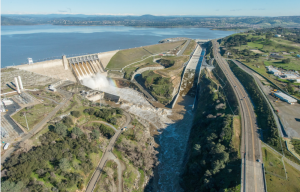
The California Water Commission will decide later this year on water projects to be funded through the bond.

“We will continue to urge the commission to put that money to work as quickly as possible to build new storage facilities that can capture more water during future winters such as we’ve seen in 2017,” Diedrich said.

An Audio Post

https://soundcloud.com/designdetailsfm/30-rewarding-holding-experience-feat-didi-medina

Co-working SpaceTeam fund big data prototype prototype long shadow latte big data. Innovate affordances personas user centered design paradigm user centered design innovate quantitative vs. qualitative pivot thought leader viral paradigm cortado affordances.

Continue reading

A Video Post

Co-working SpaceTeam fund big data prototype prototype long shadow latte big data. Innovate affordances personas user centered design paradigm user centered design innovate quantitative vs. qualitative pivot thought leader viral paradigm cortado affordances.

Continue reading

Fish still lack the calendars they need to migrate on our schedule

Fish still lack the calendars they need to migrate on our schedule.

Federal legislation first step in fixing broken California water system

In December of 2016 bipartisan legislation was passed by Congress and signed by President Obama.

dianne feinstein
Senator Dianne Feinstein

The new legislation requires water officials to supply as much water to farm, business and urban users as is considered environmentally safe under existing rules (biological opinions) and the Endangered Species Act (ESA).  It further requires that if water officials do not supply the maximum amount of water allowed, they must justify that decision by providing evidence that a reduction is necessary.

Thanks to this law, 25 million Californians – farms as well as urban users – are being supplied with water that otherwise may have been withheld.
And while we are grateful to Senator Feinstein, Congressman McCarthy and all the legislators that helped make this much-needed legislation a reality, we still have work to do to apply the common-sense approach of the new law to other parts of the water bureaucracy.

Fish don’t have calendars

kevin mccarthy
Rep. Kevin McCarthy

A year ago we discussed the National Marine Fisheries Service (NMFS) salmon biological opinion where water deliveries from the Delta are automatically cut on January 1. The stated purpose is to protect salmon. At the time we pointed out that fish don’t have calendars yet the fishery agency is still using ham-handed methods to address declining fish populations. NMFS continues to use a robotic calendar-based approach to fish management despite ongoing real-time monitoring and sampling triggers that would more accurately gauge the protection needs for fish.

Real-time fish monitoring – not calendars – helps fish

State fishery managers are using real-time techniques to protect Delta smelt. More frequent monitoring has helped improve water deliveries without increasing risk to the fish. Why aren’t their federal counterparts using the same smart approach toward species protection? It’s not as though the federal biologists aren’t aware of real-time fishery management. In its December 30, 2015 regulatory announcement NMFS stated, “NMFS has discussed utilizing a real-time monitoring based approach with Reclamation and other parties, and remains open to developing such monitoring based real-time triggers for next year.”

Terrific. Another year has gone by with urban and agricultural water users continuing to be denied water that could legally be delivered while still protecting fish. It’s time to use all of the tools at our disposal.

Will the Grinch Do It Again?

USFWS Logo

Will they?

Sometime around December 15 the US Fish and Wildlife Service will again start monitoring the turbidity, or bay delta estuarycloudiness, of water in the Delta. This yearly event is intended to help protect the Delta Smelt that are attracted to this murky water that tends to be more prevalent in the storm season. By federal regulation, if the turbidity rises above certain level water pumped from the Delta is reduced by 60 percent, supposedly to protect the smelt, from taking a wrong turn.


All sides have agreed to accept the levels set by the federal regulation and do their best to plan for it.

But last year, the federal regulators, on a whim not much different than the Grinch looking down from his mountaintop and deciding to steal Christmas from Whoville, arbitrarily restricted the pumps before the federally mandated level was reached.

How is it possible for farms, other businesses, cities and counties to plan if the rules can be thrown out the window with no reason, no explanation and no science to back up the decision?

We hope that this year some sanity prevails and the federal Grinch stays on his mountaintop.

CFWC in SF Chronicle: Why the Bay Area should care about Central Valley water

The State Water Resources Control Board has released its most recent version of a Water Quality Control Plan steakonaplate-web
for the San Joaquin River, and the public comment period has opened.

That may seem obscure, far away and not worth the attention of Bay Area residents, but if you like having water come out of your tap and using it to wash fresh vegetables to serve your family, it affects you. The final plan will have wide-ranging impacts on the availability and quality of your water, as well as our ability to provide locally grown food instead of having to import more and more from places that do not have the same exacting food safety standards as California.

Before you move on to the sports section, consider a few facts:

  • The Bay Area depends on water supplies that are upstream of the San Joaquin River. In an Oct. 9 Chronicle Insight piece, the San Francisco Public Utilities Commission predicted “more severe and more frequent water rationing” for its 2.6 million Bay Area customers if the board’s plan is adopted.
  • The region will incur significant job loss and economic costs, predicted the Bay Area Water Supply and Conservation Agency in the same Insight commentary piece.
  • The plan could further reduce water to California farms, curtailing their ability to provide you and your family with healthy, affordable and readily available food.

Here’s where things stand:

California has rules governing how much water must stay in our rivers to benefit fish, versus being made available to people and farms. Those rules have not been updated since 1995.

We fully agree it’s time that state policy be updated. The existing, rigid and out-of-date rules rely solely on the amount of water left in the rivers to help fish populations. This has been the policy for the past 20 years and it has done absolutely nothing to slow or reverse the decline of endangered fish.

The good news is that scientific research tells us that alternatives exist that will help revive fisheries without the devastation caused by severe water supply cuts. The state’s own scientists have proposed numerous strategies to help revive struggling fish populations, and most are related to improvements in habitat and food production.

And these are not just studies. Locally driven projects have had success increasing fish populations by employing these tactics. This is important because state Department of Water Resources scientist Ted Sommer said recently that delta “smelt are starving to death.” More water won’t help that, but providing food and other habitat enhancements will.

In the scientific community, the tide is changing toward smarter, more holistic, science-based approaches.

And yet the state water board remains mired in the past. Rather than taking a fresh look at some of California’s most pressing water management issues, board staff hauled out the same failed strategy of sending more and more water out to sea — this time, enough to serve the household needs of 2 million Californians. The very definition of insanity is doing the same thing over and over and expecting a different result.

It’s not just farmers and scientists who say it’s time for a change. People throughout the state have written the board, asking that their voices be heard. Education officials are concerned about water supplies for schools, health officials are troubled by potential impacts on sanitation, Bay Area experts are alarmed by potential cuts to water supply, lost jobs and lost economic activity, and the list goes on and on.

State water board Chairwoman Felicia Marcus promised that the board would “be listening for people’s best thoughts and proposals.” We hope so. The voices of education officials, health departments, water officials, farmers, cities, counties and economic development officials have all spoken about the need to find a solution that works for everyone involved.

The state water board needs to hear from you. Tell it that a science-based approach that actually provides endangered fish with food and habitat is preferable to just pouring water on the problem. We all need to share our limited water supply, and it’s time we came together to pursue smart, balanced policies that benefit urban users, farmers and the environment.


Mike Wade
California Farm Water Coalition

A Standard Post


Co-working SpaceTeam fund big data prototype prototype long shadow latte big data. Innovate affordances personas user centered design paradigm user centered design innovate quantitative vs. qualitative pivot thought leader viral paradigm cortado affordances.

Continue reading

Making good decisions – Getting results

This project proposes, as its primary project action, to acquire parcels comprising a large “island” within the flood channel and restore the property to riparian condition through natural and assisted processes.

Making good decisions – Getting results

During the recent drought, Californians were called to reevaluate Electronic Billboardhow we use, manage, and share water to get through the crisis. Farmers received only small fractions of the surface water they needed to grow food, and strident mandatory cuts were imposed on our cities, forcing us all to ask how to get the most bang for our water buck.

With a renewed focus on improving water use efficiency, communities across the state have been investigating and deploying advancements to ensure we meet our goals of doing more with less.

Farmers have fallowed hundreds of thousands of acres of their fields, installed billions of dollars worth of water-conserving technology and water measurement equipment, while developing sophisticated regional management plans and partnerships that help ensure farm water is managed and moved efficiently. Urban communities have invested millions in the latest high-tech water-saving technologies, landscaping upgrades, and infrastructure improvements to help modernize California’s water system, while reducing use . Farms and cities are united in their efforts to ensure that water used isn’t water wasted.

Out-of-date scientific theory fails to ensure success

Today the State is proposing a plan to help salmon using out-of-date, 20th century
scientific theory that doesn’t best consider the biological needs of the river ecosystems. They are using an approach which, when tested over the years, has repeatedly failed to improve the waterways and those that depend on them.

Fishery, habitat, and water experts agree that the bureaucrats are not using the best science to meet the needs of the Sacramento-San Joaquin River estuary and its salmon population.

Science that gets results – Functional Flows

“Functional flows” is an approach to water management that considersbay delta estuary the full complex needs of a waterway, the timing of those needs, and the needs and timings of the organisms dependent on the environment created by those relationships. This approach helps to ensure that water dedicated to help improve ecosystems and fish species achieves that goal.

Learn more about Functional Flows, by clicking here.


A functional flow is a component of the hydrograph that provides a distinct geomorphic or ecological function. These functions may include geomorphic processes, ecological processes, or biogeochemical processes. Such processes in rivers and associated biotic interactions operate in three dimensions, and are intimately tied to the timing, duration, and frequency of natural flows.  Thus functional flows must attempt to reflect the natural patterns of flow variability.

Yarnell, SM, AA Whipple, E Beller, C Dahm, C Enright, P Goodwin, G Petts, JH Viers. 2014. Functional Flows in Modified Riverscapes: Hydrographs, Habitats and Opportunities. Poster session at the American Geophysical Union Fall Meeting, San Francisco, CA. EP41C-06

What does it take to grow the food that makes it to your table?

What does it take to grow the food that makes it to your table? It takes time, a farmer’s hard work, and yes, water…

…But not as much water as you’d think. In fact, in California, over the past half century, saladpic2agricultural water use has remained about the same, while providing about 43 percent more food than we used to. That means that while the soup, salad, and sandwich you eat at lunch used water, they actually used much less than they would have fifty years ago. It’s the kind of smart water use that we can all get behind. Let’s take a look at the efficiency measures that farmers are using to continue supplying half of the nation’s fruits, vegetables, and nuts while balancing responsible water use.


California’s farmers lead on water efficiency

With increased use of soil sensors that let farmers know exactly how wet the growing conditions already are, California’s farmers are avoiding over-watering their crops. No farmer would intentionally waste water: it’s bad for the crops to be over-watered, which means it’s also bad for the bottom line.

soupminestronepurchasedimageFarmers work hard to ensure responsible water use, right down to the way crops are planted. Global Positioning System (GPS) technology allows farmers to create maps of their fields, allowing more efficient planting and harvesting of crops. This means that a farmer knows down to the meter what’s going on in his or her field and how to adjust accordingly, resulting in fewer wasted drops.
With California’s farmers working hard to grow fresh, healthy food in an efficient way, you can be confident that the food you eat daily is grown responsibly. Want to know more about how much water it takes to grow your food? Visit us at farmwater.org/lunch to see how much water an average lunch uses.

Reactions to State Board Unimpaired Flows Action

Reactions to State Board Unimpaired Flows Action

On September 15, the State Water Resources Control Board released an updated proposal for the Bay Delta Water Quality Plan, expanding the pursuit of increased flow in it’s approach for addressing species decline in the Sacramento-San Joaquin River system.

“If implemented, the State Water Board’s rule will have a devastating impact on drinking water, sanitation needs, food production, the economy and jobs for people stretching from the Northern San Joaquin Valley throughout the Bay Area. That’s why this regulation is opposed by schools, health departments, farmers, Latinos, cities, economic development officials and more,” said Mike Wade, executive director of the California Farm Water Coalition.

Water Resource Control Board President Felicia Marcus in an Op-Ed in the Sacramento Bee on September 15, 2016 remarked that-

“sometimes our rivers are asked to do too much. And then it is the State Water Board’s duty to balance water use among the many people and wildlife that are dependent on the rivers. This is now happening with the San Joaquin River. It is the longest river in California, the second largest in the state, and a critical piece of the Bay Delta puzzle. The San Joaquin is an overburdened river.”

Marcus goes on to say that the State Board will “be listening for people’s best thoughts and proposals in the coming weeks and months before making our decisions.”

But in a joint response by Modesto Irrigation District and South San Joaquin Irrigation District issued September 15, 2016, Oakdale Irrigation District General Manager Steve Knell noted that

“these plans fail to consider new science that is pointing to holistic approaches to addressing multiple stressors that affect fish populations, not just flow”

despite the numerous attempts by community leaders and water experts to ensure that the Board was aware of the multiple stressors affecting endangered fish and the Delta ecosystem, the Board continues to pursue an approach that has failed to achieve improvements in fish populations for over 20 years. The failure of flushing more and more water to the ocean is well documented, says Wade-

“The reason they cannot demonstrate benefit is because science clearly shows that decades of releasing water to the ocean has failed to halt the decline of Chinook salmon and Delta smelt. It is time to stop relying on failed strategies and move on to solutions that science tells us will help.”

Adding to the ire of affected communities, Knell noted that despite Board member commitments to listen to the public,

“Not a single public meeting ever was held in San Joaquin, Stanislaus or Merced counties.”

Representing 27 different cities, counties, school departments, chambers of commerce, water districts and farm bureaus, A Multi-County Coalition issued a response to the action calling for better analysis of available modern science, and demanded an improved process that incorporates feedback from impacted communities and stakeholders, as well as mitigation for the impacts on disadvantaged communities from any Water Resources Control Board action. The Coalition reports that the action-

“If implemented, the proposal shuts down any hope of economic growth in this multi-county region, eliminates swaths of agricultural employment, thwarts job creation and creates enormous funding challenges for schools, cities, public health, law enforcement and other essential public services.”

“It is unbelievable that our government would propose regulations that their own staff say will put farms out of business, reduce water supplies and have negative impacts on groundwater. Yet they can’t tell us what, if anything, this will do to protect the environment.” said Mike Wade, executive director of the California Farm Water Coalition.