Bill Diedrich on maximizing USBR water deliveries
Sarah Woolf on the importance of USBR water deliveries
Water: Time for a Fresh Look at What Works, What Doesn’t and What to Do About It
Water: Time for a Fresh Look at What Works, What Doesn’t and What to Do About It
For decades, California has been stuck in a Groundhog-Day-like water debate that pits fish and the environment against humans, farms and other water needs. Presented as a zero-sum game, we are told it is necessary for one set of water-users to lose in order for another to win. As the argument goes, if farms and cities are getting the water promised to them, fish and the environment must suffer.
Having long rejected the winners and losers approach to water we applaud the current effort by the Bureau of Reclamation to review why, when, and where California’s two main water delivery systems – the Central Valley Project (CVP) and the State Water Project (SWP) – allocate our water.
We already know that over the last two decades, the cutbacks in promised water deliveries by the Central Valley Project, as well as the instability of those deliveries, has taken an undeniable human and economic toll on farms and the communities that depend on them for survival. We also know that water diverted for the purpose of supporting struggling fish populations has totally failed to impact fish decline after 20-plus years of this failed approach. In summary, the one thing we know for sure is that the current system is not working for anyone.
The good news is that science has not been sitting still even if the policy has. Multiple studies and projects show us that fish are struggling for a multitude of reasons, many of which are correctible. Reducing the impact of non-native predators, improving habitat, access to food and other measures, are helping us find solutions that work for water supply, farms and the environment. One project underway with partners that span an area from the northern Sacramento Valley south through the San Joaquin Valley and Southern California is reconnecting the fish-food-rich floodplains with rivers, creating a win-win situation for fish, farms and people. Numerous additional projects on smaller scales are underway across the state. Collaborating on even more efforts will help us make even greater strides.
Another flaw in the current policy is that it has long ignored the environmental benefits of delivering allocated CVP water. The San Joaquin Valley is home to the largest contiguous freshwater wetlands remaining in California and the second largest contiguous wetlands in the Continental United States. These wetlands are home to millions of waterfowl, Tule elk, turtles, cranes, deer, and other species that cannot survive without CVP water.
The water we need for healthy communities, farms and the environment is there, it’s the system that is broken. For example, in 2016 Reclamation announced a five percent allocation for South of Delta CVP Water Service Contractors despite a near normal water year. In addition to a dismal five percent allocation these water users were not provided access to their water until far too late in the season for it to be of any benefit for the 2016 growing season.
It is our hope that this long overdue review process will help us more effectively meet our environmental goals and at the same time improve the supply and reliability of the CVP’s contracted water supply.
No Chicken Little, the Sky is Not Falling
No Chicken Little, the Sky is Not Falling
A quick scan of California news over the last few weeks could lead the casual reader to conclude that smelt, salmon and other species are days from extinction and the only thing that will save them is taking water from people, farms and other environmental uses and pumping it to sea as the lone savior of these struggling fish populations. This myopic view helps no one, including fish. That’s why a new plan to review Central Valley Project operations can provide multiple benefits for farms, municipal and industrial users, and iconic fish species, including the Chinook salmon.
While we can all agree the rules governing water use in California are not working for any of us – urban, farm or environmental users – we believe the best path towards balanced policy that benefits all is a calm examination of current scientific research pointing to exciting new possibilities.
Once case in point is Winter-run Chinook salmon. These wily salmon have proved themselves smarter than all of us.
While many observers have hysterically pronounced the salmon had disappeared and immediately started pointing fingers at other water users, scientists at UC Davis were busy making an exciting discovery. In order to adapt to warmer water and some man-made flood control measures that helped make their path to the ocean more difficult, they took matters into their own fins and have been make stops in safer estuaries along the journey. In other words, they couldn’t be found because we weren’t looking in the right places. Providing safer habitat is one thing current science tells us can help increase their numbers.
Another thing to keep in mind is this: When you withhold water from the Central Valley you not only jeopardize healthy food production and urban uses, you hurt the environment as well. Few people realize that federal, state and private lands in the Central Valley together make up the largest contiguous freshwater wetlands remaining in California and the second largest contiguous wetlands in the Continental United States. These wildlife refuges are home to birds, animals, plants and fish that depend on this water to survive. “Environmental” use of water in California is much broader than some would lead you to believe and all environmental uses need a voice at the table. If we make policy based on outdated information we may end up only marginally helping fish and doing serious damage to other endangered species as well as farms and people.
We support the current environmental review governing use of Central Valley Project water and believe that current science and calm logic can lead us to water policy that benefits all California water users. There’s more than one way to grow a fish.
Smart Policy- Real Solutions
California’s way of life is sustained by our flowing water. From farm fields and grocery store shelves, to city streets- moving water affects us all. Modern water management in the State focuses on two principles- moving water from places and times of abundance to places and times of need efficiently, and balancing the needs of all beneficial water uses.
California’s water managers are looking for ways to meet all of those needs responsibly. California can have both a healthy environment, and vibrant farms and communities. They are not only looking at ways to capture new surface water, to expand conservation and efficiency, or to safely move existing excess surface water to the places and people in need- but also how to achieve those goals holistically.
For example, in the San Joaquin Valley, opportunities exist to turn floodwaters into drought supply, to recharge groundwater, and to meet the needs of all users- human and environmental. It will take upgrading not only infrastructure, but also policy, but the alternative is a poor option for the local communities and for California.
Check out this recent Fact Sheet from Friant Water Authority, explaining the options confronting their community.
Our state’s future depends on sound policies that allow us to move water in smart ways. Responsible policies that protect California’s communities and economy, that preserve and recharge water supplies, and hold all water users accountable for efficient management and beneficial use.
A deep dive into the shallow end
California Magazine, the publication of the UC Berkeley Alumni Association, recently published an article by Glen Martin on California water issues. Titled, A Deep Dive Into California’s Recurring Drought Problem, the article contains a number of recommendations that, if implemented, would devastate large parts of California’s economy, without a significant improvement in California’s available water supply.  A generously quoted individual, Dr. Richard Walker, suggests a few things that may make sense in macro economics but fail to address the consequences of large-scale farmland retirement.
Walker may be an expert in geology, according to the article, but he seems to know little about agriculture and even less about the impacts of retiring vast swaths of productive farmland. He is quoted as saying that 9 million acres of impaired farmland are cultivated on the Westside. There aren’t 9 million acres currently irrigated in all of California. Furthermore, his glib assertion that retiring this supposedly “crappy” farmland would solve California’s water problems is not only ridiculous it fails to look at the costs of such a move. This so-called “crappy” land is the home of people who have farmed it for generations, growing the products that we all depend on. The Westside produces billions in food and fiber crops annually and much more in farm-related economic activity supporting local communities. Drought fallowing temporarily increased unemployment. Retiring farmland would have the same effect and it would be permanent. Rural counties depend on farm tax revenue for social services, law enforcement, and fire protection. Who pays for that when the farms are gone? And California’s Westside is an important source for winter vegetables that don’t grow in other parts of the country. The ripple effect of Walker’s irresponsible claims would also affect consumers who buy those fresh fruits and vegetables at the grocery store. When we don’t grow something in California it might be grown overseas, often under working conditions or with chemicals that are illegal here.
Reducing people to just numbers on a spreadsheet is dangerous business. Before we jump on Walker’s bandwagon let’s make sure we have our facts straight and are willing to accept the consequences of these simplistic solutions to California’s water supply challenges.
GUEST BLOG: Australia’s Water Management Controversy

By STEFANIE SCHULTE
Water Policy Manager
New South Wales Irrigators’ Council
The old adage “when it rains, it pours” seems quite apt in the context of Australia’s recent water woes.
What started with a mainstream news report aired by the Australian Broadcasting Corporation in late July about alleged water theft of Federal environmental water in Australia’s Murray-Darling Basin and purported maladministration by State Governments, soon forced both the Federal and State Governments to initiate a raft of inquiries and reviews into legislative, policy and practical implementation of compliance in water management across the Murray-Darling Basin.
None of the reports so far have been able to provide conclusive evidence of any water theft by irrigators anywhere within the Murray-Darling Basin, however the report highlights how the Australian water management and compliance system are not beyond reproach.
What the reports so far have shown is that there are some key shortfalls in the State Government’s administration of water resources:
- The State Government has mismanaged fees paid by irrigators that were intended to support water delivery oversight, which in turn undermined the public’s confidence in the water management system.
- The State Government has failed to conduct meter readings and repairs despite ongoing calls for action from irrigators and other water licence holders in the state.
- The State Government has chosen to restructure the state water department at a critical point in the Basin Plan implementation without providing sufficient support and leadership to guide the transition.
- The State Government has chosen to authorise the State water utility to conduct meter reading and compliance activities despite the conflict of interest due to the utility’s dual water supply and water compliance functions. It is clearly a case of judge, jury and executioner all being lumped into one office.
Irrigators across the state have called on the State Government to immediately fulfil its obligations to improve its management of the established compliance measures and reset the state water extraction compliance system in order to re-establish confidence in the system – by both irrigators and the general public.
The fact is that the original news report certainly (unfairly) damaged the reputation of the Australian irrigation industry and has provided greater leverage for the environmental lobby to demand a greater share of Australia’s water resources and more environmental friendly water management regulation. However, despite this very obvious agenda and the ongoing attacks on the irrigation industry, it is clear that failings at the State Government have led to unfair public criticism of irrigators who, through no fault of their own, were blamed for illegal water diversions that remain unproven.
Rising water prices hurt our farms and communities

When people talk about the effects of water shortage on the farms and communities of California, they can be tempted to say that rising statewide sales receipts prove that no harm has been done. If only that were true. Unfortunately, the reality is- harm has been done, and overall farm crop sales just aren’t a good indicator of the damage caused to local economies, or the devastating impact that water shortages and rising costs have on our communities.
California’s family farmers are adaptive and innovative, but farmers across the state have been forced to fallow cropland, while rural communities lose critical businesses, services, and infrastructure due to farm water costs and shortages. Recently, UC Davis Center for Watershed Sciences reported net farm profits were down 11% due to higher overall costs on farms, despite rising overall farm income. The farms that stay in business are increasingly pressured toward crops that can support high water costs, reducing the diversity of crops being grown in every region of the state.
California must invest in smart water management- improving the flexibility and resiliency of diverse beneficial water uses, expanding water storage, and embracing results-oriented, adaptive river management to prepare for an uncertain future.
Salmon can thrive without State’s unimpaired flow plan
Peter Fimrite’s story in the San Francisco Chronicle (http://bit.ly/2AOyfBh) brings a positive message about higher numbers of this year’s Fall run Chinook salmon on the Mokelumne River. According to Fimrite, near record numbers of fish have returned, thanks to efforts behind stream bed and habitat improvements.
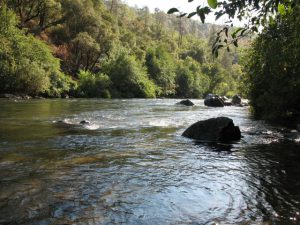
Interestingly, this success has been achieved without a massive increase in flows on the river, such as the plan proposed by the State Water Resources Control Board for the Stanislaus, Tuolumne, Merced and Sacramento rivers. Can there be any better evidence that habitat improvements are a better solution than flushing a lot of water down a river under the assumption that more water equals more fish?
The returning salmon are three years old. That means they started their journey as youngsters in 2014, a critically dry year and right in the middle of the driest period in California history. How do you explain the disconnect between big salmon numbers and low river flows? Maybe it’s not the amount of water so much as it is the quality of habitat the salmon have in the river.