STATEMENT: Voluntary Agreement on Water Represents the Future and Deserves Prop 68 Funding

STATEMENT: Voluntary Agreement on Water Represents the Future and Deserves Prop 68 Funding

By Mike Wade, Executive Director

California Farm Water Coalition

California has always prided itself on cutting-edge ideas. It is the place others turn to for new solutions to old problems. We are currently faced with a choice to continue that tradition of innovation with a fresh approach to water and environmental management or chain ourselves to outdated practices of the past.

Last fall, in a historic first, competing water interests came together to produce a voluntary agreement (VA) that will govern water use, habitat projects, and implement new science-based management practices. The Public Policy Institute of California (PPIC) says the VA would, “increase flows in rivers and the Delta and make major investments in habitat. And perhaps most important, create sustainable funding for these efforts (including fees on water diversions), while improving scientific research on and governance of restoration efforts.”

This agreement is the result of years of collaboration between government agencies, water users and environmental interests, conducting scientific studies and projects that put the new science into practice. The VA takes us out of the slow grind of the existing regulatory process and allows us to use scientific structured decision-making to address problems as we go.

The California Legislature is considering a budget this week with funds specifically earmarked for the VA that could provide additional momentum to this progress. Funding from the voter-approved Proposition 68 will help jump start this science-based process. That would mean choosing science-based rules and voluntary, holistic approaches to problems rather than the outdated regulatory status quo. The PPIC says, “What’s clear is that negotiated solutions to water conflicts are fairer and longer-lasting than top-down regulatory solutions or, worse yet, litigated solutions where judges end up trying to manage water.”

And there’s no reason to cling to the past. It’s clear that the current outdated system isn’t working for anyone. Endangered fish populations continue to struggle; farmers face dwindling water supplies; urban users make continuous cutbacks; groundwater supplies are dangerously depleted; and current policy does not address new challenges we face from climate change.

One of the many things this process has revealed is that helping struggling fish populations takes more than water, which is important, but not the only habitat feature fish need. It takes a combination of water at the right time plus attention to habitat, food supply and predator control.

There are other ingredients essential to this agreement. Under the VA, change happens now. Additional water for environmental purposes and habitat restoration begins immediately. That means we reap the benefits today. The regulatory approach could take decades. Plus, in another important first, agricultural water users will pay fees to implement ongoing environmental projects. While there is a need for initial Prop 68 funding, user fees are critical to long-term success because they are an ongoing source of funding.

In a letter to legislators in support of the VA, a group of statewide organizations, including the California Chamber of Commerce and the Bay Area Council, summed it up this way: “The Voluntary Agreements provide a tremendous opportunity to provide more water for fish, wildlife and habitat restoration and a more reliable water supply for a growing state with climate and water supply challenges. The Voluntary Agreement will replace the policy and legal conflicts that have defined the last three decades. Instead, they rely on a collaborative and adaptive management process that will move the state substantially closer to the coequal goals of providing a more reliable water supply for California and protecting, restoring, and enhancing the Delta ecosystem.”

California must choose. The Voluntary Agreement represents the future and a new path away from a failed regulatory approach.
We Need Both Wet Winters and Long-Term Planning to Stay out of Drought

We Need Both Wet Winters and Long-Term Planning to Stay out of Drought

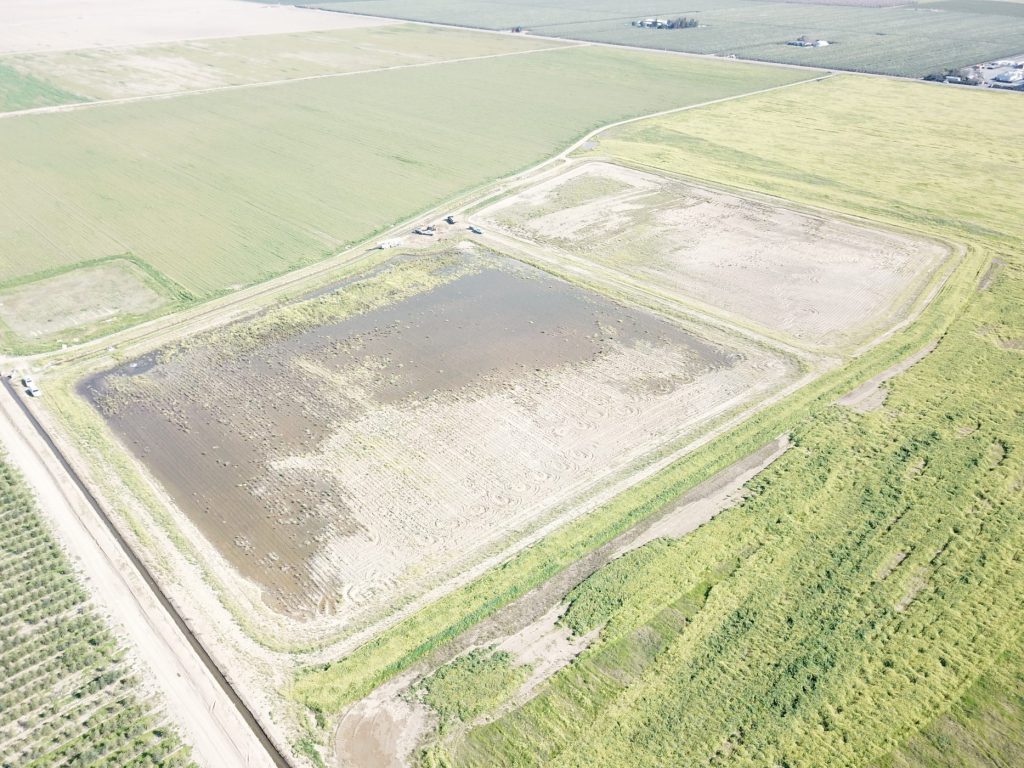
Groundwater recharge and storage ponds are part of the solution

An online search of “California drought” literally turns up millions of articles, and some of the headlines appear in conflict. One series says California is “drought-free” and others warn we’re still operating at a water deficit.

What’s the real story? Should California celebrate or is not yet time to stop doing our rain dance?

Both sets of headlines are true. We’ve definitely had a wet winter. As of April 2, the Sierra snowpack was 161% of normal and we’ve also had a lot of rain, with 18 trillion gallons falling in February alone. However, we also have depleted groundwater reserves due to the length and severity of our most recent drought. And most experts predict that California is likely to stay on this “boom” or “bust” water cycle for the foreseeable future.

The good news is there are things that can, and are, being done to equip the state to deal with our water and climate reality so Californians aren’t reduced to simply holding our collective breath each winter, waiting to see what Mother Nature decides to serve us. Water districts, government agencies and farmers have been researching solutions and preparing projects for years.

Large water storage projects are critical to our future. They allow us to save water in the wet years on a sizeable scale. Multiple projects are ready to go, with all the necessary research and studies completed and funding in the works. However, these projects obviously take time to build and we also need additional strategies to help us now.

Local water districts are expanding local and regional solutions to improve water management.

This is where local water districts have been stepping up to provide smaller solutions in the near term. By building infrastructure that captures high water flow when available, these projects help prevent flooding as well as direct that water into groundwater recharge areas. Many of these projects are now becoming operational.

One group of water districts known as the San Joaquin River Exchange Contractors Water Authority are currently expanding a pilot project. With funding assistance from U.S. Bureau of Reclamation, the Exchange Contractors, in partnership with the neighboring Del Puerto Water District, built a 20-acre recharge and recovery pilot project in the Orestimba Creek area. Due to its success, the Authority expanded the project to an 80-acre site with funding assistance from the Office of Emergency Services (OES) and the Federal Emergency Management Agency (FEMA). The expanded project, operational this year, will capture flood flows from both the San Joaquin and Kings Rivers as well as Orestimba Creek. It will provide a long-term solution to area flooding, as well as provide storage for that water.

An even larger project on Los Banos Creek, a cooperative effort among various water districts, is almost fully operational. It creates nearly 200 acres of additional recharge and storage ponds, 7 recovery wells and harnesses previously evaporating water.

In another approach, the San Luis Canal Company has invested millions in new technology and upgraded infrastructure. SLCC’s new water-regulating reservoirs and other infrastructure improvements allow for on-demand water deliveries. This makes it possible for individual farmers to install water conservation systems such as drip irrigation. The conserved water that results from these efforts helps take the pressure off our groundwater supplies. Similar projects are underway in other water districts as well.

Together, these and other projects provide multiple benefits. They not only conserve and store water, they take the pressure off the need to pump groundwater, help diminish subsidence, contribute to groundwater recharge, prevent flooding and provide a more consistent water supply to critical wildlife habitat as well as farms and people.

And in the end, we will need it all – wet winters as well as small and large projects, capable of capturing and storing the water that comes to us.

Bold Actions for People, Farms, and the Environment

Bold Actions for People, Farms, and the Environment

The United States Bureau of Reclamation is commencing a process aimed at modernizing the operations of the federal Central Valley Project (CVP).  For decades, the approaches to protecting the fish and wildlife dependent on the Bay-Delta watershed and estuary have been species-by-species and stressor-by stressor.  Those approaches have failed.  The effort by Reclamation responds to a consensus view within the scientific community and policy direction from the State of California – that, to improve protection and enhancement of fish and wildlife, comprehensive approaches are required.

The United States Bureau of Reclamation recently completed an important part of that process and issued what is known as a biological assessment.  In simple terms, a biological assessment evaluates the possible effects that a project or action may have on a species listed as threatened or endangered as well as critical habitat protected by the Endangered Species Act. The assessment leads to a set of rules to help protect threatened or endangered species, in this case, salmon, Delta smelt, and other fish dependent on the Bay-Delta. 

Reclamation’s biological assessment advances a proposed operation that responds to science and policy. It seeks to establish new rules that allow for operation of the CVP and SWP to meet the water supply needs of the people in urban and agricultural communities, within a suite of actions that address directly the many physical, biological, and chemical factors that adversely affect the health of the ecosystem.


This biological assessment process is a critical step in protecting our environment and our water supply.  The biological assessment looks back at what we’ve learned and applies it to future measures. In the case of the Bay-Delta, what we have been doing hasn’t worked as the health of the Bay-Delta continues to decline, with important species, like salmon and smelt continuing their death spiral to a point of near extinction.  Without undertaking this process and without the bold step by Reclamation, we remain mired in mistakes of the past.

Release of the biological assessment is one effort of many required to improve conditions for fish and wildlife and make water supply more reliable.  In December, California’s Director of the Department of Fish and Wildlife, Chuck Bonham, and Director of the Department of Water Resources, Karla Nemeth, laid out another effort, a far-reaching plan that incorporates what we have learned from past errors and current studies and establishes an adaptive management program designed to react to new science for the benefit of the ecosystem as a whole. This comprehensive solution provides stable funding for habitat restoration and a more comprehensive approach to fish protection and enhancement, including efforts to reduce predation, eliminate passage barriers, and increase hatchery production. Now, all parties need to commit to moving beyond incremental change and take bold action by finalizing the voluntary agreements.


Governor Gavin Newson is the right person to lead California into a bold new future for people and the environment. He joined former Governor Brown and Senator Feinstein in supporting a comprehensive solution.  The Farm Water Coalition had the opportunity in the not-too-distant past to host a tour into the heart of the San Joaquin Valley for then-Lieutenant Governor Newsom. We were impressed with his grasp of the issues, not only with respect to agriculture but for rural communities that depend on the farm economy and on the wildlife areas that partner with irrigation districts to improve water supply reliability for everyone.

Governor Newsom has been characterized as someone with big ideas and a willingness to take bold action. That’s what California needs as we look ahead to a new, overarching approach to protecting and enhancing the Bay-Delta and the water supplies of those in urban and agricultural areas as well as the willingness of locals to invest in that future.

Statement by Mike Wade, California Farm Water Coalition Executive Director On the Release of New Biological Assessments

Statement by Mike Wade, California Farm Water Coalition Executive Director On the Release of New Biological Assessments

SACRAMENTO, CA – Recognizing the failure of the existing biological opinions issued a decade ago by the U.S. Fish and Wildlife Service (USFWS) for Delta smelt and by the National Marine Fisheries Service (NMFS) for salmon, the Bureau of Reclamation released a new biological assessment which serves as the basis for new biological opinions that will be released within 135 days. The Biological Assessment details the manner in which the agencies will operate the project and make operations more effective in preserving fish and delivering water to communities and farms. The Bureau of Reclamation is now taking a common-sense approach and applying scientific principles to water supply and fishery protections.

“The current, outdated biological opinions have been plagued with operational problems that experts determined were largely ineffective at helping the endangered fish they were intended to help,” said Mike Wade, executive director of the California Farm Water Coalition. “In addition, the two outdated biological opinions often worked against one another, such as requiring more upstream storage for salmon to keep temperatures lower and at the same time, requiring more water to be released to the Delta to benefit smelt. These biological opinions have failed all parties – fish and wildlife, communities, and farmers,” he said.

The Bureau’s new Biological Assessment takes into account the failures of the older biological opinions and creates a new process to modernize operations, utilizing science and operational flexibility to improve the operations and efficiency of the Central Valley and State Water projects. The Biological Assessment makes several changes to the operations of the Central Valley Project, based on the experience with the older biological opinions, the drought, and prior policy decisions. This modern Biological Assessment requires science-based operational changes that respond to actual conditions rather than follow a calendar-based approach to species protections. Using a smarter approach encourages adjustments that will allow for better temperature control for salmon while reducing the impacts on the Delta. It bases flow requirements on a variety of factors rather than using flow as the sole determinant for water project management.

The Biological Assessment moves away from the failed presumption that water projects are the only cause of the decline in fish species.

“The new Biological Assessment starts with a “clean slate” and seeks to determine those effects that are unrelated to the projects but are impacting fish populations in order to manage the projects. By focusing on a more integrated and holistic approach, federal and state agencies can utilize science and effective operational measures in the new biological opinions to address all the factors impacting the fish populations, he said.

The operations analyzed in the new Biological Assessment are intended to allow the projects, designed and built to provide water to California communities, to fulfill that obligation and provide critical information to federal and state agencies that will improve the conditions for fish and wildlife and the Delta habitat.

Better Planet & Better Life

What can we do today to make tomorrow a better world? Smart food choices are great for the environment and enrich our daily lives!

CFWC Statement on Voluntary Agreements Presented to the State Water Board on its Bay-Delta Water Quality Control Plan

CFWC Statement on Voluntary Agreements Presented to the State Water Board on its Bay-Delta Water Quality Control Plan

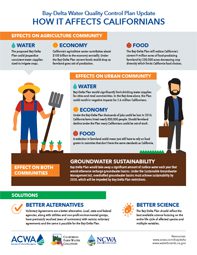
“Water users and the State of California have brought to the table almost 1 million acre-feet of water and almost $2 billion in funding to implement an unprecedented set of ecosystem restoration goals. It is a comprehensive, system-wide plan that will start showing progress in 2019 with restored habitat, functional water flows, improved temperature for fish, and floodplain improvements that are proven to grow stronger, healthier salmon on their journey to the ocean. We hope the Water Board will choose this more collaborative approach to its water quality control plan rather than a set of forced rules that will harm communities and the economy and that haven’t worked in similar efforts to help fish populations in the past.”

Learn more about the proposed voluntary agreements at: https://water.ca.gov/-/media/DWR-Website/Web-Pages/Blogs/Voluntary-Settlement-Agreement-Meeting-Materials-Dec-12-2018-DWR-CDFW-CNRA.pdf

Countdown: 1 Day to Drought

Countdown: 1 Day to Droughthourglass with dripping water close-up

On Wednesday, the State Water Board will vote to remove enough water from the system to irrigate over 200,000 acres of farmland or meet the domestic needs of 2 million people every year. If approved, this action will lead to one of the most predictable droughts California has ever faced.

Is a Compromise Still Possible?

UPDATE: Gov. Jerry Brown and Lt. Governor Gavin Newsom sent a letter late on November 6th requesting the State Water Board postpone action on the Bay Delta Water Quality Control Plan until December 12, 2018. View the Letter HERE.

Until the Board votes, it’s not too late.

Farmers, irrigation districts, large cities, small towns, schools, sanitation officials, economic development agencies, large industries, small business owners and millions of Californians who have implored the Board to reconsider are ready to sit down today, as we have been for years, and work out a compromise plan.

And we come armed with up-to-date science, real world data showing demonstrable results and a willingness to work for a sustainable solution that serves all Californians. The alternative serves no one and the devastation it would cause has been well documented – $3.1 billion in lost economic activity, according to local experts, thousands of jobs gone, land fallowed, loss of water to urban and disadvantaged rural communities alike, negative impacts on schools, local sanitation, and more.

Insufficient water means lost crop production.

 It’s also been well documented that decades of following this same water-only policy has had no effect – fish have continued to decline. And now, the benefits of trying another, more holistic approach are also documented.

A California future that includes healthy rivers and fish as well as jobs, fresh local produce and water for schools, businesses and homes is in front of us if the Board will allow it.

Countdown: 2 Days to Drought

Countdown: 2 Days to Droughthourglass with dripping water close-up

On Wednesday, the State Water Board will vote to remove enough water from the system to irrigate over 200,000 acres of farmland or meet the annual domestic needs of 2 million people every year. If approved, this action will lead to one of the most preventable droughts California has faced.

How Will This Impact Our Food Supply?

Simply put, less water for farms will mean less of the fresh, local produce our families depend on.

California farmers have proven incredibly resilient in drought situations, employing the latest technology to do more with less. However, while you can grow food with less water you can’t grow it with no water.

In conjunction with the Sustainable Groundwater Management Act, as much as 1 million acres statewide may be fallowed due to the combined impact of these two overlapping regulations. Just ONE acre of land can yield almost 100,000 pounds of tomatoes or 36,000 heads of lettuce. Imagine the impact on California-grown tomatoes, lettuce, oranges, avocadoes, apples, strawberries, grapes, almonds, peaches and more if we have one MILLION acres less to grow our food? You can’t support California’s world-class orchards without reliable water supplies from year to year. The Water Board’s answer? Grow different crops. But farmers grow the crops people want, not the ones the State Water Board’s policy dictates.

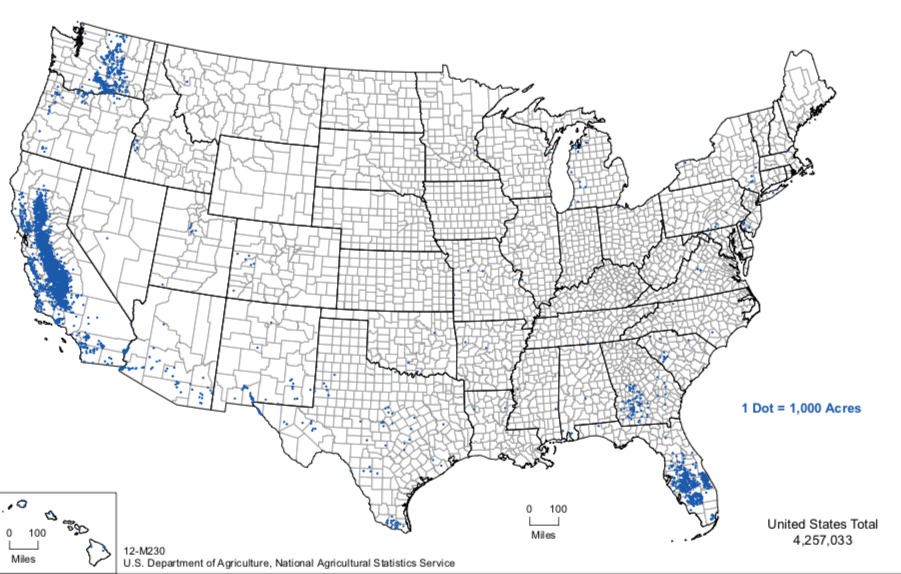
U.S. orchard land.

Will there be less produce available, higher prices, fruits and vegetables that are less fresh because they must be shipped in, or all three? It’s hard to know exactly at this point, but the impacts for California consumers will be measurable and will not be limited to freshness and availability.

Our food has to come from somewhere, right? So, if we have less California produce available, then what? If we decrease our capacity at home, we put the safety and reliability of our fresh food supply in the hands of other countries that do not grow food under the same strict regulations that we follow in California.

In addition, our environment will suffer. Importing food to replace what we don’t grow at home means more ships, moretrucks, and more pollution.

There’s still time to adopt compromise plans supported by water districts, scientists, education officials, health departments, farmers, farm workers, cities, economic development officials and others ready to implement solutions that science tells us will help.

Countdown: 3 Days to Drought

Countdown: 3 Days to Drought

hourglass with dripping water close-up

On Wednesday, the State Water Board will vote to redirect enough water in the system to irrigate over 200,000 acres of farmland or meet the annual domestic needs of 2 million people every year. If approved, this action will lead to one of the most preventable droughts California has ever faced.

Is This Just Fish vs Farms?

Absolutely not. The negative impacts of this policy are broad and deep. Education officials are concerned about water supplies for schools, water experts worry this will stall groundwater replenishment, health officials are troubled by potential impacts on sanitation, cities large and small don’t know how they will replace the lost supply, Bay Area experts are alarmed by potential cuts to water supply, lost jobs and lost economic activity, and the list goes on and on, including some unexpected consequences. In a recent article from Breitbart News, Joel Pollak writes, “Leslie McGowan, the CEO of Livingston Community Health, said local hospitals saw the impact of water shortages — in the rising number of indigent patients, and in the rise of opioid use and other forms of substance abuse.”

Read about additional consequences in the words of those impacted:

“Let us be clear. The detrimental impacts of the Board’s plan will be felt strongly by the children that we serve. . . it is unclear why you have not taken the time to study the financial implications to school districts that would be forced to provide bottled water and portable toilets, or relocate schools entirely, as wells go dry. . . Access to drinking water and water for sanitation is a basic requirement for us to fulfill our mandate to provide quality education to the children of our districts.”

Steven Gomes, Merced County Superintendent of Schools
Tom Changnon, Stanislaus County Superintendent of Schools

 “Many communities in the Merced area are already experiencing well production problems and drinking water quality issues . . . Over 800,000 people live in the two counties [Stanislaus and Merced]. Groundwater is the primary source of drinking water for the majority of the local population. The plan sorely understates the devastation this recommendation will cause. As an Interim Director of Environmental Health, I am required to ensure that safe, adequate, and dependable water supplies are available for domestic use.”

Vicki Jones, Interim Director of Environmental Health
Merced County Department of Public Health

“The consequences of these cutbacks potentially could cripple our Bay Area economy. Our initial economic analysis of the first iteration of this plan forecast up to 51 percent rationing, resulting in 140,000 to 188,000 jobs lost in the Bay Area.”

Harlan L. Kelly Jr., General Manager, San Francisco Public Utilities Commission
Nicole Sandkulla, CEO and General Manager, Bay Area Water Supply & Conservation Agency. 


There’s still time to adopt compromise plans supported by water districts, scientists, education officials, health departments, farmers, farm workers, cities, economic development officials and others ready to implement solutions that science tells us will help.