Water management: A Super Bowl of a different kind

Water management: A Super Bowl of a different kind

By Stefanie Schulte, New South Wales Irrigators’ Council

A visitor to the United States cannot fail to notice that Americans love their sports. Be it baseball, basketball, tennis, ice hockey or football – Americans ‘live and breathe’ their games. Back home in Australia there is no difference, just substitute cricket with baseball, field with ice hockey, and ‘Aussie rules’ football is a bit different to American football too, but let’s not get too technical. At the moment, it seems to be a particularly exciting time with the Super Bowl coming up on 1 February. Two teams battling for an action-packed 60 minutes with the aim to win a shiny trophy at the end, somehow reminds me a lot of the water management in Australia…

Switching off the tap for productive water user

Since Australia’s ‘millennium drought’, water management has taken a different turn. Extremely low precipitation, high temperatures (and a Federal election) enticed the then Prime Minister John Howard to introduce a AUD10 billion (USD 8.2 billion) national water management plan in 2007 with the words ‘the old ways of managing the Basin have reached their used-by-date’. The media and environmental groups spoke of degrading environmental health, poor water quality and a dying Murray Darling Basin and demanded that something needed to be done before the current trend became ‘irreversible’.

What came next was a long list of Federal and State legislation rewriting water management in Australia – at least in the Murray-Darling Basin. A key piece of legislation was the Federal Water Act in 2007, which kicked off a multitude of initiatives that removed productive water from agricultural production and transferred it to ‘the environment’ through water purchases and infrastructure funding programs. Needless to say, the Water Act 2007 effectively created new ‘rules of the game’ and the rules were certainly environmental.

southernbellfrog
Southern bell frog

Fish vs. Frogs

While the Seahawks and Patriots will battle out the super bowl championship on Sunday, the lineup in water management looks slightly different. We have agricultural producers and regional communities on the one hand, environmental groups and some urban communities on the other hand – however both ‘teams’ have vastly different motivations and goals.

It seems that every State has its own ‘Delta Smelt’ – in New South Wales it is just a large green, ground-dwelling tree frog called the ‘Southern Bell Frog’. This particular species is classified as endangered in the state of NSW and was claimed to be at the brink of extinction during the height of Australia’s millennium drought. It provided a perfect platform for environmental groups to ask for remove of nearly 5.5 million acre feet of water from agricultural production.

Removing large quantities of productive water to save a species and thereby restricting farmers’ and communities’ access to the most important resource for their agricultural production and survival– I feel I have heard this before… sounds an awful lot like the Delta Smelt case.

It seems to be irrelevant which side of the Pacific you are on – there are always two teams – those who want to use water for food and fibre production to feed a growing world population and those who want to pour it out to sea.

Millennium Water Management Planning

Admittedly, Rome was not build in a day but water management planning in Australia is soon approaching a decade. What started out as a 10-point plan and $10 billion dollar has transformed into complex and confusing framework that often does not achieve its ‘environmental’ objectives but leaves Australian rural agricultural producers and communities with significantly less productive water to grow food and fibre. The impact can be seen everywhere.

Compared to Australia, California seems to have just embarked on rewriting its water management in the state, however some of the changes are looking to cause significant economic upheaval – groundwater legislation comes to mind. If California is to learn from Australia’s experience then it is that good water management planning must come from the ‘bottom up’ with a clear goal, a solid business plan and comprehensive stakeholder engagement. This did not happen in Australia and therefore caused a lot of pain in regional communities.

While Seahawks and Patriots will be playing for the world championship on Sunday 1 February, the battle about water management on both sides of the Pacific will continue for many years to come.

Stefanie Schulte is the Policy Manager at the New South Wales Irrigators’ Council. The Council represents 12,000 water licence holders in NSW. Its members include valley water user associations, food and fibre producers, irrigation infrastructure operators and commodity groups. Visit: http://www.nswic.org.au/

Fish don’t have calendars

Federal government cuts water supply to farms

On January 1 the federal National Marine Fisheries Service (NMFS) instituted a management action that reduces water deliveries to 25 million Californians and millions of acres of struggling drought impacted farmland. All of this is done in the name of protecting salmon. But fish don’t have calendars. Regrettably, NMFS continues to use a robotic calendar-based approach to fish management despite ongoing real-time monitoring and sampling triggers that would more accurately gauge the protection needs for fish.

Real-time fish monitoring ignored

State fishery managers recently used such real-time techniques to protect Delta smelt. Why aren’t their federal counterparts using the same smart approach toward species protection? It’s not as though the federal biologists aren’t aware of real-time fishery management. In its December 30 regulatory announcement NMFS stated, “NMFS has discussed utilizing a real-time monitoring based approach with Reclamation and other parties, and remains open to developing such monitoring based real-time triggers for next year.”

Terrific. Another year will go by and farms will continue to be denied water that could legally be delivered while still protecting fish under the flexibility that environmental water managers have.

Massive food production opportunity lost

In just 22 days from December 15 to January 5 California’s water supply has lost 252,748 acre-feet of water due to Endangered Species Act-related pumping restrictions. That water could have irrigated over 84,000 acres of food-producing farmland. Because roughly half of the nation’s fresh fruits, nuts and vegetables come from California, production losses here are significant on a national scale. How much food? Here are a few individual examples of what that water could have grown in California with three acre-feet per acre. Many farmers use less.

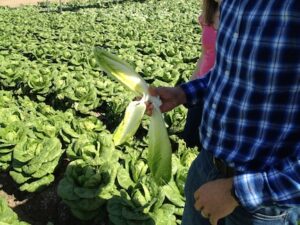
7.4 billion servings of broccoli (3 oz.)IMG_4584

10.8 billion servings of avocados (1.1 oz.)

10.9 billion servings of bell peppers (5.3 oz.)

11.1 billion servings of leaf lettuce (3 oz.)

24.2 billion servings of celery (3.9 oz.)

(Serving size based on FDA nutrition guidelines)

Increased dependence on foreign food

Meanwhile our dependence on foreign food production continues to escalate. Every unplanted acre here at home opens the door for a producer in another country to plant and grow a crop under conditions that have long been illegal here in California – e.g. poorer labor standards, clear cutting of land, unchecked pesticide use, etc.

Let’s hope NMFS provided all of the salmon in the Delta with a new calendar for Christmas so they know when to start their migration. This situation begs another question of course, if NMFS isn’t going to actually use the real-time capabilities that have been developed at significant cost, why bother?

Mismanaging Floods in a Drought – Updated 12-15-2014

Reduced Pumping Now May Protect Future Supplies

The Department of Water Resources (DWR) and U.S. Bureau of Reclamation (USBR) in conjunction with the U.S. Fish and Wildlife Service (USFWS) are experimenting with pumping reductions for several days to prevent a “turbidity bridge” from occurring in the central and south Delta. Delta smelt are attracted to turbid, or cloudy, water because it provides shelter from potential predators, such as non-native bass. According to a statement today by DWR, “Foregoing the capture of tens of thousands of acre-feet of water over the next several days may allow water project operators to avoid the loss of hundreds of thousands of acre-feet of water supply later in the winter.”

Turbidity Reduced Pumping in 2012

In December 2012, a plume of turbidity that extended into the central Delta helped to create the situation in which water project operators severely curtailed pumping storm runoff in order to avoid harm to smelt. As a result, hundreds of thousands of acre-feet of water were not moved into reservoir storage.

Will the Risk Pay Off?

Clearly there is risk associated with a decision like this. We hope the risk pays off.


Mismanaging Floods in a Drought (12-12-2014)

While this week’s big storm dropped significant amounts of rain and snow in California, many water users worry that we are on track to repeat the disaster of last year. Hundreds of thousands of acre-feet of water were in the system and Delta pumps were almost completely shut down. It surprises many that we are mismanaging floods in a drought. As it turned out, last year’s wasted water resulted in most South of Delta water users getting a zero allocation and the state suffering significant economic and social damage with no measurable environmental benefits.

As this really big storm brings its bounty of water we are situated just like we were 12 months ago except that now the State’s reservoirs and its groundwater are substantially more depleted than they were exactly one year ago.

Pumping plants are running at reduced levels

Last week, the C.W. “Bill” Jones Pumping Plant at Tracy was running at a pathetic 19.7% of capacity. This week it is running at 60% capacity, or 2,600 cubic feet per second (cfs) out of a permitted level of 4,300 cfs. Delta outflows, in comparison, are six to over 30 times the permitted export level.

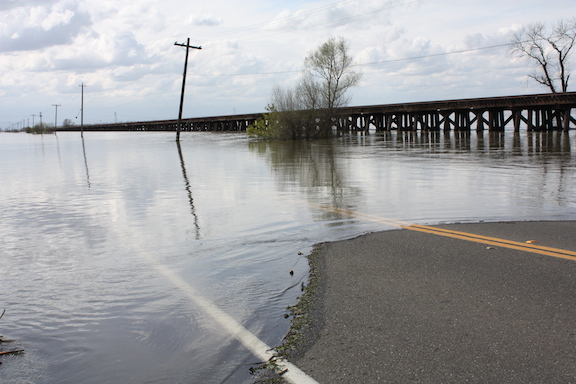
Water Flow_0048The possibility of Delta smelt will prevent additional pumping

Delta inflows are rising dramatically and with very high outflow, perhaps exceeding 100,000 cfs, a significant amount of water is available for export to put into storage for next year’s crop season. Many agencies will be in flood control management mode. Nonetheless, with the state in a historic drought, pumping is likely to be sharply curtailed due to the possibility that smelt are cloaked in the turbid water stirred up by storm flows. Except for a marginal theoretic benefit to Delta smelt, the entire southern half of the state would be able to access this precious resource, which instead will be turned to salt in the Pacific Ocean.

This is just the kind of Kafkaesque nightmare the Emergency Drought Legislation sought to relieve… at least around the margins.

Perhaps the crystal ball is wrong. If not, let’s hope this year we are better prepared to make the case that such behavior is blatantly contrary to the public interest.

Stanislaus River’s Restored Salmon Habitat

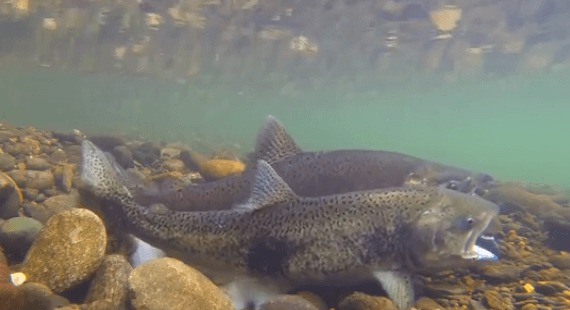
Restored salmon habitat on the Stanislaus River

Entitled “Replenishing a River: Stanislaus River Honolulu Bar Restoration,” this 11-minute video uses underwater photography, still images and narration to illustrate an important project for restored salmon habitat that was completed in 2012. The Oakdale Irrigation District and U.S. Fish and Wildlife Service split the cost of the $1.1 million project. The work was done over two years by the biologists, engineers and technicians at FISHBIO.

Addressing the steep decline in salmon and steelhead trout populations in Central Valley waterways has been a shared priority of government officials, environmentalists and local water agencies for decades. Fall run Chinook salmon are listed as species of concern by California Department of Fish and Wildlife and steelhead are listed as a threatened species under the federal Endangered Species Act.

Diminished habitat key factor in population decline

Historically, tens of thousands of salmon returned to the Stanislaus River to spawn each year. In contrast, only about 6,000 returned this year. Diminished habitat in the river is a key factor in the decline.

stanislausriversalmon-oakdale
Salmon spawn in restoration project area

The Honolulu Bar project focused on a 2½-acre site that was part of a larger gravel dredge bar in the river about halfway between Oakdale and Knights Ferry in northeastern Stanislaus County. The intent was to restore and, in some cases, create vital habitat for adults to spawn and juvenile fish to thrive until they begin their journey downstream through the Delta and San Francisco Bay to the Pacific Ocean.

Balanced approach protects farms and the environment

“I think we have to recognize that all these things – water, the resources they provide, the fish, the farming – we all have to live together in a healthy manner. You cannot use river assets and then not work to protect those river assets,” said Steve Knell, general manager of the OID.

World Agri-Tech Investment Summit


Register I Agenda l Speakers
Dear CFWC Member,The World Agri-Tech Investment Summit USA, supported by California Farm Water Coalition, taking place in San Francisco on March 3-4 2015, will gather together a truly outstanding group of international agribusiness leaders, technology innovators and investors to define future alliancing and investment opportunities in sustainable agriculture.

View the latest agenda here
Partnerships and Alliances for InnovationWhat has been the route to market for the biggest success stories in agri-tech? How do agribusinesses balance internal R&D with external collaboration and partnership? Where are the opportunities for greater horizontal collaboration with other industries?


The Business of Big Data in AgWhich companies are driving the new front in the rapidly expanding industries of robotics, drones, microsats, aginformatics and wireless communication?  How can we achieve data/systems integration of these technologies and what can we learn from other industries in this field?


Ag Biologicals under the Microscope As biologicals become more mainstream will registration and regulation become more of a hurdle? What are the challenges to scaling up biologicals to ensure a consistent quality is maintained? Microbial solutions are now gaining traction – which markets/applications present the biggest opportunity?


New Investors Entering the Agri-Tech MarketWhich sectors of agri-tech are reaching escape velocity?  How is this sector viewed by VCs entering the market? When is the agri-tech sector going to be interesting for private equity and growth capital?  Which technologies are generating most interest from entrepreneurial family offices?


With extensive networking opportunities, roundtable discussion groups and 1-1 meetings, the two-day summit brings together experts from around the world to share best practices and case studies and to identify the most exciting opportunities for investment and collaboration.Register your place today and quote cfwc2015 to secure a 20% discount and a rate of £995 / $1595.

I hope to see you there!

Mike Wade

Executive Director

California Farm Water Coalition


Agri-Tech Investment Summit

World population continues to grow and is expected to reach 9 billion by 2050, a 27 percent increase over today’s population. At the same time, a growing middle class across the planet will be more competitive for resources, goods, services, and of course, food. Not only will there be more people to feed by 2050, per capita consumption of food and other resources will likely be higher as well.


California is a significant producer of fresh fruits, nuts and vegetables. A USGS survey on food production reported that California produces one quarter of the nation’s food supply on just 1 percent of the nation’s farmland. Because California farm products make up a sizable portion of the state’s exports, production here also has international implications. Pair that with a declining amount of farmland in California and you have a recipe for disaster.


Which leads us to the question, “How will we feed the world’s population on diminishing amounts of farmland?”


That answer may be forthcoming at the upcoming World Agri-Tech Investment Summit on March 3-5 in San Francisco. CFWC will moderate a panel titled, “Water Smart Agriculture: Opportunities in the New Realities.” If you’re interested in learning more about the global perspective on food production and water use efficiency you should consider attending this big event. Information on the Summit is available at www.worldagritechusa.com/


Reservoir Levels Map

California relies on water stored during wet years for use during dry years.
Water storage, both above and below ground is critical to California. 
 
This map shows how much water is in California’s major above-ground storage.
These California’s Daily Reservoir Levels, per Department of Water Resources’ CDEC, is the water currently stored in our above-ground water storage.

Map not loading? Check the source by clicking here.

Looking for more detailed information about reservoir levels? Check out this chart, updated daily by the Department of Water Resources

Opposition to California Drought Legislation is Misleading

Opposition to H.R. 5781 is Misleading

H.R. 5781, Congressman David Valadao’s drought relief bill requires water exports to stay within the existing salmon and Delta smelt biological opinions.

Concerns raised by NRDC’s Doug Obegi are a red herring to thwart progress on providing water to a parched Central Valley. Exports may increase, as Obegi says, but they would be at a time when salmon and Delta smelt aren’t at risk.

Agricultural losses this year exceed the value of California’s entire 1.8 billion salmon industry

It’s also funny that Obegi is so concerned about fishing jobs and economics at a time when harm to the economy and job losses in agriculture are much worse. A university study this year reported that there were 17,100 farm-related job losses in California in 2014 and a $2.2 billion hit to the farm economy, eclipsing the state’s entire salmon industry, valued at $1.8 billion, according to fish and wildlife economics and statistics consultant Southwick and Associates.

17,100 farm-related job losses in California in 2014 and a $2.2 billion hit to the farm economy

The burdensome regulations that have withered Central Valley food production are the work of Obegi and NRDC in the courtroom. Of course he doesn’t want anything to change.

Any potential land fallowing in the Sacramento Valley would be done on a voluntary basis, as it is today.

Any potential land fallowing in the Sacramento Valley would be done on a voluntary basis, as it is today and water use decisions there are properly managed to protect the mosaic of abundant Sacramento Valley agricultural and wildlife resources. Delfino’s concern is nonsensical that the Sacramento Valley would be making decisions that benefit others while at the same time hurting themselves.

There is a positive relationship between Northern California and other parts of the state. It’s doubtful that they will do anything to diminish that. Maybe that’s really what worries Delfino.

STATEMENT: Water allocation is good news; but does not end drought or restrictive regulations

Water Allocation is Good News, But Doesn’t End Drought

The following is a statement by Executive Director Mike Wade of the California Farm Water Coalition in response to the DWR announcement of 10 percent water allocation from the State Water Project.)

“Today’s announcement that the State Water Project will deliver an initial allocation of 10 percent of contracted amounts to its contractors is good news, but it does not signal an end to the drought or environmental regulations that have resulted in low deliveries to farms, homes and businesses. As indicated by DWR Director Mark Cowin, that number could fluctuate depending on the months ahead and how much rain and snow fall in our state.

“The State Water Project delivers water to nearly 1 million acres of farmland. Another 2 million acres is serviced by the federal Central Valley Project, which delivered zero percent of contracted amounts in 2014. Farmers receiving water from the CVP must wait until early next year to learn if the U.S. Bureau of Reclamation will deliver any water.

“Farms, homes and businesses have experienced water cutbacks for 20 years because environmental regulations have prevented water from being delivered. Yet, no studies have provided proof that water directed for these environmental purposes has provided any benefits. It is time to rework these onerous regulations that are harming our citizens.”

On the Abandonment of Federal Drought Legislation

Drought Impacts

On the Abandonment of Federal Drought Legislation

“California’s Central Valley has shouldered more Federal Drought Legislationthan its share of the pain brought on by reduced water deliveries and the drought. For more than 20 years, misguided environmental policies have drained California of over 20 million acre-feet of water – water that was originally intended to grow food. These regulations have flushed enough water out of the system to fill Lake Shasta five times.

That might make sense if dumping massive amounts of water was actually helping the ecosystem but it’s not. Threatened and endangered fish continue to languish. The supporters of those failed policies continue to press our elected leaders to do nothing rather than find a balanced solution that serves people at the same level that we serve the environment.

It’s these regulations that Senator Feinstein was attempting to modify; To deliver more water to our communities without harming the protections in the Endangered Species Act. But that didn’t happen.

When we look around the Valley we see unemployment, long lines at food banks, failed businesses, portable showers for people without water and almost half a million acres of fallowed farmland. It’s reliable water that enables that land to produce the food that fills grocery shelves across the state and around the world. We are eroding our ability to feed ourselves and employ our people.

Without needed reform there are two certainties we can count on: The situation for Valley residents isn’t going to improve and neither will the situation for the environment.”


Mike Wade
Executive Director
California Farm Water Coalition