Water allocation inches up despite abundant supplies in reservoirs

Water allocation inches up despite abundant supplies in reservoirs

(The following is a statement by the San Luis & Delta-Mendota Water Authority on the updated Central Valley Project water allocation)

Water allocation inches up despite abundant supplies in reservoirs

LOS BANOS, CA – Today, the United States Bureau of Reclamation inched up the allocation for south-of-Delta Central Valley Project (CVP) agricultural water service contractors by raising the expected amount of water to be delivered from 40% to 45%. The new allocation is still less than reasonably could be made by Reclamation. Last year’s record hydrologic year left a tremendous amount of water in the system, yet allocations remain low for many Central Valley Project water users.

“Water users today were dismayed by the relatively small allocation increase announced by Reclamation,” said Cannon Michael, chairman of the San Luis & Delta-Mendota Water Authority. “It is unbelievable that the statewide average for CVP reservoirs is almost 108 percent of normal, yet South of Delta farmers are left with a 45 percent allocation,” he said.

The last hydrologic year, 2017, was the wettest year on record in the Sacramento River watershed, and presently, most CVP reservoirs remain above their historic average.

With the abundance of water, the 45% allocation reveals that regulations, not the availability of water, are creating supply shortages and impediments to the efficient operation of the CVP.

“If the system cannot provide an adequate amount of water when water levels are above average, then clearly changes need to be made to the regulations governing the CVP,” said Frances Mizuno, Interim Executive Director of the San Luis & Delta-Mendota Water Authority.

The allocations this year are particularly harmful to communities served by CVP water because they depend on higher allocations in years of water abundance to offset lower allocations in dry years. “The state’s groundwater aquifers need to be replenished when supplies are available but that cannot happen if water deliveries are limited when surface water is available to deliver to farmers,” said Mizuno.

“Reclamation, along with other federal agencies must reevaluate the decision-making process when these conservative and restrictive operations create enormous hardships for agricultural, urban and environmental water users,” said Michael. “The federal government continues to tell us about declining in fish populations and yet it resorts to the same ineffective policies of the past,” he said.

Communities served by the CVP have received progressively lower allocations which have impacted groundwater and water quality. And, farmers have been forced to fallow land and cut food production due to the uncertainty around water deliveries.

###

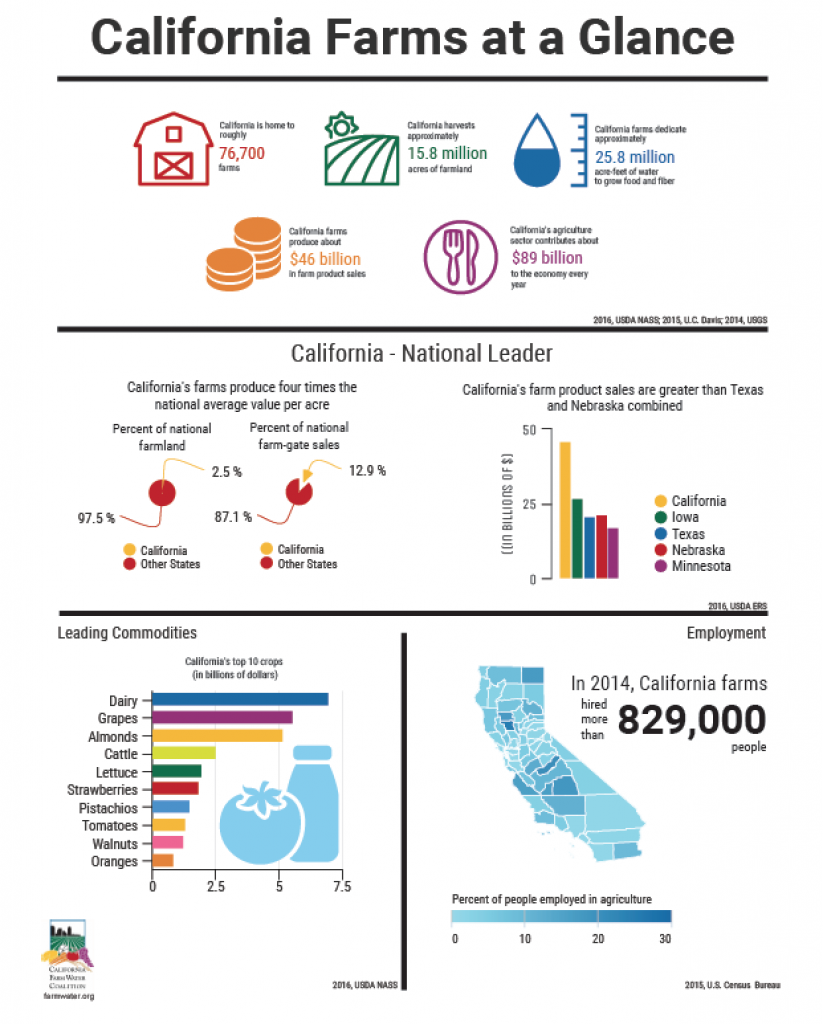
California Farms at a Glance

Learn more about California’s farms and their contribution to the economy with this fast fact sheet: California Farms at a Glance.

California Farms at a Glance Click to Download as PDF

California farms are leaders in the nation- producing high-quality, affordable, and abundant farm products efficiently. Our farms form the backbone of many rural economies, supporting businesses, jobs, and their communities.


DWR announces 30% allocation for 2018

Contractors of the State Water Project learned today that their water allocation has been raised to 30% due to late precipitation and snow in March, up from 15% in December. The State Water Project, operated by the Department of Water Resources, provides water for more than 27 million Californians and approximately 750,000 acres of California farmland.

The Department of Water Resources noted that despite above-normal precipitation in March and April, California’s major reservoirs, which are already well above their historical average water levels were unable to capture the increased runoff caused by warming weather.

Coming on the heels of widely-publicized research suggesting climate change may result in increasingly volatile water supplies, DWR’s announcement today underscores the urgent need to expand water storage wherever possible to capture and hold runoff from snow melt.

Invasive Species in the Delta: +1?

Invasive Species in California’s Delta: Nutria

Another invasive species is threatening to invade California’s Delta. Joining a long list of non-native & invasive species damaging ecosystems, degrading infrastructure, and hurting wildlife, Nutria have been found near the ailing Delta.

Past invasive non-native species that have found their way into the Delta, like water hyacinth, Chinese mitten crabs, and American Bullfrogs remain persistent challenges, bringing a host of problems for native species, particularly those already threatened or endangered.

Not content to just compete for food and habitat, many invasive species also introduce parasites and disease, or actively prey on native species like Chinook salmon and the Delta Smelt.

Nutria, are a non-native species once intentionally brought into California (for fur) like large-mouth bass (recreational fishing), and American Bullfrogs (as food) for the purposes of economic development. Today, they are widely known to threaten native species by damaging habitat, degrading infrastructure, and introducing disease.

California’s Delta faces numerous invasive challenges that alter habitats, deplete the food web, and impair water quality, including emerging algal blooms, as well as long term issues from numerous non-native plants.

HOW CAN CALIFORNIA HELP THE DELTA?

There is hope for the Delta, bolstered by emerging science and an understanding that more than just increased water flows are needed for healthy ecosystems. Identifying the problems that plague California’s native landscapes is the first step in determining a sensible course of action to correct them.

A Bold New Approach to Ecosystem Management

A Bold New Approach to Ecosystem Management

For decades, California’s water policy has been based on a false choice – choose healthy ecosystems with abundant fish and wildlife or choose water for people, farms and other purposes. And for decades the policies based on this choice have utterly failed all water users. Fish continue to decline; wildlife refuges suffer and cities and farms struggle to meet their needs.
Not willing to accept a system that forces Californians to pick winners and losers, scientists, farmers, conservationists, fishing interests and others have been working together to find creative solutions that work for all. A host of projects throughout the state have been launched with some impressive results all leading to the same conclusion: we must move away from thinking that says the only measure of a healthy ecosystem is the amount of water in our rivers and embrace a holistic approach that considers an array of factors.

Now, in an exciting new report, the Public Policy Institute of California (PPIC) details recommendations from prominent water scientists embracing this new approach to policy focused on comprehensive solutions.

These scientists discuss specific benefits of looking at the health of the eco-system as a whole rather than focusing on individual components. And most importantly, the paper recommends that current science guide future policy rather than blind adherence to past practices. In a separate article, Jay Lund, professor of watershed sciences at UC Davis says the current water-only focus represents, “a sort of a scientific laziness.”

And this is not just scientific theory. Across the state, diverse interests are working together to create and implement solutions to water problems that have produced concrete results demonstrating the validity of the holistic approach. A few examples include:

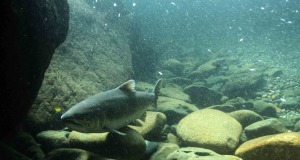
  • In Redding, farmers, environmental groups and government agencies are creating safe habitat to protect salmon from predators. It helps the salmon survive and frees up water for other uses. A healthy ecosystem makes the whole river better for everybody.
  • In the San Joaquin Valley, Del Puerto Water District is building a first-of-its-kind recycling project that addresses agricultural and wildlife refuge water supply shortages utilizing recycled water. Use of the recycled water helps reduce urban discharge into the San Joaquin River, groundwater pumping and reliance on the Delta while freeing up other water for the refuges.
  • The San Francisco Public Utilities Commission (SFPUC) working with other water interests along the Tuolumne River has put into practice the kind of plan the PPIC report discusses. It uses a comprehensive approach that manages fish habitat, predators, and water flow in order to support the fish population while maintaining water supply reliability for all of its other users – farm, city, recreation and environment.
  • Farmers in the San Luis & Delta-Mendota Water Authority are helping fund one of the most exciting projects so far. Known as the Nigiri Project, it connects the fish food in flooded Sacramento Valley rice fields to the river where fish can access it and thrive.

These are just a few examples of projects underway that show what can be accomplished when water users side-step our broken water management system and collaborate on innovative, science-based solutions. We applaud the PPIC report and urge the state water bureaucracy to either lead us towards the comprehensive approach described or let progressive conservationists, farmers, scientists, cooperative agencies and fishing interests take the lead and find solutions that work for all California water users.

Food Water Footprints, Interactive Fact Sheet

California is a world leader in food and fiber production. Our state produces more than 400 different crops across a wide range of climates, soils, and topographies. Family farmers who are experienced with local conditions adapt to circumstances, using their expert judgement, innovative practices and technologies help to make California the nation’s leading farm state.


Salmon numbers down but there’s hope in the floodplain

Salmon numbers down but there’s hope in the floodplain

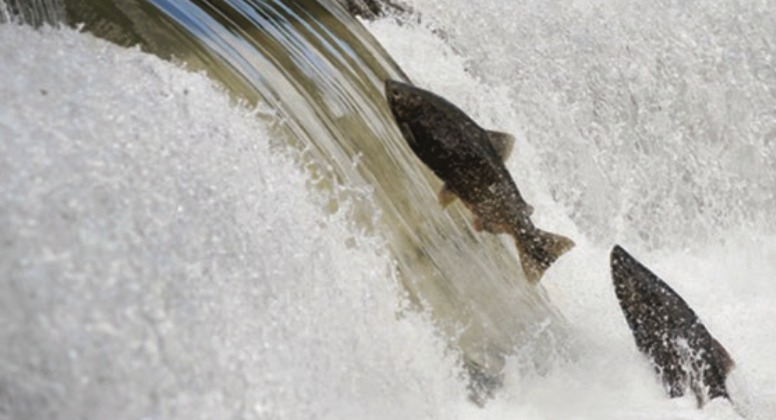
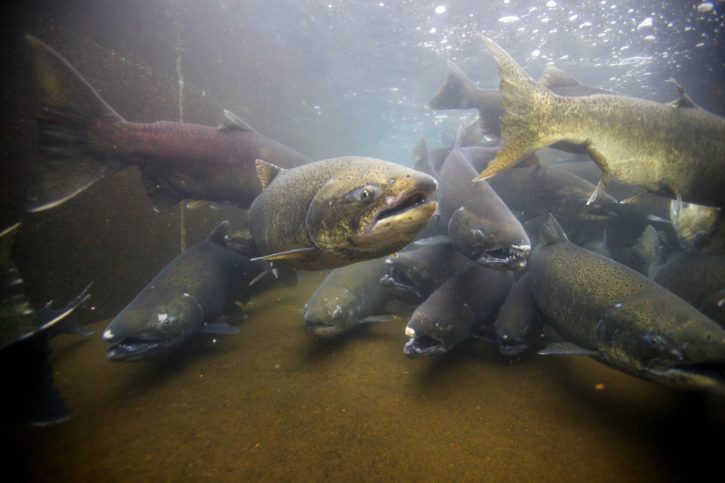
There have been valid concerns for years about the declining fish populations in California. While the immediate forecasts for the year aren’t much improved, there is reason for hope. Projects now underway are showing great promise in helping to turn around declining salmon numbers. The Nigiri Project is a collaborative effort between farmers and researchers to help restore salmon populations by reintroducing them during winter, to floodplains that are farmed with rice during summer. Salmon given time to grow in floodplains are bigger and healthier in a shorter period of time than fish left to their own in the Sacramento River. The project, operated by CalTrout, is being funded by a public-private partnership including Sacramento and San Joaquin Valley farmers, the California Department of Water Resources and Department of Fish and Wildlife, UC Davis, and others. More cooperative efforts are also underway to improve salmon fisheries in California’s rivers, such as rebuilding spawning habitats, and reducing predation.

New regulations for salmon fishermen may be coming because stocks are now considered by regulators to be overfished. Sadly, this is more evidence that past efforts to repair salmon populations have failed all of us – fishermen, the farmers who have faced water supply cuts, and the taxpayers who, in large part, foot the bill for the work of state and federal fishery agencies.

At the same time, farmers south of the Sacramento-San Joaquin Delta received a meager five percent water allocation in 2016. In 2014 and 2015 it was zero. But even with those water restrictions salmon populations are down 97 percent from their most recent peak of 12.9 million pounds in 2013. It cannot be more clearly stated that water is not the solution to restoring salmon numbers.

Efforts like the Nigiri Project that help improve salmon habitat and health while they’re young and make them stronger to survive their migration to the ocean may be the answer to the salmon dilemma. They’re showing progress where other efforts have failed.

The System is Broken

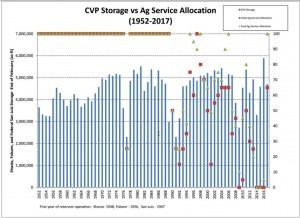
Over the past 25 years there has been considerable controversy over allocation of the Bureau of Reclamation’s Central Valley Project (CVP) water supplies. Allocation amounts vary wildly with one routinely getting 100% while others receive dramatically less. Water project opponents say that’s the result of our water rights system but those rights haven’t changed and the water service contractors are worse off than they have ever been.

Going back to 1994 South of Delta water service contractors received, on average, a 43 percent initial water allocation. But if you specifically compare years similar to 2018, where we have in excess of 4.8 million acre-feet of water stored in Shasta, Folsom and the federal share of San Luis Reservoir, the story is much different. In years like 2018 the initial allocation was on average 60 percent, not the 20 percent announced by Reclamation on February 20. On the Eastside, Friant Class I allocations are just 30 percent. Upon learning of the meager allocations Westlands Water District board member Todd Neves questioned how farmers can possibly plan based on such a paltry initial allocation.
So, what’s going on? Reclamation says its conservative allocation announcement is due to uncertainty on how much cold water will be available in Shasta this year for salmon in the Sacramento River. The CVP was designed and built in large part for the purpose of supplying water to farmland but it is now being managed first and foremost for the benefit of fish. That would be fine if these management decisions, mostly driven by the National Marine Fisheries Service, resulted in more fish but that’s not the case. Salmon populations have plummeted along with the reliability of the CVP to deliver water to Sacramento and San Joaquin Valley farms.

What’s the solution? Invest more in the science and the kinds of projects that ARE having a positive impact on salmon populations. The Nigiri Project, a public/private partnership, is showing that flooded rice fields can work for both fish and agricultural water users. Smart predator control and improved salmon habitat in the Delta can help baby salmon make it safely to the ocean where they can grow and return to spawn as adults. The Bureau of Reclamation must consider its obligation under the WIIN Act, which requires the agency to use a science-based approach instead of intuition with regard to water management. Building more water storage projects to help meet California’s future water needs is critical in light of the volume of existing storage that has been lost to serve new demands that were not part of the plan when the CVP was envisioned and built. And encouraging project operators to use the tools and legislation created for flexibility in ensuring that all areas of water management include a balanced approach. After all, water is the foundation for safe, clean and a healthy food production of our nation’s best food and fiber products.

Nutria- Another danger to California’s water

Nutria are back in California

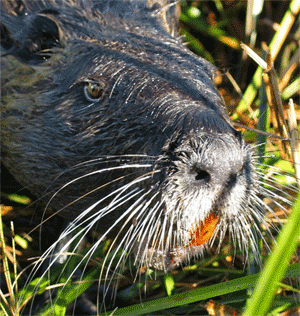
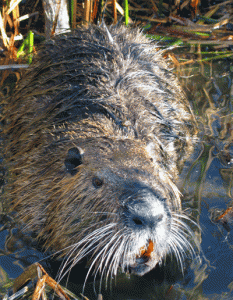
Image courtesy of U.S. Fish and Wildlife Service

Nutria, an introduced rodent once thought eliminated from California, is the latest of a string of dangerous invasive species wreaking havoc in California’s critically-important Sacramento-San Joaquin Delta.

The nutria, like many other destructive non-native species (large-mouth and striped bass, Asian clam, Chinese Mitten crab, Quagga mussels and Nerodia water snakes, among others) not only threaten the critical infrastructure that provides water, protects our communities, and creates jobs, but they also carry disease, and disrupt natural ecosystems that  threatened and endangered native species rely on.

Acting quickly can help prevent these invasive pests from gaining a foothold.

Why are nutria such an urgent challenge for California?

Infrastructure damage – Nutria excavate burrows in California’s aging levee system, degrading the integrity of the levees and putting farms, communities, and cities in danger.

Ecosystem Destruction/Competition – Nutria consume approximately 25% of their weight daily, burrowing through and destroying the vegetation of wetlands and estuaries as they seek roots, plant stems, and rhizomes to eat. They compete with native species for ecosystem resources, while spreading parasites and pathogens that affect native life.

Water Quality Degradation – In addition to excavating burrows, and eating plant stems and roots, nutria often disturb the ground cover that protects waterways from silt and debris during the winter.

Public Health Threat – Nutria are known to carry pathogens and parasites that can infect not only local Delta wildlife, livestock, and pets- but also humans.  Nutria can carry bacteria that cause tuberculosis and septicemia, as well as blood flukes, tapeworms, liver flukes


What is a nutria?

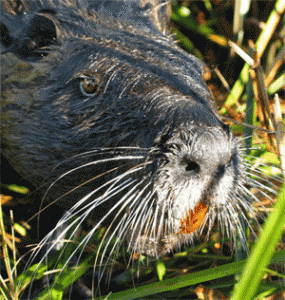
Image courtesy of U.S. Fish and Wildlife Service

The nutria, called a coypu outside of North America, is a semi-aquatic rodent of unusual size- particularly large for a rodent, they are typically about 12 pounds, but can grow to be between 15 and 20 pounds. They are native to South America.

The nutria reproduces year-round, and reach maturity quickly. While each mature female can carry up to three litters per year, each litter has on average 5 young, with as many as 13 not being uncommon.

Originally introduced to California in the late 19th century as a non-native species to support the fur industry, nutria were reintroduced periodically up until the collapse of the fur industry in the 1940s.

Nutria, like other non-native species, are a critical threat to the riparian ecosystems needed to promote recovery of endangered and threatened species in California.


If you see a nutria, report it to the State of California online at: https://www.wildlife.ca.gov/Conservation/Invasives/Report


For more information on Nutria:

https://www.wildlife.ca.gov/Conservation/Invasives/Species/Nutria


For more information on other non-native species in California:

Fish: http://calfish.ucdavis.edu/Non-Native_Fish_Species/

Plants: https://www.nrcs.usda.gov/wps/portal/nrcs/detail/ca/home/?cid=stelprdb1041704

Mammals: http://www.dfg.ca.gov/wildlife/nongame/t_e_spp/mammals.html