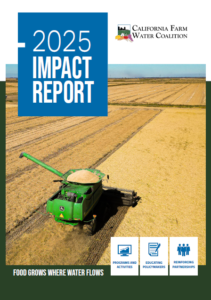
CFWC Releases 2025 Impact Report: A Year of Advocacy, Outreach, and Partnership

CFWC Releases 2025 Impact Report: A Year of Advocacy, Outreach, and Partnership

The California Farm Water Coalition has released its 2025 Impact Report, offering a comprehensive look at how the Coalition continues to serve as the trusted, fact-based voice for California agriculture—a mission it has carried out since its founding in 1989.

The report chronicles a year of strong advocacy, effective partnerships, and innovative public outreach that elevated the farm water story with policymakers, media, and consumers across the state and beyond.
A Year of Unified Advocacy

In 2025, CFWC deepened its leadership role as a unified voice for California agriculture, working alongside the Water Blueprint for the San Joaquin Valley and the San Joaquin Valley Water Collaborative Action Program. Through coordinated letters to federal and state decision-makers, the Coalition helped shape key water policy debates, advance infrastructure funding, and ensure that California’s farmers and rural communities are represented where it matters most.

Key advocacy efforts included supporting the Healthy Rivers and Landscapes alternative in the Bay-Delta Plan, championing critical infrastructure projects like the B.F. Sisk Dam improvements, Sites Reservoir permitting and construction, Success Reservoir Enlargement Project, and pressing for strong federal action under Executive Order 14181 with a shared goal of increasing available water supply by 9 million acre-feet per year by 2040.

Reaching Consumers Where They Are

CFWC’s social media programs, including the consumer-focused brand Cultivate California, continued to bring the story of California agriculture to life. By continuously monitoring public sentiment and media trends, the Coalition tailored its messaging to resonate with the audiences who matter most. In 2025, these efforts reached more than 5.5 million targeted consumers through social media and digital campaigns, generating approximately 25 million views.

Influencer partnerships with food, lifestyle, and wellness creators helped translate complex agricultural issues into relatable content. These collaborations helped ensure factual information, and the broader farm water message landed with consumers who increasingly look to trusted voices for information about where their food comes from. Partnerships with local and regional organizations brought authentic local water and agriculture narratives to digital audiences hungry for real stories from real farms.

Telling the Farm Water Story

The Coalition’s editorial and media outreach efforts achieved a publication rate exceeding 76%, with opinion pieces, letters-to-the-editor, and commentary appearing in outlets from the New York Times and Los Angeles Times to the Arizona Capitol Times and Desert Sun. Each piece drew on verified production data, peer-reviewed research, and economic analysis to build compelling pieces that help shape the public narrative on issues ranging from Colorado River operations to viral misinformation about California farm water use.

Equally important is the Coalition’s swift and strategic response to erroneous or misleading stories that threaten to distort public understanding of farm water use. When inaccurate reports about water management in the San Joaquin Valley circulated in early 2025, the Coalition responded quickly, amplifying correct information through coordinated social and digital outreach. This rapid response approach not only protected the reputations of farmers and water agencies but also reinforced the Coalition’s commitment to accuracy and accountability in public discourse. Addressing misinformation in real time ensures that stakeholders, policymakers, and the public receive reliable, timely facts, strengthening trust in California agriculture’s story.

Educational Impact

Since opening its doors to the public in November 2021, more than 562,000 individuals visited Sacramento’s Museum of Science and Curiosity (MOSAC), home to the Coalition’s interactive farm water exhibits, inspiring the next generation to understand the connection between water and food. The Coalition’s partnership with MOSAC continues to be a cornerstone of its educational mission, translating complex water data into interactive experiences that families and school groups can understand and remember.

The Team Behind the Work

This work depends on the continued efforts of CFWC staff, the active involvement of the Board of Directors, and the support of our member organizations. Research and analysis provide the foundation for the Coalition’s work, while communications and administrative functions ensure that information is shared effectively and operations remain consistent.

Together, these efforts allow CFWC to engage early in California’s water policy discussions, helping ensure that agricultural perspectives are part of the conversation before key decisions are made.

Download the Report

View the full report at: https://farmwater.org/2025-impact-report/

Our membership makes this work possible—thank you to our supporters for making CFWC’s outreach and education efforts possible.

Michelle Paul Selected as New CFWC Executive Director

Michelle Paul Selected as New CFWC Executive Director

The California Farm Water Coalition is pleased to announce the selection of Michelle Paul as its next executive director. Ms. Paul will replace Mike Wade, who is retiring in February from his role as the Coalition’s executive director, a position he has held since 1998.

Ms. Paul was selected following a comprehensive statewide search led by the Coalition’s executive director selection committee, which considered a strong and diverse field of candidates from across California. She will join the Coalition in mid-January and assume full responsibilities on March 1.

“We were fortunate to meet with a number of exceptional individuals who demonstrated a deep commitment to California agriculture and the vital role water plays in keeping our food system strong,” said Greg Johnson, President of the California Farm Water Coalition. “We are grateful to each of the highly qualified candidates who applied. Their expertise, passion, and vision were inspiring.”

Johnson continued, “Michelle brings nearly two decades of experience working alongside farmers and ranchers to elevate their voices in state and federal policy conversations. Her understanding of California’s agricultural landscape—paired with her strategic communications and outreach background—makes her well-positioned to lead the Coalition into its next chapter.”

“I am honored to join the California Farm Water Coalition and to support the farmers, ranchers, and water managers who work every day to feed our communities,” said Michelle Paul. “California agriculture is resilient, innovative, and deeply rooted in stewardship of the land and water. I look forward to working collaboratively to strengthen understanding and build relationships that help ensure a secure agricultural future for California.”

Michelle Paul is a passionate advocate for agriculture with nearly 20 years of experience in marketing, communications and public affairs. She has spent the bulk of her career dedicated to amplifying the voices of California’s farmers and ranchers, both in Washington DC and in her home state of California. She currently serves as Vice President of Marketing and Outreach at AgWest Farm Credit, where she leads initiatives to bridge the gap between rural communities and the people that govern them. She has launched outreach programs to connect young, beginning and small producers with vital resources, and helped elevate AgWest as a trusted resource for agricultural policy.

Paul’s commitment to agriculture extends beyond her professional work. She currently serves on the boards of the California Agricultural Council and the Center for Land-Based Learning. She is a proud member of Class 53 of the California Agricultural Leadership Program, holds a master’s degree in international affairs from CSU Sacramento, and a bachelor’s degree in history from CSU Fresno. Her career has included roles from legislative analyst at the State Capitol to hands-on marketing and advocacy at the federal level, reflecting a broad perspective and unwavering dedication to supporting the people who grow our food.

“Michelle understands that California agriculture thrives when farmers, ranchers, water providers, and policymakers work together with mutual respect,” Johnson said. “She has demonstrated throughout her career that she is skilled at building those bridges.”

Paul envisions a California where agriculture is valued as a vital function in every community—rural and urban alike. She believes in a future where the innovation, water stewardship, and resilience of farmers and ranchers are recognized and celebrated, inspiring others and shaping policy that reflects the realities of those who care for the land.

When she is not working to advance the agriculture industry, Michelle enjoys exploring California’s natural landscapes with her family and playing with her goldendoodle.

RELEASE: Jenny Scheer Joins Western Canal Water District as General Manager

Member Release: Jenny Scheer Joins Western Canal Water District as General Manager

Nelson, Calif., September 22, 2025 – Western Canal Water District has announced the appointment of Jenny Scheer as its new General Manager, with Scheer’s expertise in sustainable water use and strong background representing agricultural landowners positioning her well to lead the 41-year-old special district.

Most recently Scheer served as an Ag Water Specialist with Water and Land Solutions, LLC, partnering with farmers to respond to the Sustainable Groundwater Management Act and other water challenges. In this role, Scheer charted a path to sustainable water use through groundwater recharge projects, policy development, water district management, and infrastructure projects.

Prior to her role with Water and Land Solutions, Scheer worked in consulting roles advancing both international and domestic agriculture projects. Scheer also led the Santa Clara Farm Bureau as its Executive Director for several years, guiding the work of the nonprofit membership organization dedicated to promoting and preserving farming and ranching in the Santa Clara Valley.

Scheer graduated from California State University, Chico in 2008 with a bachelor’s degree in Agricultural Business and a minor in Religious Studies. She earned her master’s degree from the University of California, Davis in Agricultural and Resource Economics in 2016. The Board of Directors selected Scheer for the General Manager role, following a comprehensive executive search supported by Morrison, a business consulting firm serving clients nationwide, with a strong focus in food and agriculture.

“Jenny’s commitment to collaborative leadership; her depth and breadth of experience in water-related challenges and solutions; and her vision for the role Western Canal Water District will continue in play as a leader in water policy and infrastructure on a local, regional, and state level made her the ideal choice to lead this organization,” said Corrie Nichols-Davis, Western Canal Water District Board President.

Scheer will begin her role December 2025 and is eager to take the helm of the organization that she has a strong connection to, having grown up in the rice farming community of Richvale.

“Being raised in a farming family that benefitted from the vision and tenacity of the founders of Western Canal Water District, I am deeply honored not only to join, but to lead this organization,” said Scheer. “Western Canal is instrumental in protecting the livelihoods of our North State farmers and plays a critical role in stewarding habitat for waterfowl and wildlife in some of the most productive watersheds in California. I look forward to sharing my experience and talents to continue to advance the incredible work of Western Canal.”

Current General Manager Ted Trimble will retire from his post in December. He will continue to serve Western Canal Water District, contributing to key projects in a part-time capacity.

Golden Mussels: A Looming Crisis for California’s Farms and Water Supply

The golden mussel, an invasive species from East and Southeast Asia, is spreading rapidly in the Sacramento-San Joaquin Delta since its discovery in October 2024. This tiny invader threatens California’s $50 billion agricultural industry by clogging irrigation systems, which could disrupt water deliveries, reduce farm production, and raise food prices. Efforts are underway to monitor and control its spread to protect our food supply.

Continue reading

Central Valley Project Water South of Delta Allocation Rises to 55%

This week, the U.S. Bureau of Reclamation announced an increase in the Central Valley Project (CVP) water allocation for south-of-Delta agricultural contractors, raising it from 50% to 55% for the 2025 water year. While this modest increase offers some relief to farmers, farm workers, and rural communities in the San Joaquin Valley, it underscores the ongoing challenges of California’s unreliable water supply system. Insufficient water allocations have far-reaching consequences, not only for agriculture but also for the nation’s food supply.

Continue reading

Adapting California Agriculture: Water Shortages, Solar, and Food Production

California’s agricultural landscape is transforming due to water supply challenges and the push for renewable energy. With projections of 500,000 to 1 million acres fallowed in the San Joaquin Valley by 2040, driven by the Sustainable Groundwater Management Act (SGMA) and decades of environmental water policies curtailing water supplies, farmers face tough choices: grow crops, convert land to solar, or try to do both.

Continue reading

Water Scarcity’s Economic Toll on California Agriculture: Why We Must Act Now

Water Scarcity’s Economic Toll on California Agriculture: Why We Must Act Now

If egg prices are any indication of what happens when a disruption occurs in our food supply, consumers should prepare for rising prices and reduced availability in other aisles of the grocery store as well.

Unlike temporary and short-lived supply interruptions like those affecting egg prices today, we should all be concerned about the effect of increased water shortages on the fruits, nuts, and vegetables that have long been grown in California.

Background

It’s no secret that water is the lifeblood of California agriculture. It is fuel for the industry that feeds the nation and sustains our rural communities. But as droughts intensify, as some experts say they will, regulations become more onerous, and water supplies shrink even further, the economic impacts will only get worse – for everyone.

Unstable, but shrinking water supplies for farms- from drought or onerous regulation, threaten farms, jobs, and ultimately the food prices we all pay at the grocery store.

The rising price of eggs provides a simple and relevant example of how California consumers feel the effects of what happens on-farm.

The population of California’s egg-laying poultry has been decimated by bird flu, with infections first appearing in early 2022 as part of a nation-wide outbreak. California lost about 25 percent of its egg-laying birds, which was a significant hit.

In normal market conditions, suppliers in other parts of the country could have helped fill the demand, but avian influenza in other states and California’s cage-free requirements, also emerging in 2022, meant that fewer eggs nationwide were available or met the legal requirements to help fill the Golden State’s egg shortage.

The average nationally retail price in February for a dozen eggs was $5.90, according to the U.S. Bureau of Labor Statistics. In California it was $7.57, based on the March 7 USDA Egg Market Overview report of wholesale prices. Anecdotal evidence shows retail prices as high as $10.99 per dozen in some parts of California.

Simply put, fewer eggs were available because of avian influenza and California’s almost unique cage-free requirements (Colorado and Utah have similar laws). As a result, prices far outpaced the national average, even though avian influenza is a problem in all 50 states.

Egg prices in California have continued to rise as ongoing disease reduces local production– but the price Californians pay are then multiplied by the market restrictions that our regulations and water scarcity impose.

The Economic Cost of Water Scarcity

Not unlike California’s cage-free requirements that restricts our ability to obtain supplies from out of state, the state’s unique Mediterranean climate and specialty crop production means that what we can’t grow here is unlikely to come from other states. Food shortages almost always cause higher prices for consumers at the grocery store.

Recent data from the Public Policy Institute of California (PPIC, November 2024) paints a stark picture on another disruption on the horizon- the loss of farmland due to water scarcity.

PPIC reports that up to 900,000 acres of California farmland could be forced out of production, (or fallowed) due to water scarcity, costing billions in lost production and ripple effects across the state, affecting not only the price of food, but the availability of locally-sourced options.

Imported fresh fruits, vegetables, including leafy greens, are already finding their way onto grocery store shelves, but they often come from areas that use farming practices that are illegal in California, leading to the potential for more food safety and supply chain problems.

Here's why addressing this economic crisis is urgent - and what we can do about it

California agriculture is a $50 billion part of our state’s economy, employing over 400,000 people and producing more than half of the nation’s fruits, nuts, and vegetables. But water shortages are eroding this foundation.

According to PPIC’s November 2024 report, reduced surface water deliveries and groundwater restrictions under the Sustainable Groundwater Management Act (SGMA) are forcing farmers to fallow land at unprecedented rates. The economic losses are staggering:

  • Higher Food Prices: Reduced production will drive up costs for consumers, with ripple effects on grocery bills nationwide.
  • Lost Revenue: Fallowed land could reduce farm revenue by $2.5 billion annually, hitting crops like almonds, pistachios, and tomatoes hardest.
  • Job Losses: Each acre fallowed means fewer farmworkers, truck drivers, and processors. PPIC estimates up to 50,000 jobs could be lost in the Central Valley alone.

With California producing over a third of the vegetables and almost 70 percent of the fruits and nuts un the U.S., reduced output will strain markets and increase reliance on imports, threatening food security and creating a bigger environmental (and water) footprint elsewhere in the world.

Ripple Effects on Rural Communities and Beyond

The economic pain extends beyond the farm gate. Rural communities, already struggling with poverty, face declining tax revenue and business closures as farm income drops. Schools, hospitals, and local shops feel the squeeze. As California’s food production declines, families across the nation face higher food costs and more supply chain disruptions. 

Taking Action

What steps can California take to assure plentiful supplies of water for the farms that grow our food? Here are just some of the examples that can help deliver more water, protect our food supply, and reduce the number of acres that are under threat:

  • Canal Repairs: A major focus are capacity correction projects in critical conveyance projects, like the Friant-Kern Canal and Delta-Mendota Canal. Repairing these canals ensures more efficient water delivery to farms across the valley.
  • New Storage and Conveyance Systems: Building and upgrading water storage facilities to capture and store water during wet periods, such as the Sisk Dam Raise at San Luis Reservoir, Los Banos Creek and Del Puerto Canyon reservoirs, and the Sacramento Valley’s Sites Reservoir, can all help to offset shortages during dry years and support agricultural needs. It’s estimated that up to 3.5 million acre-feet of water is available for groundwater recharge if adequate infrastructure existed to deliver it to suitable recharge projects.
  • Policy and Regulatory Changes: Eliminating policies that, according to the U.S. Fish and Wildlife Service, deliver no environmental benefits, yet continue to restrict water supplies for that farmers can use to grow food.

Solutions to Secure our Future

Water scarcity is a challenge, but it’s not insurmountable. The California Farm Water Coalition continues to advocate for policies and innovations to protect agriculture and its economic contributions.

That’s important for on-farm and farm-related jobs and because it supports reliable food supplies in California and across the nation.

And it’s important because reliable food production means affordable prices for consumers everywhere.